2tonnes
An immersive workshop to test, until 2050, the individual and collective levers for low-carbon transition.
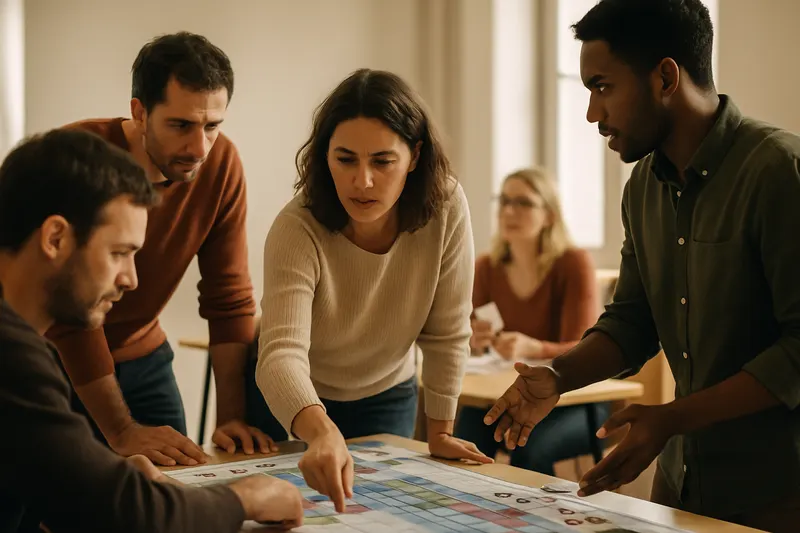
2tonnes is an immersive workshop lasting approximately 3 hours, designed and delivered by 2tonnes, facilitated by a trained facilitator using an official simulation platform. Its name refers to the goal of around 2 tonnes of CO2 equivalent per person per year by 2050, in line with the Paris Agreement. Participants project themselves as a team into 2050 and choose, over several rounds, individual and collective actions. The workshop illustrates the comparative impact of choices related to transport, housing, food, consumption, public policies, and business decisions. It complements a Climate Fresco: the Fresco explains the problem, while 2tonnes explores the solutions.
Walkthrough
- 1
Welcome, framework, and intention
15 minThe facilitator welcomes the group, checks that everyone can see the screen or platform, and then outlines the framework: "We will explore possible trajectories until 2050, not seek the perfect answer." They present the objective symbolised by the name 2tonnes: around 2 tonnes of CO2 equivalent per person per year by 2050, in line with the Paris Agreement. They clarify that the workshop uses an official tool and that the detailed content belongs to the publisher. Participants briefly introduce themselves and share an expectation.
Tip — Set a non-judgmental framework from the outset: clearly state that the workshop tests levers and scales, it does not judge the lifestyles of those present.
- 2
Connecting to the simulation and initial state
20 minThe facilitator launches the 2tonnes simulation platform and guides the group in getting started: "We will use this tool as a common dashboard." They highlight the starting footprint and the collective trajectory proposed by the simulation. Participants identify the main areas of action: transport, housing, food, consumption, as well as collective levers. The goal is for everyone to understand what will be measured: the personal footprint and the country's footprint.
Tip — Before launching the choices, ask participants to formulate a hypothesis: "Which lever do you think will have the most impact?" This creates attention on the results displayed later.
- 3
First round of individual decisions
30 minThe facilitator opens the first round of choices focused on the individual actions proposed by the platform. They state: "Choose actions that you could imagine adopting, then let’s look together at their simulated effect." Participants select levers in the areas of transport, housing, food, and consumption, according to the options available in the official tool. The facilitator validates the choices, displays the results, and encourages participants to express their surprises. The aim is to link concrete decisions with measured impact.
Tip — Avoid lengthy debates on a single action: note objections on the board or in the chat, then promise to revisit them in the debrief to maintain the simulation's pace.
- 4
Subsequent rounds: trade-offs and combining levers
35 minThe facilitator guides the team through the subsequent rounds up to the horizon of 2050, following the structure of the platform. At each round, they remind: "You must make trade-offs: not everything is possible at the same time, and each choice affects the trajectory." Participants discuss, prioritise, and then collectively decide on the actions to test. The facilitator displays the evolution of the individual footprint and the country's footprint after each series of choices. This stage highlights the cumulative dynamics of decisions.
Tip — When the group hesitates, conduct a quick show of hands or use the video tool to vote: the important thing is to test a trajectory, not to achieve perfect consensus on every choice.
- 5
Collective actions: public policies and business choices
30 minThe facilitator explicitly introduces the collective levers available in the workshop: public policies and business choices. They say: "We will now look at what changes when action does not rely solely on individuals." Participants debate the collective measures proposed by the platform, assess their acceptability and coherence with the choices already made. The facilitator launches the simulation of the retained decisions and shows the impact on the country's footprint. The challenge is to compare the effects of individual and systemic levels.
Tip — Assign speaking roles if the debate becomes political: one person defends effectiveness, another acceptability, another feasibility, then the group decides.
- 6
Reading the final trajectory
20 minThe facilitator displays the trajectory obtained and compares it to the objective of around 2 tonnes of CO2 equivalent per person per year by 2050. They ask: "What have we managed to reduce? What remains challenging?" Participants observe any gap between the simulated trajectory, the personal footprint, and the country's footprint. The facilitator highlights the families of levers that have mattered most, without inventing figures outside the platform. This synthesis prepares the transition from simulation to real action.
Tip — Do not only comment on the final result: also acknowledge the learnings along the way, particularly the trade-offs that changed during the workshop.
- 7
Debrief and transition to action
30 minThe facilitator closes the simulation and opens a structured debrief: "We are leaving the game to return to our real, personal, and professional decisions." They invite each participant to name one awareness, one individual lever, and one collective lever they wish to explore further. Participants then formulate a commitment or a next conversation to have. The facilitator reminds that 2tonnes explores solutions and can complement prior work such as the Climate Fresco. They conclude by directing participants to the official resources of 2tonnes.
Tip — Ask for a very concrete and dated commitment, even modest: for example, a discussion to organise, a piece of data to verify, or an action to test as soon as the following week.
Variants
- Remote format: facilitate via video conference with screen sharing of the official 2tonnes platform, quick votes in the chat or via polls, and short breakout groups to prepare choices before returning to plenary.
- Corporate format: focus discussions on the business choices available in the workshop, then conclude with a list of internal projects to pursue after the session, without turning the workshop into a detailed action plan.
- Awareness format after Climate Fresco: remind in the introduction that the Fresco helps to understand the problem and that 2tonnes serves to explore solutions, then dedicate more time to the transition to action.
- Large group format within the planned limit: assign small pairs to analyse a family of levers, then have them present a recommendation to the group before each collective decision.
Debrief guide
- What surprised you most about the gap between your initial intuitions and the results of the simulation?
- Which individual levers seem truly actionable, and which require external conditions to become possible?
- At what point did you feel that collective actions changed the scale of the problem?
- Which trade-offs were the most difficult for the group, and what do they reveal about our real constraints?
- What do you take away from the difference between reducing a personal footprint and transforming a country's footprint?
- What action, discussion, or collective decision could be initiated right now in your organisation or community?