The Blind Square
Form a perfect square blindfolded to reveal leadership, listening, and shared understanding.
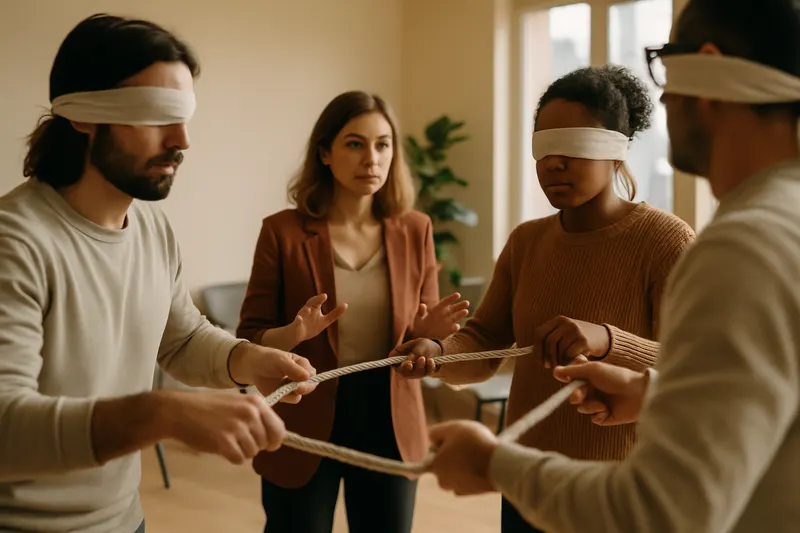
The Blind Square is a classic in-person team-building activity. Participants, blindfolded, hold a long rope tied in a loop and must form a perfect square without ever letting go. The group decides when they believe they have succeeded, places the rope on the ground, and then removes their blindfolds. The game concretely illustrates the issues of emerging leadership, collective listening, clarification, and the role of quieter individuals.
Walkthrough
- 1
Set the framework and space
3 to 5 minThe facilitator chooses a clear, flat, and safe space, then places a 10 to 20 m long rope tied in a loop in the centre. They check that there are no obstacles hindering movement and that participants can place the rope on the ground safely. They announce: "You will undertake a collective challenge that is simple to understand but difficult to coordinate." Participants position themselves around the rope without putting on their blindfolds yet. This step creates safety conditions and prevents attention from being diverted by the environment.
Tip — Have the group walk quickly around the area before blindfolding them: this reassures and limits the micro-fears that later disrupt listening.
- 2
Provide the challenge rules
3 to 5 minThe facilitator states the rules before starting: "All participants will be blindfolded and will hold the rope. Your goal is to form a perfect square with this rope, then place it on the ground. You must never let go of the rope. The group will decide when they believe they have succeeded; only at that signal will you remove your blindfolds." They clarify that the facilitator will not help organise the method during the exercise. Participants may ask questions for understanding about the rules, but not about the solution.
Tip — Ask someone to rephrase the rules aloud: this immediately reveals misunderstandings before everyone is blindfolded.
- 3
Choose the level of preparation
0 to 5 minDepending on the educational objective, the facilitator may or may not allow a preparation time without blindfolds. If they do, they announce: "You have a few minutes to organise yourselves, define a method or roles; after that, you will not see anymore." If they do not allow it, they simply say: "The challenge starts immediately after the blindfolds are put on." Participants can then discuss, or alternatively, move straight into action. This choice strongly influences the observation of leadership and shared understanding.
Tip — For a group that knows each other little, allow a short preparation; for a group used to working together, start without preparation to reveal real reflexes.
- 4
Blindfold and take the rope
2 to 3 minThe facilitator distributes or has the blindfolds put on, then checks that everyone cannot see. They invite all participants to hold the rope with at least one hand, reminding them: "From now on, no one lets go of the rope until the end." They ensure that all individuals are in contact with the loop before launching the challenge. Participants slowly adjust, discover the sensory constraint, and often begin to talk more. This transition establishes mutual dependence and makes coordination visible.
Tip — Do not try to position people on the rope yourself: let the initial imbalance become a learning material for the debrief.
- 5
Start building the square
8 to 20 minThe facilitator gives the start signal: "Your mission begins: form a perfect square with the rope, without letting go. When you think you have succeeded, place it on the ground and announce it clearly." They remain in the background, observing exchanges, leadership takes, silences, reformulations, and moments of confusion. Participants debate, move, test hypotheses, and seek a common shape without seeing the result. The facilitator does not evaluate during the action, except to ensure physical safety. The group must decide for themselves what they consider sufficiently successful.
Tip — Discreetly note exact phrases heard during the exercise; recalling them in the debrief is much more powerful than giving a general impression.
- 6
Conclude the attempt and reveal the result
3 to 5 minWhen the group announces that they think they have succeeded, the facilitator only checks that the rope is on the ground and that no one is still holding it taut. They say: "You can now remove your blindfolds and look at your square." Participants observe the actual shape, often with surprise, amusement, or frustration. The facilitator allows a few seconds of silence before commenting, so that everyone becomes aware of the gap between intention and result. They avoid judging performance and redirect attention to the collective process.
Tip — Let the group look before speaking: spontaneous reactions often provide the best entry points for the debrief.
- 7
Debrief the learnings
10 to 20 minThe facilitator gathers the group standing or sitting around the rope on the ground. They start with factual questions, then explore the dynamics: who spoke, who listened, who checked understanding, who remained silent. They remind that the goal is not to find culprits but to understand how the collective organised itself in a situation of uncertainty. Participants then relate the experience to their daily work: meetings, cross-projects, quick decisions, or limited remote coordination. The facilitator concludes with one or two lessons articulated by the group itself.
Tip — Always start with "What happened?" before "What does this say about us?": this avoids overly quick and defensive interpretations.
Variants
- Without preparation: participants put on blindfolds right at the start. This variant highlights spontaneous reflexes, power takes, and the ability to build a method while moving.
- With preparation: the group has a short time without blindfolds to decide on a strategy before the exercise. This variant is useful for working on planning, clarifying roles, and the quality of a shared instruction.
- External observation: one or two people do not participate and observe behaviours without intervening. They then report specific facts about exchanges, silences, reformulations, and decisions.
- Second attempt: after a short initial debrief, the same group repeats the exercise with the identified learnings. The comparison between the two attempts makes visible the progress in listening, coordination, and mutual verification.
Debrief guide
- At what moment did you feel that the group truly shared the same objective and method?
- How did leadership emerge: through the loudest voice, through listening, through method, or through initiative?
- What facilitated or hindered listening when several people spoke at the same time?
- How did you verify that everyone understood the same thing behind the words "square", "side", or "angle"?
- What role did the quieter individuals play: were they lost, observing, supporting, or prevented from contributing?
- What does the gap between your blind perception and the visible result teach us about our coordination modes?
- What concrete practice do you want to transfer to your meetings or projects to better coordinate under constraint?