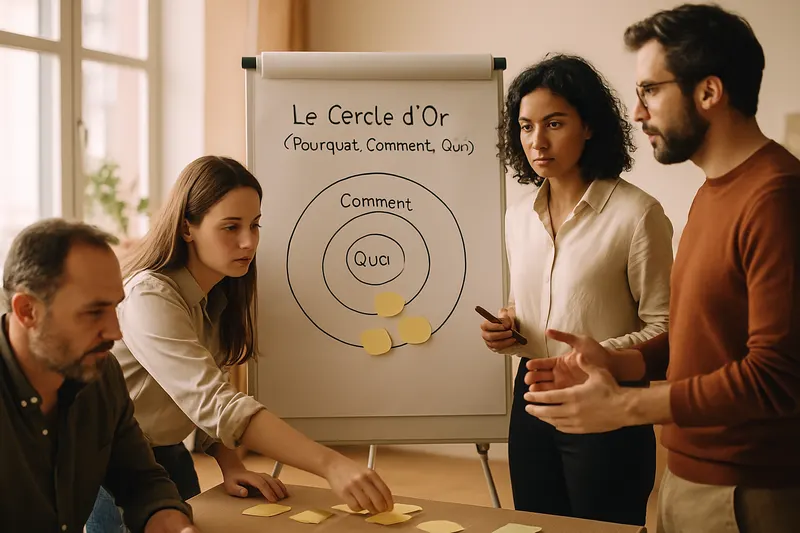
The Golden Circle (Why, How, What)
To bring forth a shared Why, then align it with action principles and concrete outputs.
The Golden Circle is a workshop based on Simon Sinek's Golden Circle model, popularised in Start With Why. It helps a group clarify three levels: the Why, which is the purpose or belief; the How, which are the distinctive action principles; and the What, which refers to what is produced concretely. The game follows an inverse path from the usual communication of organisations: starting from the centre, the Why, before moving to the How and then the What. Participants draw on stories of pride, extract common themes, and then formulate a shared Why statement.
Walkthrough
- 1
Setting the Framework and the Three Circles
5 to 10 minThe facilitator draws three concentric circles visible to all and writes 'Why' in the centre, followed by 'How', then 'What'. They explain: 'The Why is our purpose or belief; the How describes what distinguishes us and our action principles; the What refers to what we produce. Today, we start from lived experiences, not a slogan.' Participants listen, ask clarifying questions, and validate the working framework. The goal is to secure the workshop and prevent the group from jumping directly to offers, deliverables, or activities.
Tip — Gently prohibit marketing phrases from the start: say that beautiful statements will come after the stories, otherwise the group risks creating an empty promise.
- 2
Sharing Moments of Pride
10 to 20 minThe facilitator asks each participant to choose a moment when they felt pride within the relevant collective. They give the instruction: 'Share a concrete situation: what happened, who was there, what did you do, why did it matter to you?' Participants prepare their stories individually, then share them in a roundtable or in small groups depending on the size. The facilitator listens for recurring words and notes strong expressions without rephrasing too early.
Tip — Prompt with 'what exactly made you proud?' rather than 'why?' at the beginning: this brings forth convictions without pushing participants to intellectualise.
- 3
Extracting Common Themes
10 to 15 minThe facilitator invites the group to view the stories as raw material. They say: 'We are looking for recurring themes, not the most spectacular anecdotes. What words, intentions, or beliefs appear multiple times?' Participants propose common themes, which the facilitator visually groups without yet seeking a definitive statement. This step allows the transition from individual stories to a collective reading of the Why.
Tip — Ask the group to distinguish facts from interpretations: a solid theme should be able to connect to several stories that were actually heard.
- 4
Formulating a Why Statement
10 to 20 minBased on the common themes, the facilitator suggests drafting a Why statement. They remind: 'This statement should express a purpose or belief, not a list of activities or a numerical objective. It should resonate with the stories heard.' Participants produce one or more formulations, then compare them aloud. The group chooses a working version, clear enough to guide the next steps, without seeking perfection in wording.
Tip — Test each formulation with the question 'could this statement explain the moments of pride shared?'; if the answer is no, return to the stories.
- 5
Defining the Hows
8 to 15 minThe facilitator shifts attention to the second circle and announces: 'Now that the Why is established, let's identify our Hows: what distinguishes us and the action principles we want to embody.' Participants list ways of acting that are consistent with the Why statement. The facilitator ensures these elements are formulated as observable principles, not just abstract values. The outcome should allow for the concrete recognition of how the collective acts.
Tip — If the group writes overly generic words, ask: 'What would we see in a meeting, a decision, or a client relationship if this principle were truly applied?'
- 6
Clarifying the Whats
5 to 10 minThe facilitator addresses the third circle: 'The What corresponds to what we produce concretely: our offers, services, deliverables, actions, or visible results.' Participants list current or expected outputs, then check their coherence with the Why and Hows. The facilitator encourages the group to identify the Whats that strongly embody the centre, and those that seem more distant. This step makes the model operational and prevents the Why from remaining a disconnected intention.
Tip — Do not let the Whats dominate the discussion: remind that many organisations start there, while the exercise is precisely to return to the centre.
- 7
Sharing, Adjusting, and Anchoring
7 to 15 minThe facilitator reads aloud the three levels in order: Why, How, What. They ask: 'Is everything coherent? What seems right, unclear, or missing?' Participants adjust the formulations and identify what they want to keep as a working version. The facilitator concludes by reminding that the Golden Circle serves to communicate and decide starting from the Why, then to check the alignment of actions.
Tip — Make a final slow reading from the centre outwards; inconsistencies often appear when hearing the complete chain aloud.
Variants
- Short version: limit stories to one moment of pride per person, then produce a provisional Why statement and three priority Hows. This variant is suitable when the workshop lasts about 45 minutes.
- In-depth version: first work in sub-groups on several formulations of Why, then organise a sharing session to converge. This variant is useful with a group close to 15 people.
- Remote version: use a shared whiteboard with three concentric zones or three columns for Why, How, What. Participants drop their stories and themes in short notes, then the facilitator groups them on screen while commenting on each grouping.
- Project team version: after formulating the Why, ask the group to review an ongoing project through the three circles. Participants then identify what needs to be strengthened, stopped, or reformulated to better align actions.
Debrief guide
- What did you discover by starting from stories of pride rather than an abstract definition of your mission?
- Which words or common themes seem truly energising for the group?
- How does the Why statement formulated today explain your best collective moments?
- Which Hows are already visible in your practices, and which still need to be embodied?
- Among your current Whats, which are most aligned with your Why, and which deserve to be questioned?
- How would communicating or deciding more often starting from the Why change things?