Giant Chifoumi (rock-paper-scissors tournament)
A quick tournament where losers become supporters and the room fills with energy until a giant final.
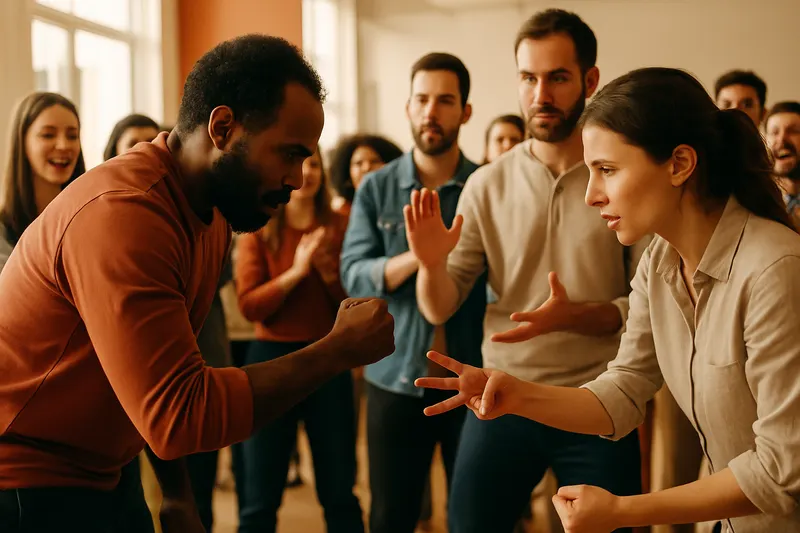
Giant Chifoumi is a large group energizer based on the game rock-paper-scissors. All participants first play in pairs, then the winners face off while the losers become their supporters. In just a few minutes, the room transforms into two large camps, each cheering for a finalist. The game physically embodies collective energy and the act of supporting someone even after losing.
Walkthrough
- 1
Set the framework and intention
1 minThe facilitator gathers the group standing in a clear space and announces: "We are going to have a giant, very fast and very loud rock-paper-scissors tournament. The goal is not to win at all costs, but to raise the collective energy. When you lose, you do not leave the game: you become a supporter of the person who beat you." They check that everyone can move without disturbing others.
Tip — Announce from the start that noise is allowed and encouraged: this frees the group, especially in professional contexts where participants tend to self-censor.
- 2
Remind the rules of Chifoumi
1 minThe facilitator shows the three signs: rock, paper, and scissors. They clarify the usual rule: rock beats scissors, scissors beat paper, paper beats rock. They set the rhythm: "Together, you say rock-paper-scissors, then show your sign at the same time. In case of a tie, you replay immediately until there is a winner." Participants may repeat the gesture once to synchronise.
Tip — Do a demonstration with someone close to you: a micro-demo avoids hesitation and makes the start much smoother.
- 3
Start the first round in pairs
1 to 2 minThe facilitator asks: "Quickly find someone near you, form a pair, and play a round." Everyone plays at the same time, without waiting for an individual signal. As soon as someone loses, they stand behind the winner or next to them and start cheering loudly. The winner keeps their role as an active player and looks for another available winner.
Tip — Emphasise that the loser must become a supporter immediately: this quick switch creates the wave effect and prevents passive spectators.
- 4
Grow the supporter camps
2 to 3 minThe facilitator circulates and stimulates the dynamic: "Winners look for another winner, supporters follow their champion!" When a winner loses to another winner, they join the winner's camp along with all their supporters. The groups thus become larger with each round. The facilitator ensures that active players are identifiable and that supporters remain mobile, visible, and vocal.
Tip — If two groups hesitate to face each other, bring them physically closer and simply say: "These two champions are playing now." This avoids downtime in large groups.
- 5
Organise the giant final
1 to 2 minWhen only two active winners remain, the facilitator places them face to face in the centre. They invite each camp to gather behind their finalist and cheer: "The whole room is now supporting one of the two champions. We want to hear both camps!" The finalists play a round of rock-paper-scissors, replaying if necessary in case of a tie. At the end of the round, the facilitator celebrates the winner and immediately thanks both camps.
Tip — Mark a brief silence just before the final, then start the countdown aloud: the contrast of silence/explosion makes the moment much more memorable.
- 6
Close and bring down the energy
1 minThe facilitator applauds the entire group, not just the winner: "Well done everyone: you played, lost, followed, encouraged, and supported someone else." They invite everyone to return to their place or form a circle depending on the next part of the workshop. If the activity serves as an introduction to a debrief, they ask participants to keep in mind what they felt at the moment of losing and then supporting. This transition transforms the energizer into learning material.
Tip — Do not let the energy fade into ambiguity: immediately give a simple physical instruction, such as 'return to a circle', to maintain control of the rhythm.
Variants
- Express version: launch the tournament without a formal debrief, solely to energise a large group before a sequence that requires attention.
- Observation version: designate a few observers who do not play and ask them to identify moments when the energy shifts, then share their observations in the debrief.
- Theatrical final version: to enhance the collective effect, place the two finalists in the centre and ask supporters to create a very short slogan for their champion before the final round.
Debrief guide
- What did you feel when you lost and became a supporter?
- What changed when you were no longer alone, but supported by a group behind you?
- At what moment did the collective energy become visible or audible to you?
- What does this game say about our ability to support someone even when our own initial goal disappears?
- In your work context, what does it look like to 'join someone's camp' to help them succeed?
- What conditions make support sincere rather than obligatory?