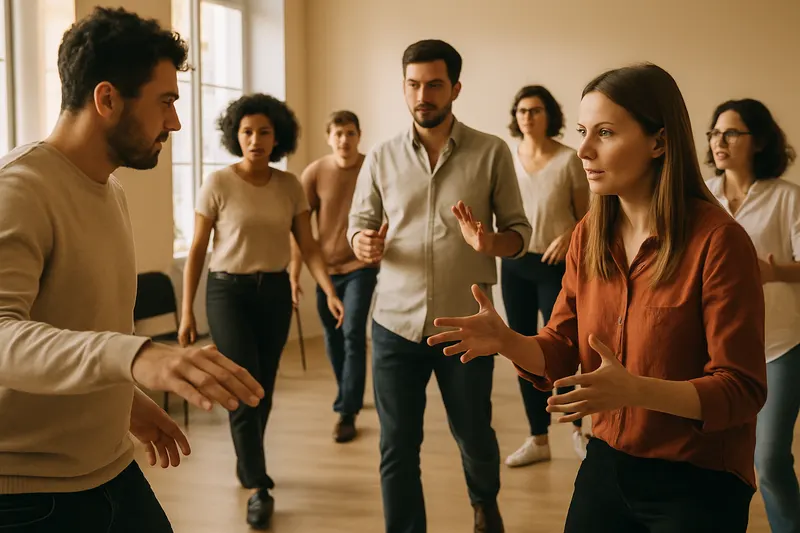
The Moving Debate
Elicit arguments, nuances, and shifts in opinion through movement in space.
The moving debate is a facilitation tool derived from popular education, also known as the river of doubt or positioning game. The facilitator states a deliberately divisive statement, after which participants physically position themselves according to whether they agree or disagree. The game makes visible the convictions, hesitations, and shifts provoked by the arguments heard. It serves to open a sensitive topic, explore the diversity of viewpoints, and learn to argue without seeking to win.
Walkthrough
- 1
Set up the space and framework
3 to 5 minThe facilitator clears a space for movement and clearly designates two sides of the room: "Here, the side of agreement; over there, the side of disagreement." They specify that there will be no position in the middle at the start, even if there is doubt. They remind everyone to speak from their own perspective and that the goal is to listen to arguments, not to convince at all costs. Participants remain standing to make positions visible and mobile.
Tip — Mark the separation on the ground with a very clear imaginary line: announce it while walking from one side to the other, which avoids vague groupings.
- 2
State the divisive statement
2 to 4 minThe facilitator reads a deliberately divisive, short, and easily understandable statement. They repeat it a second time slowly, then ask: "If you mostly agree, position yourself on this side; if you mostly disagree, position yourself on the other. No one stays in the middle for this first positioning." Participants choose a side without starting to debate. This step forces an initial clarification, even if imperfect.
Tip — Choose a statement that genuinely calls for two possible positions; if everyone smiles and stands on the same side, it is probably too consensual.
- 3
Observe the initial positions
2 to 3 minOnce participants are positioned, the facilitator takes a brief moment to observe: "Look at the distribution of the group, without commenting for now." They can only reformulate the two camps: "So we have a group in agreement and a group in disagreement." They do not yet ask for individual justifications and do not give their own opinion. This moment establishes the initial snapshot, useful for measuring movements later.
Tip — Avoid stating that one camp is majority or minority in an evaluative tone; simply name what is visible to avoid influencing the next steps.
- 4
Encourage the first arguments
6 to 12 minThe facilitator gives the floor to the first camp: "Who can propose an argument to explain this position?" After one argument, they move to the other camp: "What argument responds to or sheds light on the question differently?" The camps speak in turn to balance the discussion. Participants formulate arguments, not personal attacks. The facilitator distributes the floor and remains neutral on the content.
Tip — Ask for short arguments, one at a time; if someone strings together multiple ideas, thank them and invite the opposing camp to respond with a single argument.
- 5
Allow and value the shifts
5 to 12 minBefore continuing, the facilitator reminds the central rule: "At any time, if an argument convinces you or makes you evolve, you can change sides." Participants move freely when an argument resonates with them, even without justifying immediately. The facilitator observes these movements and can simply name them: "I see that some people are moving." The movement is presented as a sign of listening, not as a weakness.
Tip — When someone crosses the room, do not immediately question them; let the movement exist to avoid participants fearing being put on the spot.
- 6
Reinvigorate by balancing the speaking time
5 to 10 minThe facilitator continues the rounds of arguments, ensuring that each camp can express itself in a balanced manner. They can say: "We will now hear a voice that has spoken little" or "I will give the floor back to the other side." If they hear a repetition, they invite a new argument. They do not make decisions, correct opinions, or take sides. Their role is to maintain the framework and encourage active listening.
Tip — Identify very engaged individuals and thank them before physically turning towards the quieter ones; the facilitator's body language helps redistribute the speaking time.
- 7
Close the debate and reflect on the movements
5 to 8 minThe facilitator announces the end of the debate before the energy wanes: "We will stop the arguments here and look at what has happened." They invite everyone to observe their final position compared to their starting position. Then they open a reflection on the shifts: "What made you move, or conversely, what kept you from moving?" Participants share the significant arguments and the hesitations that arose. The closure transforms the debate into collective learning.
Tip — Keep at least a few minutes for this step: without a final reflection, the game can leave an impression of confrontation rather than a work on reasons and nuances.
Variants
- Make several successive statements on the same theme, keeping the same principle: mandatory initial positioning, alternating arguments, and possible shifts at any time.
- During the final reflection, only ask for input from those who changed sides to precisely identify the arguments that produced movement.
- For a large group, limit speaking turns to very short arguments and strictly alternate the camps to maintain rhythm and balance.
Debrief guide
- Which argument made you think the most, even if it didn't make you change sides?
- What made you move, or what kept you from moving?
- Did you hear an argument that you wouldn't have imagined before the exercise?
- How did you feel about having to choose a side without staying in the middle at the start?
- What did the physical movements make visible in the group?
- How does this exchange change your approach to the debated topic?