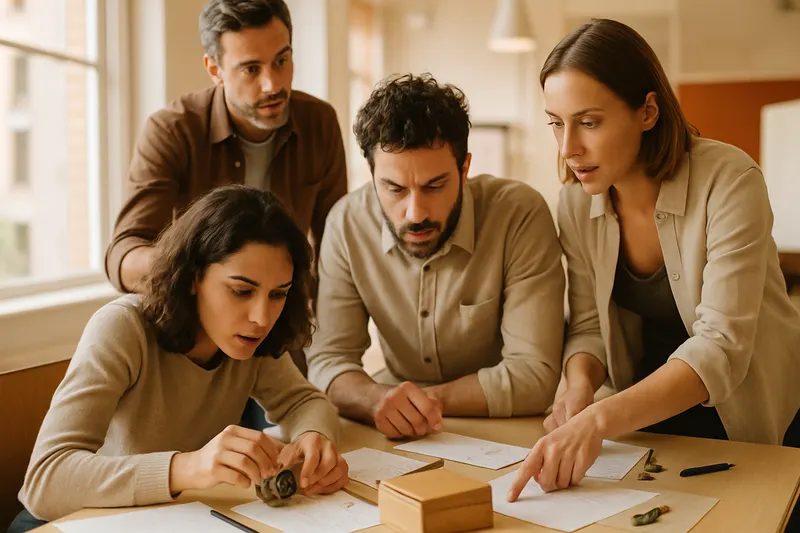
Educational Escape Game
A scripted challenge in a limited time to learn through solving, cooperating, and debriefing.
The educational escape game is a training device inspired by escape games: a team solves a series of puzzles within a limited time to achieve a scripted objective. It serves to mobilise concepts to be learned through action, exploration, reasoning, cooperation, and decision-making. The puzzles can be arranged in a linear sequence or addressed in parallel. The final debriefing is essential, as it explicitly connects the lived experience to the intended learning outcomes.
Walkthrough
- 1
Design the game based on educational objectives
BeforehandBefore the workshop, the facilitator starts from the educational objectives rather than the setting or locks. They list the concepts that participants will need to mobilise to progress, then choose a scenario and a mission that align with these learnings. They design puzzles whose resolution requires the use of these concepts, without limiting themselves to decorative riddles. They also decide whether the puzzles will be linear, with a step-by-step progression, or parallel, to encourage role distribution.
Tip — To test the educational robustness, ask yourself for each puzzle: 'What concept are we learning or reactivating here?' If the answer is vague, simplify or replace the puzzle.
- 2
Prepare the space, materials, and the role of the game master
BeforehandThe facilitator prepares the boxes, locks, clues, documents, potential digital supports, and any elements necessary for the scenario. They check that each code, key, clue, or piece of information leads correctly to the intended stage, then conduct a complete test of the course. They also define the role of the game master: to observe, prompt, secure the timing, and assist without giving the answer. In a remote setting, they prepare the digital environment and shared documents necessary for the process.
Tip — Conduct a rehearsal with someone outside the project: if they get stuck for a long time without understanding what to attempt, it is not a failure of the player, but often an indication that a clue needs repositioning.
- 3
Launch the framework and immersion
5 to 10 minThe facilitator welcomes the participants, reminds them that the group will play as a team, and announces the total duration of the activity, which is between 45 and 90 minutes depending on the chosen format. They state the central rule: 'Your mission is to solve a series of puzzles within a limited time, usually 45 to 60 minutes of actual play, to achieve the final objective of the scenario.' They specify that cooperation, listening, and sharing information are expected. They then set up the story, mission, and safety or handling limits.
Tip — Clearly state what can be manipulated and what should not be. This prevents the group's energy from going into random searching rather than solving.
- 4
Form the team and explain the progression rules
5 minThe facilitator organises the participants into one or more teams depending on the total number, from 3 to 30 people. They explain the type of sequence planned: linear if one puzzle unlocks the next, or parallel if several paths can be explored simultaneously. They say: 'Any clue found can be useful now or later; share it aloud and keep a record of your discoveries.' They remind that the game master can help but will not directly give the solution.
Tip — If the group is large, encourage the early creation of small temporary sub-groups, then impose regular sharing points to avoid lost information.
- 5
Facilitate play and regulate without solving for them
45 to 60 minThe game master starts the timer and allows participants to explore, formulate hypotheses, open boxes, use locks, and combine clues. They observe the dynamics: who speaks, who manipulates, who understands, who disengages. When a blockage becomes unproductive, they offer graduated help, for example, prompting on what has already been found, without giving the answer. They ensure the overall pace so that the team experiences the tension of the limited time without slipping into frustration.
Tip — Prepare three levels of help for each puzzle: a refocusing question, a more explicit clue, and then a procedural orientation. This allows for equitable assistance without breaking the joy of discovery.
- 6
Conclude the mission and ease the tension
5 minAt the end of the allotted time or when the objective is achieved, the facilitator clearly stops the game. They announce the result within the context of the scenario, then congratulate the group for the observed processes, not just for the final success. If some puzzles were not solved, they can briefly reveal them so that no one is left with a misunderstanding. This transition serves to exit the game and prepare for the subsequent learning work.
Tip — Do not start the debriefing in the heat of the moment amidst noise and excitement. Have the main objects put away, seat the group, and verbally mark the transition: 'Now, we will transform the experience into learning.'
- 7
Debrief to connect puzzles to learning
15 to 25 minThe facilitator leads a structured debriefing, which is essential in this device. They revisit the key puzzles and ask: 'What concept or skill did you mobilise here?' They encourage the articulation of reasoning, useful mistakes, moments of cooperation, and resolution strategies. They then connect each important step to the educational objectives defined beforehand, so that the game does not remain just a playful experience.
Tip — Display or note the learnings throughout the debrief. Participants thus see that the locks and clues were not gadgets, but triggers for reasoning.
Variants
- Linear version: the puzzles are solved in a set order, with each answer unlocking the next step. This is suitable when the goal is to follow a precise educational progression.
- Parallel version: several puzzles are accessible at the same time, and the team must distribute the exploration. This is adapted for larger groups and places more emphasis on coordination.
- Remote version: the scenario, clues, documents, and validations are provided in a digital environment. The game master facilitates via videoconference, observes exchanges, and provides graduated assistance without giving answers.
- Short awareness version: reduce the number of puzzles and focus the debrief on one or two key concepts. This variant maintains the escape logic while allowing more time for pedagogical analysis.
Debrief guide
- At what moment did you understand what the mission really required of you, and what helped you to understand it?
- What concepts or knowledge did you need to mobilise to solve the most important puzzles?
- Which clues did you misinterpret at first, and what does this error reveal about your reasoning?
- How did the team organise itself to share information, decide, and progress under time constraints?
- What behaviours facilitated collective success, and which ones hindered it?
- If you had to redo the mission, what strategy would you adopt differently from the very first minutes?
- What connection do you make between what you experienced in the game and a real work or learning situation?