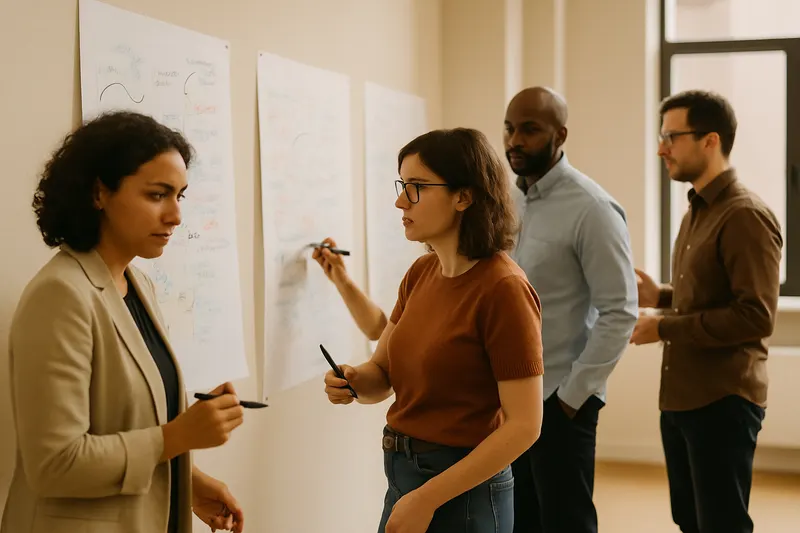
Gallery Walk (the poster gallery)
Circulate ideas, enrich posters, and collectively synthesise while keeping a visible record.
Gallery Walk, or poster gallery, is an active learning technique that can be used both in-person and remotely. Posters, each displaying a question, theme, or the output of a subgroup, are distributed throughout the space. Subgroups circulate at regular intervals, read previous contributions, and add their ideas, questions, or comments. The format encourages movement, gives a voice to quieter individuals, and produces a visible record for synthesis.
Walkthrough
- 1
Prepare the gallery
5 to 10 minThe facilitator sets up several posters in the room, each with a clearly readable question, theme, or subgroup output. The posters are spaced to allow for circulation and to avoid crowding. Markers are prepared, ideally one colour per group, to distinguish contributions. The facilitator checks that each poster has enough space for writing and that the route is smooth.
Tip — Number the posters and provide a visible direction for rotation: this avoids hesitation and unnecessary crossings from the very first movement.
- 2
Launch the activity and form subgroups
5 minThe facilitator explains the objective: "You will enrich several posters by reading what is already there, then adding your ideas, questions, or comments." They form subgroups appropriate to the number of participants, ensuring that the posters are covered without overload. If possible, they assign a marker colour to each group. They emphasise that value comes from both reactions and new ideas, encouraging quieter individuals to contribute.
Tip — Give a simple instruction for roles: one person reads aloud, one person writes, and the others propose; the writing role can rotate at each poster.
- 3
First station at the starting poster
3 to 5 minEach subgroup positions itself in front of its starting poster. The facilitator initiates the first interval: "You have 3 to 5 minutes to write your initial ideas, be clear and concise." Participants produce a basis for reflection in the form of keywords, questions, examples, or comments. The facilitator circulates, clarifies instructions, and ensures that no single group monopolises the writing.
Tip — Announce the remaining time halfway through: this encourages groups to shift from discussion to writing without abruptly interrupting the momentum.
- 4
Rotate groups in the gallery
12 to 25 minAt each signal, groups move to the next poster in the designated direction. The facilitator reminds them: "Start by reading what is already written, then add without repeating: complement, question, nuance." Each station lasts 3 to 5 minutes, at regular intervals, until groups have visited the planned posters. The colours allow for tracking the contributions and maintaining a clear record.
Tip — Prohibit lengthy debates at the foot of a poster: if a discussion starts, ask the group to write down the open question rather than trying to resolve it on the spot.
- 5
Return to the original poster and synthesis
5 to 10 minEach group returns to its original poster. The facilitator gives the instruction: "Read through everything, identify the strong ideas, surprises, open questions, then prepare a brief synthesis." Participants organise the contributions without erasing the diversity of viewpoints. They may circle, group, or underline if it aids readability, while keeping the written records.
Tip — Explicitly ask to mention at least one idea added by another group: this reinforces listening and avoids a synthesis focused solely on the initial output.
- 6
Present the syntheses
8 to 15 minEach subgroup briefly presents its original poster and the synthesis of the contributions received. The facilitator frames the speaking turns: "Get to the point: the converging points, the divergences, the questions to address next." Others listen and may ask for a short clarification. The facilitator notes recurring themes or decisions to revisit, in order to transform the gallery into usable material.
Tip — Have presenters stand next to the poster: the visual support remains central and limits overly abstract presentations.
- 7
Close and utilise the visible record
3 to 5 minThe facilitator concludes by naming what the activity has achieved: circulation of ideas, gradual enrichment, and expression of multiple voices. They indicate what will be done with the posters after the workshop: photography, synthesis, prioritisation, or revisiting in a subsequent stage. They thank participants for their written contributions, including questions. The closure gives meaning to the record produced and avoids the impression of an exercise without follow-up.
Tip — Photograph the posters immediately, before tidying up: this is often the only moment when the record is complete, readable, and still contextualised.
Variants
- Initial production variant: each subgroup first creates its poster on a theme, then other groups circulate to enrich it before returning and synthesising.
- Questions variant: the facilitator prepares only open questions on the posters; groups respond, complement, and question the previous answers.
- Remote variant: use a collaborative whiteboard with a zone for each poster; groups move from zone to zone every 3 to 5 minutes and write in a dedicated colour.
- Large group variant: with many participants, reduce the number of rotations or duplicate certain posters to avoid saturation around the supports.
Debrief guide
- What did you discover by reading the contributions from other groups?
- Which ideas were reinforced over the course of the rotations, and why do you think that is?
- What divergences or open questions deserve to be worked on now?
- How did moving and writing change your participation?
- Which voices or ideas would have been less visible in a traditional discussion?
- What do we concretely take from this gallery for the next steps in our work?