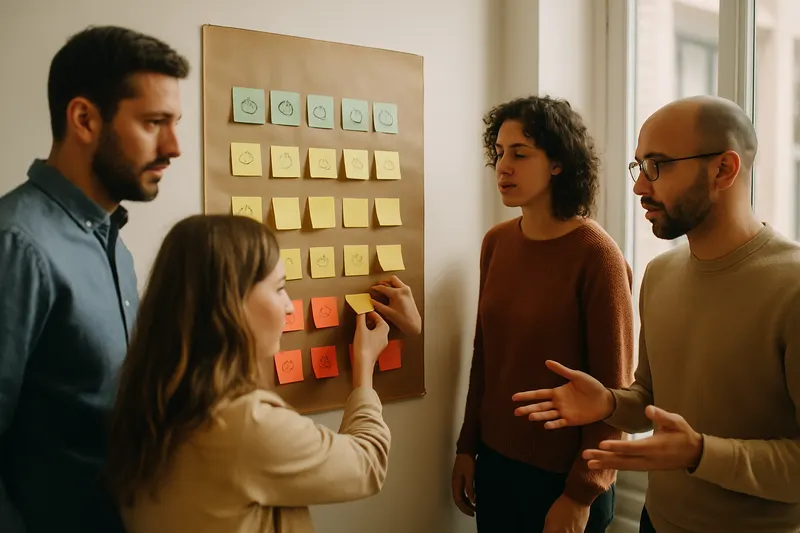
Happiness Door
A visual, anonymous, and immediate feedback tool to adjust a workshop while there is still time.
Happiness Door is a Management 3.0 practice attributed to Jurgen Appelo. It combines a feedback wall and a happiness index to capture participants' feelings as they leave the room or a session. Each person anonymously places a post-it on a vertical scale ranging from a smiling face at the top to an unhappy face at the bottom, with an optional comment. The facilitator reads the feedback and adjusts the rest of the workshop, meeting, or day accordingly.
Walkthrough
- 1
Prepare the feedback door
2 minBefore the exit or on a wall nearby, the facilitator prepares a very visible vertical scale. They place a smiling face at the top and an unhappy face at the bottom, without complicating it with too many categories. They add post-its and markers within easy reach, preferably in the natural flow of exit. The goal is for the action to be simple, quick, and possible without interrupting the group's movement.
Tip — Place the post-its before the door, not after: participants should be able to write and stick them without blocking the passage or feeling observed.
- 2
Present the intention to the group
1 minThe facilitator briefly explains the setup before the break, the end of the meeting, or the end of the day. They say: 'As you exit, stick a post-it at the height that corresponds to your feeling: more satisfied towards the smiling face, more dissatisfied towards the unhappy face. You can add a comment, it's optional. It's anonymous and helps me adjust what comes next.' Participants understand that this is not a decorative vote, but a real lever for adaptation.
Tip — Emphasise the concrete use of the feedback: if participants think nothing will be read, they will respond less or in a less useful way.
- 3
Have participants place post-its at the exit
1 à 3 minAt the scheduled time, the facilitator allows participants to exit normally and gestures for them to use the Happiness Door. Each person sticks a post-it at the height corresponding to their feeling, from the smiling face at the top to the unhappy face at the bottom. The comment is free: a word, a remark, a request, or nothing at all. The facilitator avoids commenting on the choices during the posting to preserve anonymity and sincerity.
Tip — Step back slightly from the door during the posting: your presence too close can turn anonymous feedback into a socially expected response.
- 4
Quickly read the trend
1 à 2 minOnce the flow is complete, the facilitator first observes the general distribution of post-its on the scale. They look to see if the feedback is concentrated towards the top, the bottom, or if it is dispersed. They then read the optional comments, identifying recurring signals rather than isolated phrases. The goal is not to produce a statistical analysis, but to obtain an immediate reading of the atmosphere and the lived experience.
Tip — Always start with the overall shape of the post-it cloud before reading the details: this avoids overreacting to a very visible but isolated comment.
- 5
Decide on an adjustment
1 à 2 minThe facilitator chooses one or two realistic adjustments based on the feedback: pace, clarity of instructions, energy level, need for a break, format of exchange, or deepening a point. They ask themselves: 'What can I change in the next session?' If the feedback is generally positive, they also identify what should be retained. The interest of the practice is to transform immediate feedback into immediate action.
Tip — Do not try to address all comments: choose a few visible actions so that the group sees the link between their feedback and your decisions.
- 6
Close the loop with the group
1 minUpon returning from the break or starting the next session, the facilitator gives a brief collective feedback without naming anyone. They might say: 'I read your post-its: I see that the pace is well perceived, but some would like shorter instructions. I will therefore announce the steps more clearly.' This loop shows that the feedback has been read and taken seriously. It encourages sincerity during future uses.
Tip — Phrase the feedback without defensive justification: thank, name what you understood, announce what you are adjusting.
Variants
- Use at the end of the day: participants place their post-it before leaving the room, then the facilitator adjusts the opening of the next day based on the observed trends.
- Use during a break: the door serves as an intermediate sensor, particularly useful if the facilitator wants to correct the pace, clarity, or energy before the end of the workshop.
- Remote version: replace the door with a collaborative board featuring a vertical scale from a smiling face at the top to an unhappy face at the bottom; each person anonymously places a note with an optional comment, if the tool allows.
- Short meeting version: use the Happiness Door at the exit of a meeting to capture the overall feeling without opening a long roundtable discussion.
Debrief guide
- What did you feel when giving immediate and anonymous feedback rather than responding later to a questionnaire?
- What does the distribution of post-its reveal that we might not have heard otherwise?
- What types of comments are most useful for enabling a concrete adjustment of what comes next?
- What encourages or hinders sincerity in this type of very quick feedback?
- How can we show the group that their feedback has genuinely influenced what comes next?
- In what moments of our meetings, training sessions, or workshops would this practice be most valuable?