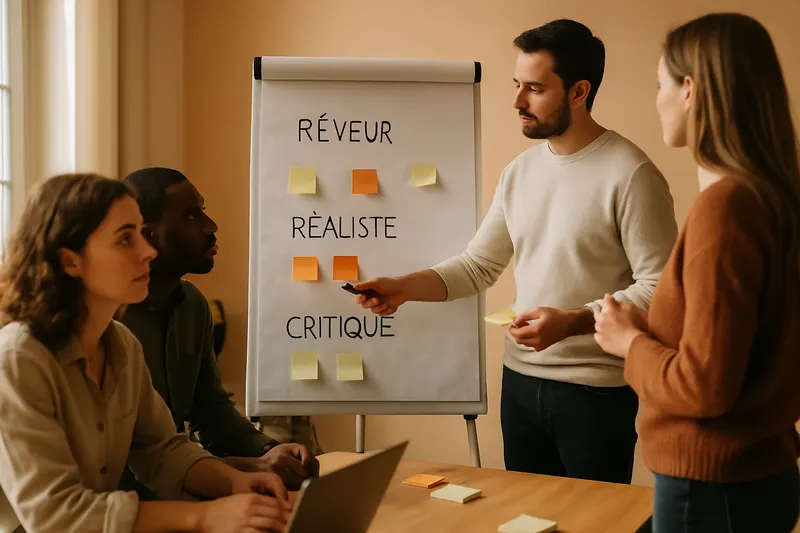
Walt Disney Method (Dreamer, Realist, Critic)
Maturing an idea by separating dreams, action plans, and constructive criticism.
The Walt Disney method is a creativity strategy modelled by Robert Dilts based on the working style attributed to Walt Disney. It guides a group through three successive roles: the Dreamer, the Realist, and the Critic. The game serves to generate ambitious ideas, transform them into concrete plans, and then strengthen them through risk analysis. The separation of roles prevents criticism from killing ideas too early and allows for a feedback loop until a more robust plan is achieved.
Walkthrough
- 1
Setting the Framework and the Three Roles
5 to 10 minThe facilitator presents the objective: "We will work on an idea in three stages, without mixing the roles. First, we dream, then we build, and finally we critique the plan." They remind that the game is suitable for a group of 2 to 12 people, either in person or remotely. They specify the key rule: criticism is directed at the plan, never at individuals. Participants ask their clarification questions before starting. This step protects the process and creates a framework where everyone knows when and how to contribute.
Tip — Display the three words Dreamer, Realist, Critic from the start: this avoids debates about the method during the exercise.
- 2
Defining the Topic to Work On
5 to 10 minThe facilitator helps the group to clearly and openly formulate the challenge: "What project, problem, or opportunity do we want to work on today?" They check that the topic is concrete enough to be actionable but open enough to allow for imagination. Participants propose, clarify, and validate a common formulation. The facilitator notes this formulation visibly and announces that it will remain the common thread. This step prevents the generation of good ideas on a vague or differing subject.
Tip — If the group goes in several directions, have them choose a single topic and keep the others in a parking list.
- 3
Switching to the Dreamer Role
10 to 20 minThe facilitator invites the group to position themselves in the Dreamer space, ideally in a distinct area. They say: "Here, everything is possible. We imagine without constraints, without budget, without immediate feasibility, and without criticism." Participants formulate ideas, images, solutions, scenarios, or ambitions, while the facilitator collects them without judgment. Any remarks about feasibility or risk are set aside for later. The goal is to broaden the scope before realism and caution intervene.
Tip — Gently interrupt phrases that start with "yes, but": note them in a Critic area and bring the group back to dreaming.
- 4
Switching to the Realist Role
10 to 20 minThe facilitator moves the group to the Realist space and announces: "We keep the ambition, but now we look for how to implement it concretely." Participants transform ideas into steps, actions, possible responsibilities, necessary resources, and initial milestones. The facilitator specifies what needs to be done, by whom, or with what resources, without debating risks yet. Vague ideas are reformulated into observable actions. This step structures the dream without reducing it too quickly.
Tip — When an idea remains abstract, ask: "What would be the very first visible action if we started tomorrow?"
- 5
Switching to the Critic Role
10 to 20 minThe facilitator moves the group to the Critic space and reminds the rule: "We critique the plan, not the individuals or their creativity." Participants identify risks, blind spots, what is missing, what seems fragile or insufficiently defined. The facilitator reformulates criticisms into useful objections: success conditions, open questions, points to strengthen. Personal attacks or value judgments are immediately reframed. This step secures the project by putting fragilities to the service of improvement.
Tip — Transform each dry criticism into a working question: "What needs to be true for this to work?"
- 6
Looping Back with the Objections
10 to 20 minThe facilitator brings the group back to the Dreamer role with the collected objections. They say: "From these limits, what new possibilities, alternatives, or improvements can we imagine?" Participants enrich the idea, then may return to the Realist to adjust the plan and to the Critic to test it again. The loop continues until a plan is deemed more robust by the group. The principle is to have the roles interact without mixing them.
Tip — Limit each return to a few priority objections; otherwise, the group will disperse and lose creative energy.
- 7
Consolidating the Final Plan and Closing
5 to 10 minThe facilitator synthesises the result: the chosen idea, the main steps, key resources, identified risks, and planned responses. They ask: "What is clear enough to move forward, and what remains to be clarified outside the workshop?" Participants validate the decisions and open points. The facilitator distinguishes the outcomes of the game from the topics to be addressed later. This closure transforms the creative experience into actionable material after the workshop.
Tip — Finish with a visible decision statement: "At this stage, our plan is..." to avoid a too vague ending.
Variants
- In a small group of 2 or 3 participants, each person can successively embody the three roles. The facilitator ensures that the role change is clearly materialised to avoid mixing.
- In a larger group, divide participants into subgroups working on the same topic, then compare the plans obtained. This variant enriches the diversity of ideas without changing the Dreamer, Realist, Critic logic.
- Remotely, create three distinct areas in a collaborative board or three separate pages: Dreamer, Realist, Critic. Ask the group to contribute only in the area corresponding to the current role.
- For a project already advanced, start directly with the Realist using the existing plan, then move to the Critic and loop back to the Dreamer to overcome blockages.
Debrief guide
- What has the separation between Dreamer, Realist, and Critic changed in the quality of your ideas?
- At what moment did the group have the most energy, and what does that reveal about their working style?
- Which criticisms actually strengthened the plan rather than blocking it?
- Which role felt the most natural for you, and which required the most effort?
- Which ideas would likely have been killed too early without this method?
- What still needs clarification to move from this plan to real implementation?