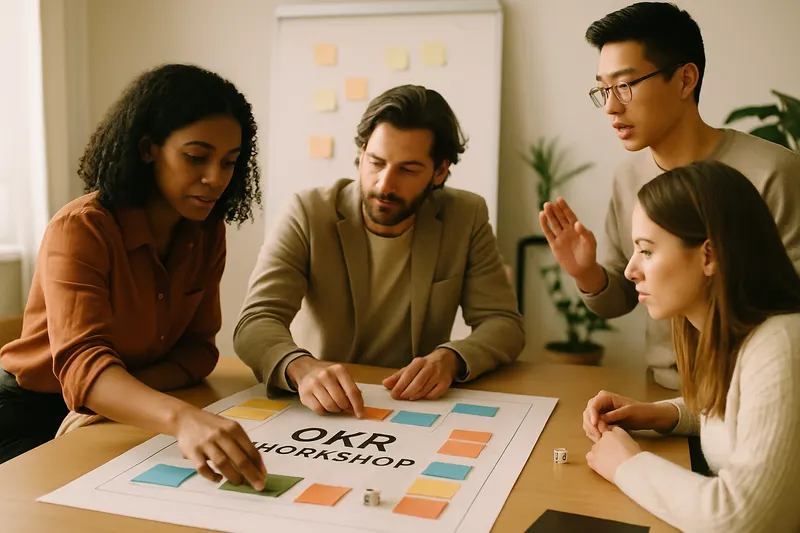
OKR Workshop
Co-create inspiring and measurable objectives with OKRs.
The OKR workshop enables teams to define ambitious objectives and measurable key results for the quarter. This exercise promotes alignment and product vision, going beyond mere deliverables. By collaborating, participants learn to formulate clear objectives and determine success indicators, thereby strengthening team coherence and engagement.
Walkthrough
- 1
Introduction to OKRs
15 minThe facilitator begins by explaining what OKRs (Objectives and Key Results) are and their importance for strategic alignment. They present concrete examples of successful OKRs and highlight the difference between ambitious objectives and measurable key results. This step aims to get all participants on the same page regarding the usefulness and structure of OKRs.
Tip — Use examples of OKRs from your own organisation to make the exercise more relevant.
- 2
Defining Objectives
25 minParticipants regroup by teams or departments to brainstorm potential objectives. The facilitator asks them to focus on inspiring objectives that motivate and align the team's efforts. Each group must formulate 2 to 3 clear objectives. The facilitator circulates to offer advice and ensure that the objectives are sufficiently ambitious.
Tip — Encourage participants to think of objectives that personally excite them to increase engagement.
- 3
Identifying Key Results
30 minFor each defined objective, teams identify 3 to 5 measurable key results. The facilitator emphasises the need for specific, measurable, and achievable results. They encourage participants to ask themselves: 'How will we know we have achieved this objective?'. This step helps clarify expectations and establish performance indicators.
Tip — Use post-its to write down the key results and place them under each objective for clear visualisation.
- 4
Presentation and Feedback
20 minEach team presents its OKRs to the group. The facilitator facilitates the feedback session by asking other teams to pose questions and make constructive suggestions. This step ensures that the OKRs are well understood and incorporates diverse perspectives for improvement.
Tip — Encourage positive and constructive feedback to maintain a collaborative and supportive atmosphere.
- 5
Finalising OKRs
15 minTeams integrate the feedback received and finalise their OKRs. The facilitator reminds them of the importance of collectively committing to these objectives for the upcoming quarter. Each team must ensure that its OKRs are aligned with the overall vision of the organisation.
Tip — Remind participants that OKRs can evolve and should be reviewed regularly.
- 6
Planning Reviews
10 minThe facilitator explains the importance of regular reviews to track the progress of OKRs. Teams plan monthly meetings to assess their progress and adjust actions if necessary. This step ensures constant follow-up and proactive adaptation.
Tip — Suggest using an OKR tracking tool to facilitate transparency and ongoing communication.
Variants
- Organise the workshop online using collaborative tools like Miro or Mural for distributed teams.
- Include a segment on prioritising OKRs to help focus efforts on the most impactful objectives.
- Add an inter-team sharing session to discover the OKRs of other departments and promote overall alignment.
Debrief guide
- What have you learned about formulating ambitious objectives?
- How can OKRs improve your team's alignment?
- What challenges did you encounter when defining key results?
- How do you plan to track and adapt your OKRs over time?
- What impact do you think these OKRs will have on your daily work?
- How can you ensure that your OKRs remain relevant and motivating?
- What are the next steps to integrate these OKRs into your work process?