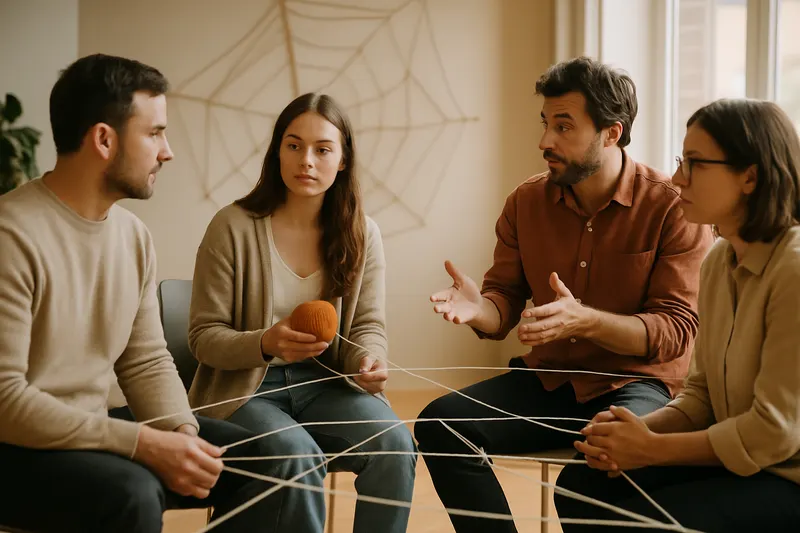
The Ball of Wool (the Team Web)
A circle, a ball of wool, and a visible web to feel the connections and interdependence of a team.
The ball of wool, also known as the team web, is a simple circle game that materialises the connections between participants. Each person answers a question, keeps a portion of the thread, and then throws the ball to someone else. Gradually, a web forms in the centre of the group, making interdependence visible. It can be used at the beginning for introductions or at the end to express gratitude, learning, or commitments.
Walkthrough
- 1
Setting up the circle and the intention
2 à 3 minThe facilitator invites the group to form a circle, standing or sitting, so that everyone can see each other. They show the ball and announce: "We are going to create a web between us, each taking a turn to speak." They specify the chosen use: introduction at the beginning, gratitude, learning, or commitment at the end. Participants listen to the instructions and position themselves with enough space to throw and receive the ball without hindrance.
Tip — Ensure that the circle is not too wide: if throws become difficult, attention shifts to aim rather than connection.
- 2
Providing the passing question
2 minThe facilitator formulates a single, short, and clear question that everyone will answer before throwing the ball. For example, at the beginning: "State your name and one thing you bring to the group today." At the end: "Share what you take away, or what you appreciate about someone in the circle." They clarify that the response should remain brief, so everyone can participate. Participants take a few seconds to think about their answer.
Tip — Choose a question appropriate to the group's level of safety: factual introduction with a new group, gratitude or commitment with a group already in trust.
- 3
Launching the web
2 à 4 minThe facilitator firmly holds the end of the thread and keeps this end in hand throughout the activity. They answer the question themselves to set the tone, then say: "I keep my thread, and I throw the ball to someone else." They then throw the ball to a person in the circle, ensuring that the thread remains visible and slightly taut. The person receiving understands that they will speak in turn before throwing.
Tip — Physically demonstrate the action of holding the thread before throwing: this detail prevents the ball from circulating without creating a web.
- 4
Passing the ball
6 à 12 minEach participant who receives the ball answers the question, holds a portion of the thread, and then throws the ball to another person. The facilitator reminds if necessary: "Keep the thread in your hand before throwing; this is what builds the web." The speaking continues until all participants have contributed, or until the group has created a web that is sufficiently clear. Gradually, the centre of the circle fills with crossed threads, making the connections visible.
Tip — If the same person is often chosen, gently invite the group to widen: "Let’s see who hasn’t received the ball yet." This preserves inclusion without breaking the rhythm.
- 5
Observing the created web
2 à 3 minWhen the web is formed, the facilitator asks the group to look at it in silence for a few seconds. They might say: "Look at what our speaking has built: it is no longer a series of individuals, it is a network." Participants observe the crossings, tensions, and each person's place in the whole. This pause allows for a transition from the playful activity to collective awareness.
Tip — Do not comment too quickly on behalf of the group: allow a real silence, as the image of the web often speaks for itself.
- 6
Feeling the interdependence
2 à 3 minThe facilitator offers a simple demonstration: "One person will gently pull on their thread; observe what you feel." The person pulls gently, and then the group quickly verbalises that the movement is transmitted to others. The facilitator can then ask someone to release their thread to show that the web also changes when a connection loosens. They conclude: "In a team, what one does affects the whole."
Tip — Emphasise the word "gently": the goal is to feel the collective effect, not to provoke material disorder or physical discomfort.
- 7
Closing and placing down the symbol
2 à 3 minThe facilitator concludes the experience by linking the web to the context of the workshop: starting together, recognising contributions, or leaving with commitments. They invite everyone to gently place down the thread or to gradually let it go, without breaking the dynamic. They might say: "The physical web disappears, but the connections and what we have just named remain available for the future." Participants then return to their place or to the next sequence.
Tip — Do not finish in haste: the way the thread is placed down influences the emotional quality of leaving the game.
Variants
- Opening version: each participant states their name and a simple element to introduce themselves before throwing the ball. This variant is suitable for groups that know each other little.
- Recognition version: each participant throws the ball to someone they wish to appreciate. Ensure that everyone is included in the web.
- Learning version: at the end of the workshop, each participant shares what they take away before throwing the ball again. The web then becomes a visual synthesis of the group's learnings.
- Commitments version: each participant states an action or intention for the future before throwing. This variant helps to transform collective energy into action.
Debrief guide
- What did you feel while holding your part of the thread and watching the web build?
- What does this web make visible about our group or team?
- What happened when someone pulled or released their thread?
- In our work together, where do we already see this interdependence?
- What connections do we need to take care of for the collective to function better?
- After this activity, what individual commitment can strengthen the group's web?