Photolangage
Making images speak to reveal representations, experiences, and feelings without debate or judgment.
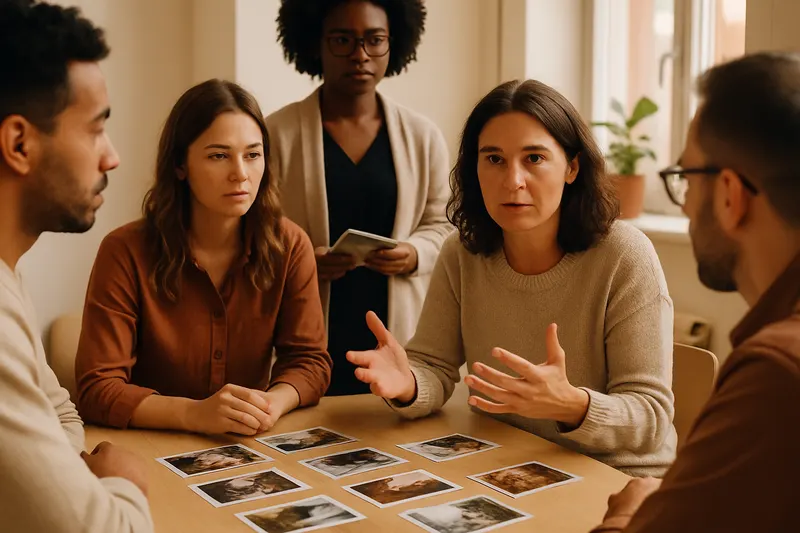
Photolangage is a method created in 1965 in Lyon by Alain Baptiste and Claire Bélisle; Photolangage is a registered trademark. The principle involves responding to a clear question by choosing a photograph and then sharing what it evokes for oneself. The game serves to bring forth representations at the beginning of training, to conduct an assessment, or to facilitate the expression of an experience. Official documents are published; the approach can also be practiced with a set of varied and non-stereotypical royalty-free photos.
Walkthrough
- 1
Setting the framework and intention
5 minThe facilitator welcomes the group and announces the objective: "We will use photographs to express a perception, an experience, or a representation. There are no right answers: only your personal interpretation of the image matters." They clarify the rules: speak in "I", listen without interrupting, do not judge, do not interpret for others, do not seek debate. Participants thus know they will not be evaluated. This framework secures speech and prevents the exercise from becoming a discussion of opinions.
Tip — State the rules slowly and display them if possible; the rule "I do not know what the other means until they have said it" is very useful to prevent projections.
- 2
Asking the working question
3 à 5 minThe facilitator formulates a single, clear, and open question, then repeats it word for word. Examples depending on the context: "What does this theme evoke for you today?", "Which image represents your state at the end of the training?", or "Which photo best speaks to your experience of this situation?" They check that the question is understood, without turning it into a debate. Participants keep the question in mind to guide their choice. The quality of the question conditions the depth of the shares.
Tip — Prepare the question in advance and write it visibly; if you improvise, you risk asking a question that is too broad or double, which scatters the choices.
- 3
Presenting the photographs
5 minThe facilitator spreads the photographs visibly on a table, on the floor, or on a shared online platform. They say: "Take your time to look at all the images. For now, do not pick up a photo; silently choose the one that best expresses your response." Participants move around or observe without commenting. This silent step allows everyone to listen to their first personal resonance rather than being influenced by others.
Tip — Arrange the images with enough space for several people to look at the same time; in person, avoid piles of photos that create haste.
- 4
Choosing in silence
5 à 8 minThe facilitator allows a calm selection time and reminds: "Choose the photo that speaks to you the most regarding the question, even if you do not yet know how to explain why." Each person mentally identifies their image without immediately removing it from the setup. If two people choose the same photograph, it is not a problem: they can both refer to it. The absence of immediate taking avoids competition for the images. Silence helps participants stay focused on their own response.
Tip — Monitor hesitations without intervening too quickly; if someone is stuck, suggest they choose the image that attracts or intrigues them the most, rather than "the right" image.
- 5
Sharing your image and its evocation
15 à 30 minIn turn, each participant designates or takes their photo and presents what it evokes for them. The facilitator gives the instruction: "Speak in I: what I see, what it makes me think, what it says about my response to the question." Others listen without interrupting, interpreting, or judging. After the person's speech, those who wish can briefly say what they see in the photo, remaining on their own perception. The facilitator ensures that these contributions do not correct or discuss the initial testimony.
Tip — If a participant says, "you chose that because...", gently reframe immediately: "Rephrase by talking about what you see in the image, not what the other thinks."
- 6
Sharing the learnings
5 à 10 minThe facilitator offers an oral synthesis without betraying individual words: "What comes up often? What surprises? What differences in perception appear?" They may note keywords, themes, or expressed tensions, keeping the formulations at the collective level. Participants can add or nuance. The goal is not to conclude with a single truth but to make visible the representations or experiences present in the group. This step transforms individual expression into common working material.
Tip — Do not try to restate everything; only note the useful motifs for the continuation of the workshop, otherwise the synthesis becomes a heavy report and cools the group.
- 7
Closing the exercise
2 à 5 minThe facilitator thanks the group for their quality of listening and reminds that interpretations belong to each individual. They may say: "Keep in mind an idea, an image, or a phrase that accompanies you for the future." The photographs are put away or the digital platform is closed. If the exercise opened a training session, the facilitator links it to the upcoming theme; if it served as an assessment, they highlight what the group takes away. The closure allows for a clean exit from a moment that can sometimes be personal.
Tip — End with a very concrete transition phrase to the next activity; after a sensitive sharing, a sudden shift can give the impression that the speech has only been consumed.
Variants
- At the beginning of the training, use the question "Which image represents your current relationship to the subject?" and then rely on the expressed keywords to adjust examples and pedagogical priorities.
- In the assessment, ask "Which photo represents what you are taking away?" Each participant shares a strong idea, an emotion, or a realization related to their image.
- For remote sessions, prepare a digital board of numbered royalty-free photos. Participants choose silently, then announce the number of their image when it is their turn to speak; the framework remains the same: speak in I, listen, no debate.
- For a group that is not comfortable with personal expression, start with a less intimate question focused on the representations of a theme before moving towards an experience or assessment.
Debrief guide
- What did choosing your photo allow you to express that you might not have articulated directly?
- What did you discover about the diversity of perceptions in the group?
- Which images or words surprised, touched, or shifted your understanding of the subject?
- What common themes emerge from the shares, despite the differences in chosen photos?
- What does this exercise reveal about our way of listening without interpreting too quickly?
- What do you take away for the continuation of the training, project, or collective work?