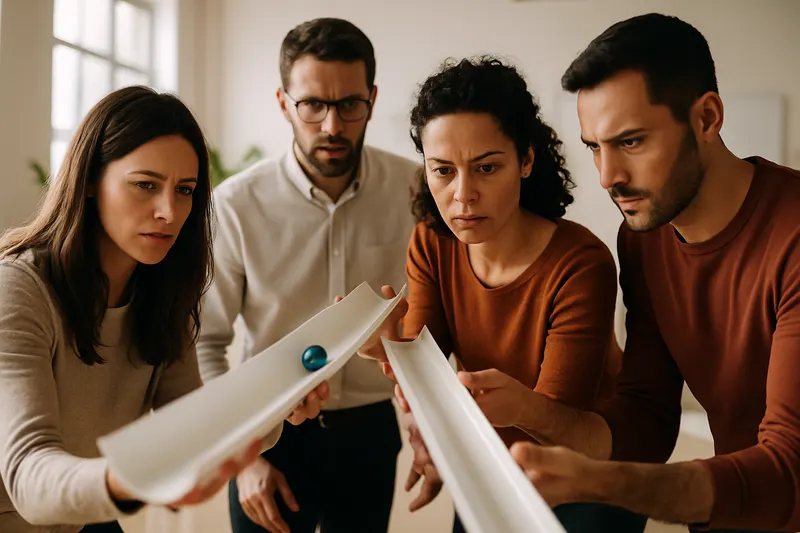
The Pipeline (the ball and the gutters)
Move a ball without touching it: coordination, rapid learning, and the right to trial in action.
The Pipeline is a face-to-face team building activity where the team constructs a living path with half-tubes or short gutters. Participants must transport a ball from a starting point to a distant receiving container, only by rolling it from gutter to gutter. The rules create a strong interdependence: the person carrying the ball cannot move their feet, and any mistake requires starting over. The game embodies coordination, continuous improvement, and collective management of failure.
Walkthrough
- 1
Set up the field and the challenge
3 to 5 minThe facilitator clearly establishes a starting point and, at a distance, a visible receiving container for all. They distribute a half-tube or short gutter to each participant and keep the ball in hand. They announce: "Your mission is to transport this ball to the container without ever touching it. You will need to create a mobile and coordinated human pipeline." Participants observe the space, take their equipment, and position themselves without starting yet.
Tip — Choose a sufficient distance to require players to reposition, but not too long for the first attempt: the interest comes from successive trials, not from endless failure.
- 2
State the non-negotiable rules
4 to 6 minThe facilitator states the rules one by one, demonstrating with a gutter. "The ball must roll from gutter to gutter to the container; no one touches it with their hands or body. When the ball is in your gutter, you cannot move your feet. The ball must not stop, roll back, or fall: if this happens, the team starts over from the beginning." They clarify that players will need to run to reposition at the end of the line once their gutter is free.
Tip — Have the group rephrase the four prohibitions before starting: touching, moving feet with the ball, stopping or rolling back, falling. This avoids debates during the action.
- 3
First attempt without long preparation
3 to 6 minThe facilitator invites the team to quickly attempt a first crossing. They say: "You are allowed to talk, to organise yourselves while walking, but I will launch the ball as soon as you are ready. Pay attention to what works and what blocks." They place the ball in the first gutter and only monitor the announced rules. In case of stopping, rolling back, falling, or contact with the ball, they calmly stop and send the team back to the start.
Tip — Do not coach during this first attempt, even if you see the solution. The gap between intention and execution provides material for the debrief and improvement.
- 4
Collective improvement break
4 to 7 minAfter the first attempt, the facilitator stops the game and gives a short improvement time. They ask: "What have you learned? What is the next small team rule you want to test? Who sets the pace, who looks ahead, how do we reposition?" Participants exchange ideas, choose an organisation, and clarify their signals. The facilitator ensures that the discussion remains focused on concrete experimentation, not on finding a leader.
Tip — Deliberately limit the break: too much planning freezes the group. Look for a simple and testable improvement, such as a password or a scout role.
- 5
Successive attempts and increased coordination
8 to 15 minThe facilitator launches several new attempts, always with the same rules: do not touch the ball, do not move your feet when it is in your gutter, do not let it stop, roll back, or fall. Between attempts, they allow a brief time to adjust the method. Participants run to reposition at the end of the line as soon as their gutter is free and learn to synchronise speed, tilt, and communication. The facilitator values observable progress rather than just the final success.
Tip — When a failure occurs, name the fact without judgment: "The ball stopped, back to the start." This neutrality maintains energy and transforms the error into a working data point.
- 6
Success, stop the game and transition
2 to 4 minWhen the ball reaches the container, the facilitator clearly marks the success and allows the group a few seconds to celebrate. If the allotted time runs out before success, they also stop neatly: "We stop here to keep time for learning; the result is part of the experience." They ask participants to place the gutters down and return to a circle. This physical transition helps shift from rapid action to collective analysis.
Tip — Do not initiate an additional attempt at the expense of the debrief. In this game, the educational value is revealed especially when the group articulates its adjustments.
- 7
Learning-oriented debrief
8 to 12 minThe facilitator opens the debrief by starting from the observed facts: starts, errors, adjustments, success or blockage. They ask the group to relate the experience to their work situations: coordination, handover, communication, pressure, and continuous improvement. They ensure that several people speak, not just those who led the action. They conclude by asking for a concrete practice to retain for upcoming collective projects.
Tip — Lean on specific moments from the game: "At which attempt did you change something?" This helps participants avoid generalities and identify real team mechanisms.
Variants
- Silent variant: after a first spoken attempt, prohibit speech during the next attempt. The group must invent non-verbal signals, which enhances attention, anticipation, and reading of others.
- Observer variant: for a large group, a few participants observe an attempt without a gutter, then provide only observed facts and a suggestion for improvement. They then rejoin the pipeline in the next round.
- Constrained path variant: add a simple detour or a narrow passage between the start and the container. Keep all the basic rules; the additional difficulty should serve coordination, not put the group in permanent failure.
Debrief guide
- At what point did the team really start to function as a coordinated system rather than a series of individuals?
- What helped the ball advance the most: speed, precision, communication, roles, or something else?
- How did the group react to failures and returns to the start? What does this reveal about their way of learning?
- Which rules or constraints were the most difficult to adhere to, and why?
- What signals, words, or behaviours improved the transmission between two people?
- In your work, where do you need a handover as smooth as in this pipeline?
- What small practice of continuous improvement do you want to retain from this game and test quickly in the team?