Planning Poker
Estimate complexity as a team to foster alignment and collaboration.
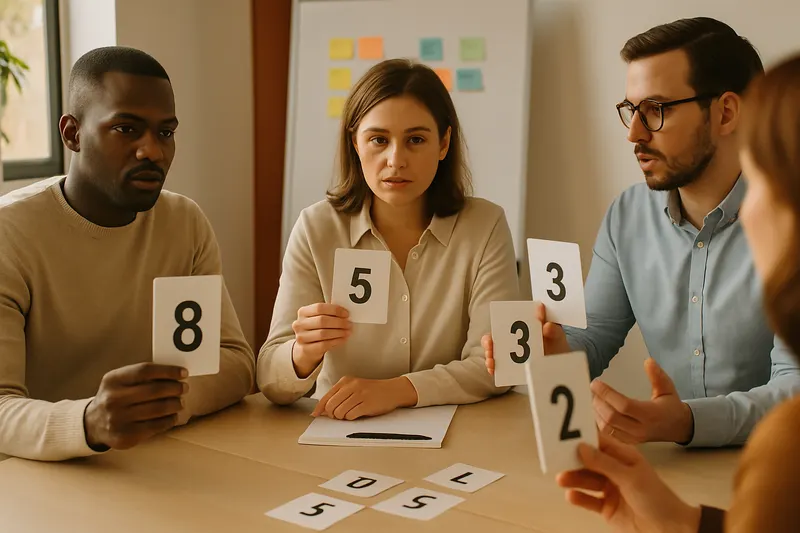
Planning Poker is an agile estimation tool that uses cards to assess the complexity of tasks. Each team member proposes an estimate simultaneously, allowing for the revelation and discussion of discrepancies. This method promotes shared understanding and team alignment while avoiding anchoring bias.
Walkthrough
- 1
Introduction to Planning Poker
10 minThe facilitator briefly explains the concept of Planning Poker and its objective: to estimate the complexity of tasks as a team for better work planning. They present the cards used, typically based on the Fibonacci sequence (1, 2, 3, 5, 8, 13, etc.), and emphasise the importance of relative estimation rather than absolute.
Tip — Use a simple metaphor, such as building with Lego, to illustrate the concept of relative complexity.
- 2
Presentation of User Stories
15 minThe facilitator presents a series of user stories to estimate. Each story is read aloud and clarified if necessary. Participants can ask questions to ensure they fully understand the requirements and context of each story.
Tip — Encourage participants to ask open-ended questions to explore the hidden details of the stories.
- 3
Individual Estimation
10 minEach participant secretly chooses a card that represents their estimate of the complexity of the story. Once everyone has chosen, the cards are revealed simultaneously. This step helps to avoid the influence of other team members' estimates.
Tip — Remind participants that the estimate should reflect complexity, not the time required.
- 4
Discussion and Convergence
15 minIf estimates vary, the facilitator invites participants to discuss the reasons for their choices. Those who provided the extreme values explain their reasoning. The goal is to reach a consensus or narrow the gap between estimates.
Tip — Encourage constructive discussion by asking questions like 'What makes this story complex in your opinion?'.
- 5
Finalisation of Estimates
10 minAfter the discussion, participants re-vote if necessary to adjust their estimates. The facilitator notes the final consensus estimate. This step is repeated for each story in the session.
Tip — Set a time limit for each discussion to maintain the group's pace and energy.
- 6
Session Conclusion
5 minThe facilitator concludes the session by thanking the participants and highlighting the benefits of the exercise: better understanding of tasks, team alignment, and continuous improvement of future estimates.
Tip — Finish with a quick round where each participant shares a key learning from the session.
Variants
- Use digital cards for distributed teams, using a tool like Miro or Mural.
- Incorporate regular breaks to encourage individual reflection before each estimation.
- Try a variant with dice to add an element of randomness and encourage discussion about uncertainties.
Debrief guide
- What did you learn about the complexity of tasks through this exercise?
- How did this method influence your understanding of user stories?
- What are the advantages of estimating as a group compared to individual estimation?
- How did this session impact your view of agile planning?
- What difficulties did you encounter during estimation and how did you overcome them?
- How could you improve your estimation process in the future?
- What elements of this method could you apply to other areas of your work?