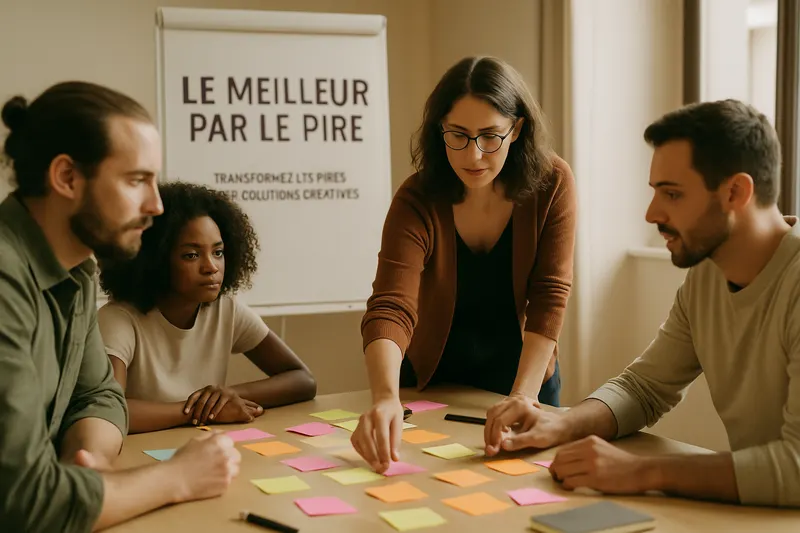
The Best from the Worst
Transform the worst ideas into creative solutions.
The Best from the Worst is a creativity game that allows for an original approach to problem-solving. By generating catastrophic ideas, participants discover unexpected and innovative solutions to improve the initial situation. This game encourages divergent thinking and helps break free from habitual thought patterns.
Walkthrough
- 1
Introduction
10 minThe facilitator introduces the game and its objectives: "We will explore innovative solutions by starting from the worst possible ideas." They explain that the goal is to stimulate creativity and think outside the box. Participants are invited to relax and not hesitate to propose absurd ideas.
Tip — Use a light and encouraging tone to make participants comfortable with the idea of proposing 'bad' ideas.
- 2
Defining the Problem
10 minThe facilitator asks participants to clearly define the problem or challenge to be solved. "What is the problem we want to address today?" Encourage a quick exchange to clarify what the group wishes to improve or resolve.
Tip — Ensure that everyone understands the problem and that it is neither too broad nor too narrow.
- 3
Generating the Worst Ideas
15 minParticipants are invited to propose the worst possible ideas to solve the problem. "Imagine how we could make the situation worse." The facilitator notes all ideas, even the most absurd, on a board or sticky notes.
Tip — Encourage laughter and lightness, as this helps to unleash creativity.
- 4
Transforming into Solutions
20 minEach 'bad' idea is examined to extract positive aspects or innovative solutions. "How could this idea be transformed into a viable solution?" Participants discuss in small groups and share their reflections.
Tip — Guide participants by asking open-ended questions that encourage reflection and transformation.
- 5
Presenting Solutions
15 minThe groups present their transformed solutions to the rest of the participants. "Here’s how we transformed our initial idea into a potential solution." Each group briefly explains the transformation process.
Tip — Encourage questions and comments to enrich the proposed solutions.
- 6
Conclusion and Thanks
5 minThe facilitator concludes by thanking participants for their creativity and active participation. "Thank you for your engagement and innovative ideas today." They summarise the key solutions discovered and encourage applying this method in other contexts.
Tip — Make a connection to real situations where this method could be applied.
Variants
- Use additional constraints, such as a limited budget or tight deadline, to complicate the challenge.
- Adapt the game to a virtual context by using a digital whiteboard to collect ideas.
- Add a voting step to select the most promising solutions to develop further.
Debrief guide
- How did you feel generating 'bad' ideas?
- How did you transform an absurd idea into a viable solution?
- What surprises did you encounter in this process?
- How could this approach be applied in your daily work?
- What creativity skills did you mobilise today?
- Did you discover aspects of yourself or your team that you were unaware of?
- How has this experience changed your perception of problem-solving?