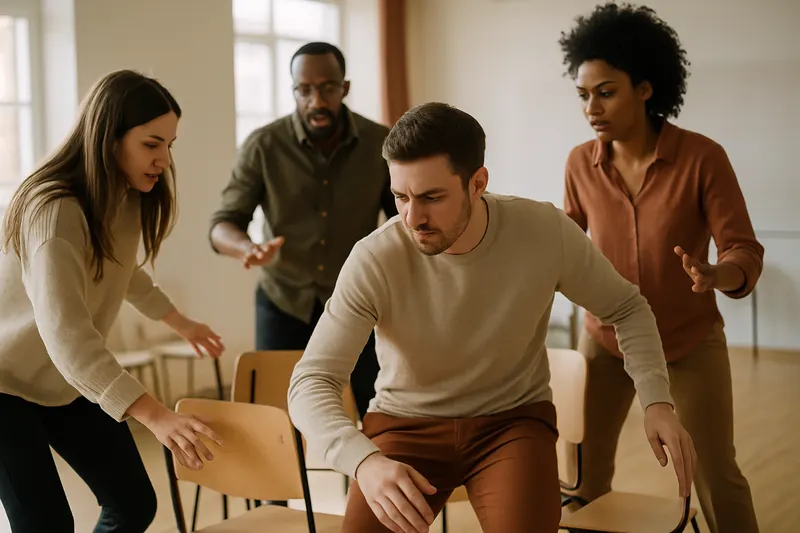
The Non-Musical Chairs
Enhance cooperation with a game of chairs without music.
The Non-Musical Chairs is a cooperative game aimed at improving communication and coordination within a team. Participants must find creative and collaborative ways to sit on an increasingly reduced number of chairs. This game highlights the importance of active listening and flexibility in a playful and engaging setting.
Walkthrough
- 1
Introduction to the game
5 minThe facilitator explains the rules of the game: the goal is to successfully seat all participants on a progressively decreasing number of chairs. The chairs must not be moved, and each participant must have at least one part of their body in contact with a chair. This requires active cooperation and effective communication.
Tip — Use an enthusiastic tone to motivate participants and clarify that cooperation is the key to success.
- 2
Setup
5 minArrange the chairs in a circle or in a line, depending on the available space. Ensure there is one chair for each participant at the start. Invite participants to sit down and familiarise themselves with the space. This helps create a safe environment before starting the game.
Tip — Ensure the area around the chairs is clear to avoid any risk of falling.
- 3
First round
10 minAsk participants to stand up and remove one chair. Invite them to find a solution so that everyone can sit down again. Observe the communication and collaboration strategies that emerge naturally. This step helps break the ice and encourages creativity.
Tip — Encourage participants to voice their ideas aloud to strengthen communication.
- 4
Progressive reduction of chairs
15 minContinue to remove one chair in each round, allowing the group to organise themselves to sit down. Each new configuration requires increased adaptation and coordination. This stimulates participants' ingenuity and team spirit.
Tip — Be attentive to group dynamics and intervene if necessary to encourage quieter participants to express themselves.
- 5
Final round
10 minWhen the number of chairs becomes very limited, challenge participants to sit all together on the remaining chairs. This final step tests the group's ability to work together under pressure.
Tip — Remind everyone of the importance of safety and encourage participants to be attentive to one another.
- 6
Closure of the game
5 minCongratulate participants for their creativity and team spirit. Invite them to share their feelings and the strategies that worked. This reinforces learning and celebrates collective successes.
Tip — Encourage a quick roundtable for everyone to express their feelings.
Variants
- Add constraints, such as not speaking during a round, to increase the challenge.
- Introduce a time element by limiting the duration of each round.
- Allow participants to move the chairs to encourage strategy and planning.
- Integrate specific roles, such as a round leader, to diversify group dynamics.
Debrief guide
- What strategies were most effective for seating everyone together?
- How did communication evolve during the game?
- What did you feel as the number of chairs decreased?
- How did you manage moments of tension or disagreement?
- What collaboration skills did you use or develop?
- How could you apply what you learned in a professional context?
- What did you learn about yourself by participating in this game?