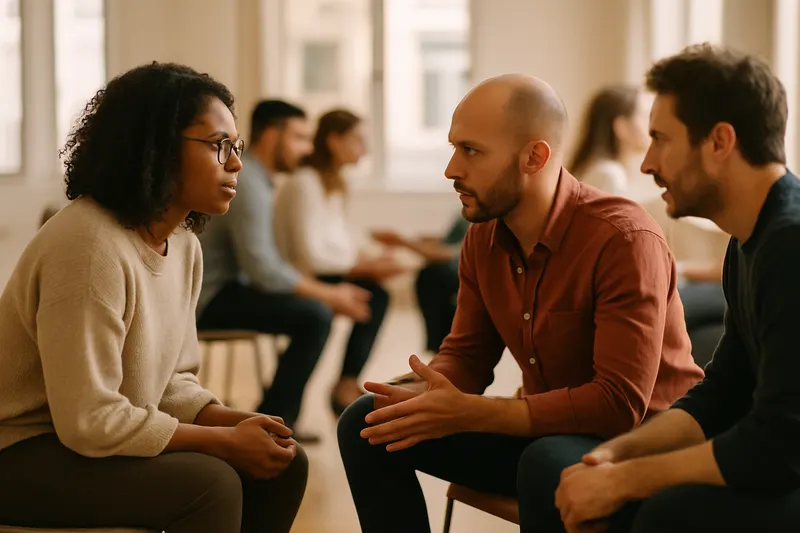
Speed Meeting (Express Meetings)
Express meetings in rotating pairs to quickly build connections and open discussions.
Speed Meeting is a timed meeting format in rotating pairs, usable both in-person and remotely. Participants engage in pairs for 2 to 4 minutes around a set question, then change partners at the signal. The questions can gradually become more personal or related to the theme of the seminar, onboarding, or training. The game facilitates a quick, rhythmic, and inclusive connection, even with a large group.
Walkthrough
- 1
Set up the arrangement
3 to 5 minThe facilitator prepares two rows of chairs facing each other, or two concentric circles if space allows. They ensure that each participant has someone opposite them; in the case of an odd number, a temporary trio can be formed. They announce: "You will meet several people one-on-one, for short and structured times." Participants sit facing each other and keep their belongings to a minimum to facilitate rotations.
Tip — Clearly mark the row or circle that will move at each round; this avoids hesitation and unnecessary crossings from the first rotation.
- 2
Explain the rules of the game
2 to 3 minThe facilitator explains the complete principle: each round is in pairs, lasts between 2 and 4 minutes, and focuses on a set question. At the signal, only one row shifts one place, always in the same direction, while the other remains fixed. They clarify: "Your goal is not to tell everything, but to listen and create a first contact." They remind that the questions may gradually become more personal or related to the theme of the workshop.
Tip — Do a mini-physical demonstration of the shift before starting the first round; thirty seconds of testing often prevent several minutes of confusion.
- 3
Start the first round
2 to 4 minThe facilitator proposes a first simple and accessible question, suitable for the opening context. They might say: "During this first round, each person answers the same question, then listens to the other. You have 2 to 4 minutes in total, so be concise and attentive." Pairs immediately exchange without a collective round table. The facilitator circulates, observes the energy level, and prepares the end signal.
Tip — Begin with a very easy question; the first round mainly serves to establish relational safety and the rhythm of the game.
- 4
Rotate the pairs
1 min per rotationAt the end of the allotted time, the facilitator gives a clear signal: bell, raised hand, music stopped, or vocal instruction. They announce: "Thank you for concluding your sentence, then the designated row shifts one place in the same direction." Participants quickly change partners and sit facing their new pair. The facilitator checks that no one is left without a conversation partner before launching the next question.
Tip — Always keep the same direction of rotation; changing direction midway significantly increases duplicates and time loss.
- 5
Chain progressive questions
8 to 20 minThe facilitator launches several successive rounds, each lasting 2 to 4 minutes, with a different set question. They build a progression: first a light question, then a more personal question, followed by a question related to the theme of the seminar, onboarding, or training. They say before each round: "New person, new question, same rule: active listening and short response." Participants thus meet several peers in a rhythmic and equitable framework.
Tip — Prepare your questions in advance and display them one by one; this prevents participants from mentally answering the next questions too early.
- 6
Conclude the exchanges
2 to 3 minThe facilitator stops the rotations before the energy drops, especially if exchanges become repetitive. They say: "Take ten seconds to thank your last pair, then return to a collective posture." Participants turn towards the facilitator or gather in a circle depending on the room. The facilitator marks the transition: "We will now look at what these meetings have produced for the group."
Tip — It's better to finish with a slight frustration than with saturation; Speed Meeting works thanks to its short rhythm.
- 7
Debrief collectively
5 to 10 minThe facilitator leads a brief but structured debrief, without asking each person to recount their private exchanges. They ask open questions about what surprised them, facilitated connection, or changed their perception of the group. They protect confidentiality by saying: "Share what you learned about the dynamics, not what belongs to your pair." Participants formulate useful insights for the continuation of the seminar, onboarding, or training.
Tip — Politely prohibit nominative reports; this maintains trust and prevents the debrief from becoming intrusive.
Variants
- Thematic version: all questions are related to the workshop topic, with a progression from personal experience to collective issues.
- Onboarding version: questions help newcomers identify people, roles, work habits, and support points within the group.
- Large group version: use two concentric circles instead of rows to facilitate rotations and limit lateral movements.
- Remote version: create breakout rooms for pairs, randomly recreated at each round, then send the question in the chat before opening the rooms.
Debrief guide
- What surprised you in these very short meetings?
- What facilitated contact with someone you knew little or not at all?
- At what moment did a question change the quality of the exchange?
- What did you discover about the diversity of backgrounds, expectations, or viewpoints in the group?
- What does this rapid format allow, and what does it not allow?
- How can we use these initial connections in the continuation of the seminar, onboarding, or training?