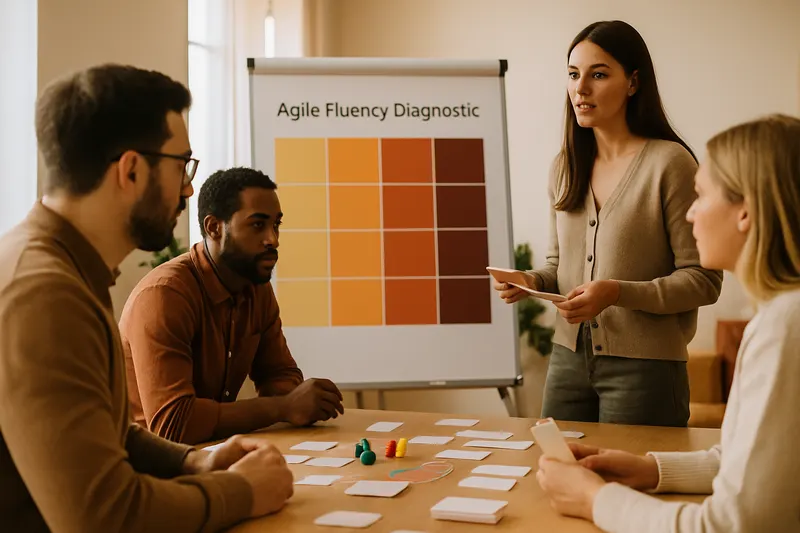
Agile Fluency Diagnostic
Assess your team's agile maturity across four key areas.
The Agile Fluency Diagnostic is a tool that evaluates a team's agile maturity based on four areas: Focusing, Delivering, Optimizing, and Strengthening. It helps identify strengths and areas for improvement, facilitating targeted coaching investments. This diagnostic promotes a shared understanding of the team's current state and future goals.
Walkthrough
- 1
Introduction and Objectives
15 minThe facilitator begins by explaining the concept of fluency in agility and the importance of the four key areas. They present the workshop objectives: to assess the team's current maturity and identify areas for improvement. Participants are invited to ask questions to clarify their understanding.
Tip — Use concrete examples from each area to illustrate your explanations and make the concept more tangible.
- 2
Presentation of the Four Areas
20 minThe facilitator describes each of the four areas in detail: Focusing (clarification of priorities), Delivering (value delivery), Optimizing (continuous improvement), and Strengthening (capacity building). Each area is illustrated with concrete examples and expected behaviours. Participants reflect on how these areas manifest in their own work.
Tip — Prepare visual cards or posters for each area to help participants remember the concepts.
- 3
Individual Assessment
30 minEach participant receives an evaluation grid to note their perception of the team's maturity in each area. They are invited to reflect individually and note concrete examples that support their evaluation. This personal introspection is essential for preparing the collective discussion.
Tip — Encourage participants to be honest and thoughtful in their evaluations, emphasising that there are no right or wrong answers.
- 4
Group Discussion
45 minParticipants regroup to share their individual assessments and discuss differences and similarities. The facilitator guides the discussion by asking open-ended questions to explore the reasons behind each evaluation. The goal is to reach a consensus on the team's assessment in each area.
Tip — Use a whiteboard to capture key points from the discussion and visualise emerging trends.
- 5
Identification of Actions
30 minBased on the collective assessment, the group identifies concrete actions to improve maturity in each area. The facilitator encourages participants to formulate SMART actions (Specific, Measurable, Achievable, Realistic, Time-bound) and designate responsible individuals for each action.
Tip — Suggest regular follow-up sessions to assess the progress of the identified actions.
- 6
Conclusion and Commitment
10 minThe facilitator concludes the workshop by summarising the key points and agreed actions. Each participant is invited to express a personal commitment to an action or area for improvement. This reinforces collective and individual accountability.
Tip — Ask each participant to note their commitment on a card that they can keep as a personal reminder.
Variants
- Use post-its for each participant to note their evaluations and place them on a large board for an overview.
- Organise sub-groups to delve deeper into each area, then report back in plenary.
- Incorporate role-playing to simulate scenarios in each area and stimulate reflection.
Debrief guide
- What did you learn about your team during this workshop?
- Which area seems most critical for improvement and why?
- What obstacles might you encounter in implementing the identified actions?
- How has this workshop changed your perception of your team's agile maturity?
- What concrete actions will you take starting tomorrow?
- How can we measure our progress in each area?
- What additional support would be necessary to achieve our improvement goals?