Ball Point Game
Optimise your team workflow through the Ball Point Game.
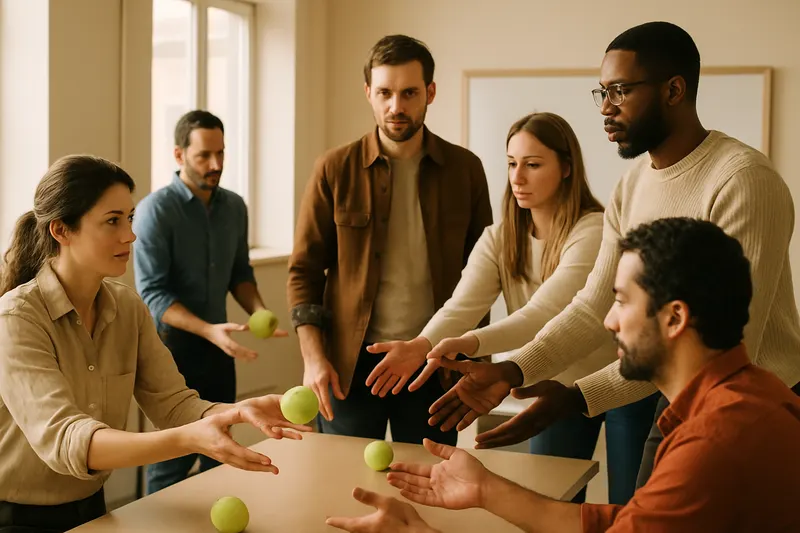
The Ball Point Game is an agile game that allows teams to discover continuous improvement by handling balls. Participants must circulate as many balls as possible while adhering to specific rules, over several iterations. This game promotes understanding of flows, dependencies, and encourages inter-team collaboration.
Walkthrough
- 1
Introduction and Setup
10 minStart by explaining the objectives of the game: to improve collaboration and understand workflows. Divide participants into teams of 6 to 8 people and distribute the balls and containers. Ensure each team has space to move and a board to note their estimates and results.
Tip — Use a visible timer for everyone to manage time and energise the activity.
- 2
Explanation of the Rules
5 minPresent the rules of the game: each ball must be touched by all members, not passed to a direct neighbour, and must return to its starting point. Explain that each iteration lasts 2 minutes, followed by a 2-minute retrospective.
Tip — Display the rules on a visible support so participants can easily refer to them.
- 3
First Iteration
6 minAsk teams to prepare their strategy for 2 minutes, then launch the first iteration. At the end, each team notes the number of balls passed and discusses possible improvements for 2 minutes.
Tip — Encourage teams to experiment with different strategies to maximise the number of balls processed.
- 4
Subsequent Iterations
20 minRepeat the cycle of preparation, execution, and retrospective for 3 more iterations. Teams should adjust their strategies each round to improve their performance.
Tip — Observe the teams and note examples of good practices to share during the debrief.
- 5
Introduction of the Challenge
5 minAfter 4 iterations, introduce the challenge: each team must manage balls of a different colour, requiring the intervention of a team member of that colour. Explain that this simulates inter-team dependencies.
Tip — Prepare concrete examples to illustrate how to manage balls of different colours.
- 6
Iterations with Challenge
15 minLaunch 3 new iterations incorporating the challenge. Teams must now collaborate with others to succeed. Each iteration is followed by a 3-minute retrospective.
Tip — Encourage teams to share their dependency management strategies during retrospectives.
- 7
Final Retrospective
15 minOrganise a retrospective in a 1-2-4-All format: individual reflection, sharing in pairs, then in groups of four, before concluding in plenary. Ask questions to explore what has been learned and what could be improved.
Tip — Use debriefing cards to stimulate reflection and discussion.
Variants
- Add additional rules to simulate resource constraints.
- Reduce the iteration time to increase pressure and adaptability.
- Integrate specific roles within teams to diversify responsibilities.
Debrief guide
- What did you observe about how your team collaborated?
- Which adjustments had the most impact on your performance?
- How did you manage dependencies with other teams?
- What lessons on continuous improvement can you apply to your daily work?
- How did the team dynamics evolve over the iterations?
- What obstacles did you encounter and how did you overcome them?
- What new strategies would you like to try in the future?