Barnga
Experience cultural shock when everyone believes they are playing by the same rules… without being able to explain them.
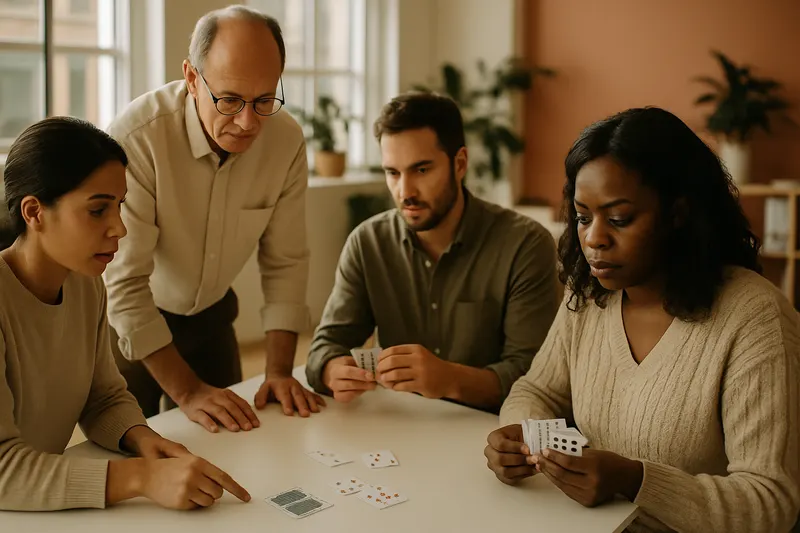
Barnga is an intercultural simulation created by Sivasailam 'Thiagi' Thiagarajan. Participants learn, at tables, a simple card game from a rules sheet, and then play in complete silence. In each round, winners and losers change tables, unaware that the rules vary slightly from table to table: different trump cards, different values for aces. The game concretely brings to light implicit assumptions, misunderstandings, adaptation to a new team, and potential tensions during an organisational merger.
Walkthrough
- 1
Set up the tables and frame the experience
5 à 10 minDivide participants into several balanced tables, ideally with enough players to allow for table changes after each round. Say: 'You will learn a small card game, and then we will play several rounds with an important constraint. The goal is not to be good at cards, but to experience a situation.' Do not reveal that the rules differ between tables. Just ensure that everyone is seated, can see the cards, and has space to play.
Tip — Present the activity as a mundane card game: the less you dramatise the framing, the more impactful the discovery of rule discrepancies will be during the debrief.
- 2
Distribute the rules and have each table learn
8 à 12 minGive each table a rules sheet for a simple card game, prepared in advance or from the official Barnga materials. The sheets should appear identical in form but contain slight variations depending on the tables, particularly regarding trump cards and the value of aces. Say: 'Read together, practice, and ensure everyone at your table understands how to play. You can talk freely during this phase.' Circulate to check that players are genuinely practicing and not just reading.
Tip — Avoid answering substantive questions about the rules: refer them back to their table sheet, so each group anchors its own version as 'the correct one.'
- 3
Remove the rules and announce silence
3 à 5 minCollect all the rules sheets before starting the official rounds. Announce clearly: 'From now on, the game will be played in complete silence. No spoken or written words are allowed. Gestures, expressions, and drawings are permitted.' Specify that participants must continue to play to the best of their ability, even in the event of disagreement. This constraint makes interpretations, implicit assumptions, and adaptation strategies visible.
Tip — Be very firm about the absence of words: silence is the heart of the setup, as it prevents players from resolving the issue through simple explanation.
- 4
Conduct the first round at fixed tables
5 à 8 minStart the first round with the original groups, each applying the rules learned from their sheet. Say only: 'Play now in silence until I stop you. At the end, identify at your table who won and who lost.' Observe behaviours: confidence, hesitation, watching others, non-verbal disputes. This round solidifies the local norm of each table before the movements.
Tip — Discreetly note one or two strong scenes from each table: they will serve you later to prompt the debrief without accusing participants.
- 5
Organise the table changes
3 à 5 minAt the end of the round, ask each table to identify its winners and losers according to the rules it applies. Have winners and losers change tables, following a simple rotation that you announce verbally before they move, for example, winners to a neighbouring table and losers to another. Remind them: 'Silence continues, you cannot explain the rules with words.' The newcomers then discover practices they believe to be incorrect, without knowing that the rules are not the same.
Tip — Keep a smooth and quick rotation: if participants have too much time between rounds, they may rationalise or circumvent the constraint.
- 6
Chain several rounds in silence
15 à 25 minConduct several successive rounds, repeating the same principle: silent play, identification of winners and losers, then table changes. Never confirm which rule is correct, even if participants look to you for validation. Only encourage the continuation of the game through neutral gestures: picking up cards, restarting, pointing to the silence. The tensions, compromises, imitations, and renunciations constitute the main material for learning.
Tip — If a table gets stuck, intervene only on the process: 'Continue without talking, find a way to move forward,' without arbitrating the content of the rules.
- 7
Reveal the mechanism and lead the debrief
15 à 25 minStop the game, allow the group to breathe, and permit speaking again. First, ask what happened before revealing that the tables had received slightly different rules, particularly regarding trump cards and the value of aces. Say: 'No one had all the information, yet everyone often acted as if their rule was obvious.' Then connect the experience to real situations: joining a team, expatriation, mergers, collaboration between departments or organisations.
Tip — Start with emotions and observations before analysis: if you reveal the 'moral' too quickly, you lose the richness of the contradictory experiences.
Variants
- Use Barnga for the integration of newcomers: after the general debrief, ask participants to identify the unwritten rules of their own team and choose those that deserve to be made explicit.
- Direct the simulation towards an organisational merger: assign different team or site identities to the tables, then debrief on local norms, power dynamics, and compromises after the merger.
- Short version: reduce the learning time and play only a few rounds, while absolutely maintaining silence, the removal of rules, and the table changes, which are the essential levers of the game.
- Avoid the remote version unless very well prepared: Barnga relies on card manipulation, non-verbal signals, and movements between tables, making it primarily a face-to-face format.
Debrief guide
- When did you start to feel that something was not working as expected?
- What did you assume about the other players when they did not play as you expected?
- How did you try to enforce your rules or understand those of others without speaking?
- Who adapted, who resisted, and what influenced these reactions?
- In your professional context, where are there implicit rules that newcomers do not know?
- What does this experience teach us about team mergers, intercultural collaborations, or organisational changes?
- What concrete practices could make our implicit rules more visible and more discussable?