Buy a Feature
Prioritise through fictitious purchasing to reveal what truly matters and why.
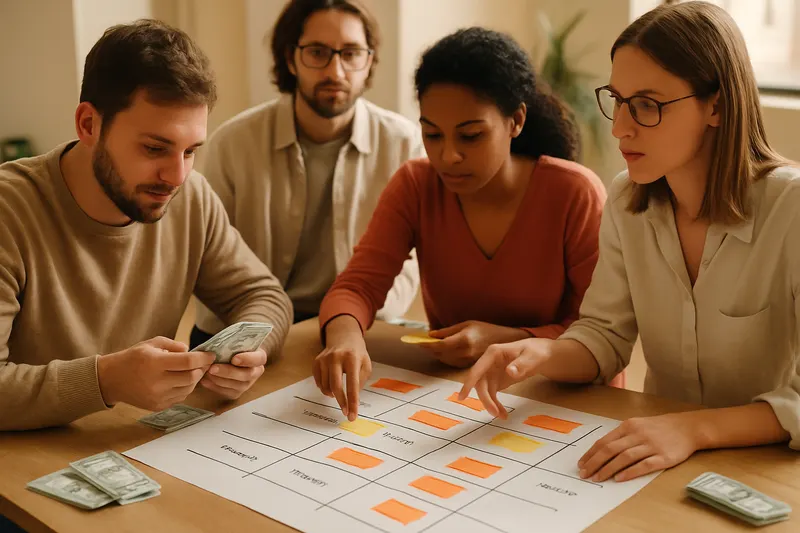
Buy a Feature is an innovation game by Luke Hohmann, derived from Innovation Games. It is designed to prioritise a list of potential features by clients or stakeholders, with each feature having a price that reflects its cost. Participants receive fictitious currency that is insufficient to buy everything: the group can only fund about one third to half of the list. The heart of the game is not just the final ranking, but the negotiations and arguments that reveal the true criteria of value.
Walkthrough
- 1
Prepare the list and prices
15 to 30 min before the workshopThe facilitator prepares a clear list of possible features, each associated with a price reflecting its cost. They ensure that the total amount of fictitious currency to be distributed will only allow for a portion of the list to be purchased, about one third to half. They also plan for a few features that are more expensive than a single player's budget, to create a need for negotiation. The goal is to avoid a simple individual vote and provoke reasoned trade-offs.
Tip — Test the list before the workshop: if each participant can buy their preferred choice alone, the game loses much of its power.
- 2
Set the framework and intention
5 to 10 minThe facilitator welcomes the 4 to 8 participants and announces: "You will buy the features that seem most important to you, with a limited budget. Not everything can be funded." They clarify that the prices represent a relative cost and that the exercise serves to understand priorities and their reasons. They emphasise that the discussions are as important as the final outcome. Participants can ask their clarification questions before starting.
Tip — Explicitly state that this is not a persuasion contest: we are looking for the best trade-offs, not the best salesperson.
- 3
Present the features and costs
10 to 15 minThe facilitator goes through the list of features, giving each its name, intention, and price. They only answer clarification questions, without defending any option or steering choices. They remind: "Each price reflects a cost; your collective budget will not be enough to buy everything." Participants can ask for details to compare options. This step ensures that the negotiation will be based on a shared understanding.
Tip — Maintain a steady pace: over-explaining a feature can make it artificially more attractive than others.
- 4
Distribute the fictitious currency
5 minThe facilitator distributes to each player an identical or pre-defined amount of fictitious currency, according to the prepared setup. They remind that the total distributed will only allow for the purchase of about one third to half of the proposed features. They point out that some features exceed a single player's budget: they will therefore require pooling. Participants check their budget and become aware of the constraint. The productive tension comes from this assumed scarcity.
Tip — Make the money tangible, even with simple tokens: handling it makes the budget limit much more concrete.
- 5
Individual purchase and initial intentions
5 to 10 minThe facilitator allows a short reflection time: "Identify what you would buy if you were deciding alone, and why." Participants examine the features, compare prices, and prepare their arguments. They can mentally or physically place their budget without yet concluding a final purchase, depending on the chosen format. The facilitator observes hesitations, spontaneous groupings, and initial justifications. This moment brings individual priorities to the surface before collective negotiation.
Tip — Ask participants to note their main reason before speaking: this prevents them from changing their minds too quickly under influence.
- 6
Negotiate and pool resources
15 to 35 minThe facilitator opens the negotiation: "You can pool your money to buy features, especially those that are too expensive for one person. All purchases must be funded at the stated price." Participants discuss, defend their choices, seek alliances, and negotiate between perceived value and cost. The facilitator does not intervene in the substance; they mainly note the arguments exchanged, compromises, and disagreements. The richness of the exercise comes from these conversations, often more revealing than the final list.
Tip — Note the exact wording of strong arguments: they will be valuable for the debrief and prevent reducing the outcome to a simple ranking.
- 7
Close purchases and make the result visible
5 to 10 minThe facilitator announces the approaching end: "Finalise your purchases; only fully funded features will be retained." Participants definitively allocate the fictitious currency to the chosen features. The facilitator displays or summarises the prioritisation achieved: features bought, not bought, and possibly those that failed due to lack of agreement or budget. They do not conclude too quickly on the absolute value of the result. They prepare the transition to the reasons and lessons learned.
Tip — Keep the unpurchased features visible: the trade-offs are often as instructive as the chosen ones.
- 8
Debrief the reasons and learnings
10 to 20 minThe facilitator refocuses the group: "We will now analyse what guided your decisions, not just what was purchased." They read back some observed arguments, without judgement, and ask participants to specify their criteria for choice. The group identifies the priority features, the reasons for their importance, and points of tension. The facilitator clearly distinguishes the result of prioritisation from the lessons on needs, risks, costs, or expectations. The useful output is a shared understanding of the trade-offs.
Tip — Start by asking why a feature was funded, then why others were abandoned: the order facilitates a less defensive discussion.
Variants
- Mixed stakeholder variant: bring together different profiles in the same group to observe negotiations between viewpoints. The facilitator ensures to balance speaking time to prevent one role from dominating the prioritisation.
- Client variant: use the game with representative clients or users to understand their reasons for purchasing. The debrief should emphasise the wording used by participants, as it sheds light on their needs.
- Remote variant: use a collaborative board with the list of features, their prices, and digital tokens of fictitious currency. Participants move their tokens live and negotiate via video conference, while the facilitator notes the arguments in a separate area.
- Two-group variant: have two groups of 4 to 8 participants play with the same list, then compare the features bought and the reasons given. The differences between groups become the main material for the debrief.
Debrief guide
- Which features did you want to fund first, and what does that reveal about your real priorities?
- What arguments caused some participants to change their minds, even partially?
- Which features required pooling, and what does that say about their perceived value?
- Which trade-offs were the most difficult, and why?
- Did the price of the features change your perception of their importance?
- What disagreements remain open after the game, and what information is missing to address them?
- What should we remember for the next prioritisation decision?