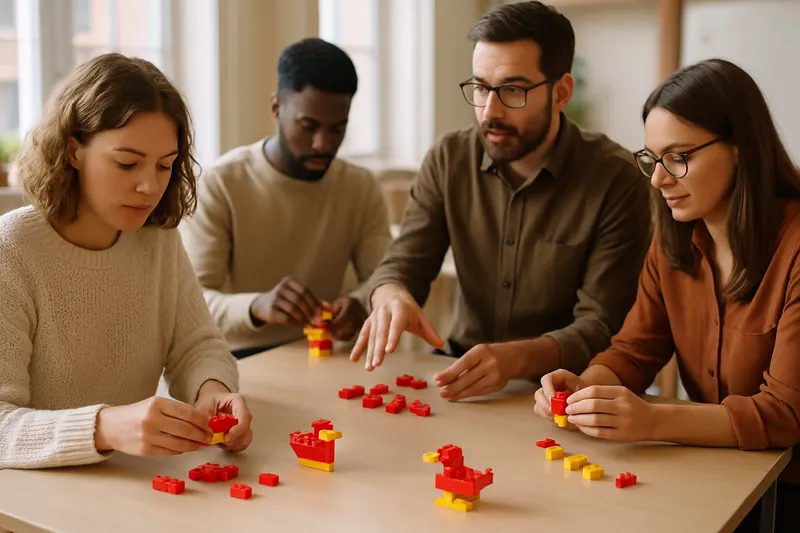
The LEGO Duck (Duck Challenge)
With 6 identical bricks, reveal in 10 minutes the power of different interpretations.
The LEGO Duck, often referred to as the Duck Challenge, is a warm-up commonly used at the beginning of workshops, particularly in LEGO Serious Play practices. Each participant receives the same small bag of 6 yellow and red bricks and builds a duck in about 60 seconds. Comparing the creations immediately shows that, with identical instructions and resources, the responses are all different. The game serves to establish a creative atmosphere, to experience the idea that there is not just one correct answer, and to remind participants that they can think with their hands.
Walkthrough
- 1
Set the framework and distribute the bricks
2 minThe facilitator welcomes the group and announces a short, concrete warm-up with no performance stakes. They say: "You will all receive exactly the same 6 yellow and red bricks. Keep them in front of you, but do not start just yet." Each participant receives an identical bag and checks that they have 6 bricks. The goal is to create a strictly common starting situation so that the differences observed later come from interpretations and not from the materials.
Tip — Distribute the bags closed or turned upside down and ask participants to wait for the go signal: this prevents some from starting to think or assemble before others.
- 2
Give the building instruction
1 minThe facilitator gives a deliberately simple instruction: "With these 6 bricks, build a duck. You have about 60 seconds. Use all the bricks and work alone, without looking at what your neighbour is doing." They clarify that there is no model to replicate and no right or wrong answer expected. Participants listen and only ask questions for clarification if necessary. This step prepares the key experience: the same instruction can open several legitimate paths.
Tip — Never show an example of a duck before the construction: a model, even a quick one, would strongly standardise the productions.
- 3
Build in 60 seconds
1 minThe facilitator starts the timer and says: "Go, build your duck now." Participants manipulate the 6 bricks and assemble their version in silence or in a light atmosphere. With 10 seconds left, the facilitator announces: "There are a few seconds left, finish your idea." After about 60 seconds, they clearly say: "Stop, place your duck in front of you." The short time encourages intuition, limits over-analysis, and brings forth thinking through hands.
Tip — Stick to the time limit: if you give too much time, some will try to optimise or compare, which reduces the spontaneity of the exercise.
- 4
Observe the ducks without judging
2 minThe facilitator invites the group to look at the creations: "Hold your duck up slightly or place it in the centre of the table so everyone can see it." Participants observe the shapes, orientations, proportions, and assembly choices. The facilitator emphasises: "We all had the same 6 bricks, the same instruction, and the same time. Yet, no duck is exactly identical." The aim is not to elect the most beautiful duck, but to make the diversity of responses visible.
Tip — Gently prohibit rankings like 'the best' or 'the worst': replace them with 'different', 'surprising', 'another interpretation of the instruction'.
- 5
Verbalise the choices
3 minThe facilitator asks a few volunteers: "What makes your construction a duck for you?" Participants explain their references: beak, body, tail, legs, posture, or intention. The facilitator reformulates without correcting: "So, for you, the main sign of the duck is..." This short verbalisation shows that each person has selected certain criteria and left others aside. It connects the constructed object to each person's mental representations.
Tip — Encourage discussion about ducks that are very different from each other: this enriches awareness more than a series of similar constructions.
- 6
Link the experience to the workshop
3 minThe facilitator concludes the exercise by linking the observation to the upcoming collective work. They say: "What we just experienced in miniature happens in all workshops: the same instruction, the same information, but different understandings." They remind participants of the lessons: there is not just one correct answer, everyone interprets the same request in their own way, we think with our hands, and the diversity of viewpoints is a richness. Participants retain this experience as a common reference. The exercise thus serves as an entry point to listening, exploration, and creativity.
Tip — Anchor a short phrase that you can reuse later: 'Let’s remember the ducks: same start, multiple useful answers.'
Variants
- Very short version: limit sharing to a collective observation and a single debrief question, for example, 'What do you notice?'. This variant takes 5 minutes and works well as an opening icebreaker.
- Large group version: have participants raise their ducks simultaneously, then ask them to find two ducks around them that are very different from their own. The debrief is then conducted in plenary with a few contrasting examples.
- Collaboration-focused version: after individual construction, pair participants and ask them to compare what they considered essential for recognising a duck. This variant enhances listening to implicit criteria.
- Remote version not recommended unless each participant has the same bag of 6 yellow and red bricks in advance. In this case, start the 60 seconds via videoconference, then have participants show their ducks to the camera or in a shared photo.
Debrief guide
- What did you notice when seeing all the ducks built with the same 6 bricks?
- What guided your choices during the 60 seconds: a mental image, a particular piece, an intuition, something else?
- At what moment did you decide that your construction resembled a duck sufficiently?
- What does this exercise teach us about how each person understands the same instruction?
- In our collective work, where might we mistakenly believe that everyone understood the same thing?
- How can we use the diversity of interpretations as a resource rather than a problem?