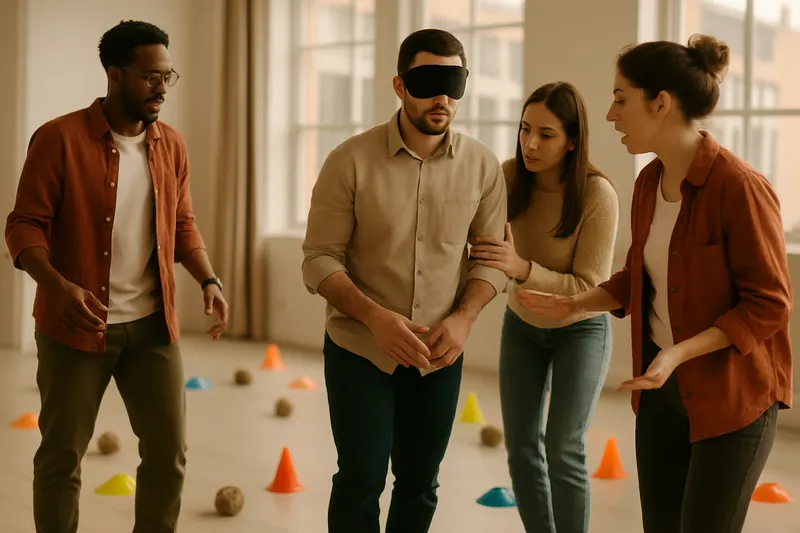
The Minefield
Guide a blindfolded partner through obstacles to experience trust, precision, and communication amidst noise.
The Minefield is a trust-building activity in pairs, conducted in person, for 4 to 30 participants. A designated area is scattered with obstacles called 'mines': cups, balls, leaves, or lightweight objects. One person crosses with their eyes blindfolded while their partner, positioned outside the area, guides them solely by voice. The game highlights the challenge of giving precise instructions in a noisy environment, especially when multiple pairs are crossing simultaneously.
Walkthrough
- 1
Prepare the area and secure the space
5 to 8 minThe facilitator clearly marks the play area with tape, chairs, or visible markers. They place lightweight obstacles, called mines, such as cups, balls, or leaves, on the ground, leaving possible passages. They ensure that no object can cause injury, slip dangerously, or cause a strong trip. They announce: 'Here, the goal is not speed, but the quality of guidance and trust.' Participants observe the terrain without yet choosing their strategy.
Tip — Provide a clearly identifiable entrance and exit corridor: this prevents blindfolded individuals from hesitating at the first step or accidentally leaving the area.
- 2
Form pairs and set the framework
3 to 5 minThe facilitator forms pairs or allows participants to choose their partners, then asks each duo to designate a first guided person and a first guide. They clarify that the guided person will be blindfolded and must only move forward based on their partner's vocal instructions. The guide remains outside the area and does not touch their partner. They say: 'Your mission is to cross the area without touching the mines; if a mine is touched, you start again or receive the announced penalty.' The group collectively validates the chosen option before starting.
Tip — If the group is uncomfortable, choose the 'start again' option rather than a penalty: it maintains the stakes without turning the trust exercise into an anxiety-inducing competition.
- 3
Build a communication code
4 to 6 minBefore blindfolding, the facilitator gives pairs a short preparation time. They say: 'Agree on simple words for move forward, stop, turn, slow down, and signal danger.' Pairs can also define how to speak: loud voice, short phrases, repeating the name, or directional cues. The facilitator reminds them that several duos will cross simultaneously, so noise will be part of the exercise. Participants quietly test their code without entering the minefield.
Tip — Encourage guides to always use their partner's name before giving an instruction: in the noise, this helps the blindfolded person distinguish the information directed at them.
- 4
Launch the first crossing
6 to 10 minThe facilitator blindfolds the first guided individuals or checks that the blindfolds are properly positioned. The guides position themselves outside the area, in a spot where they can see the course but do not obstruct others. At the signal, several pairs start simultaneously to create noise and a real communication constraint. The facilitator monitors safety, reminds them to slow down if necessary, and applies the chosen rule in case of a touched mine: start again or receive the planned penalty. Participants continue until they cross the area.
Tip — Stay mobile around the field and intervene only for safety, not to correct instructions: communication mishaps are the raw material for the debrief.
- 5
Take a short adjustment pause
3 to 5 minWhen the first crossings are completed, the facilitator quickly gathers the pairs without yet launching the full debrief. They ask: 'What helped you? What disturbed you? What will you change in your code for the second crossing?' Participants discuss in their pairs and adjust their words, voice volume, or rhythm. The facilitator emphasizes one point: instructions must be precise enough to act upon, but simple enough to be understood under stress. This pause transforms the experience into immediate learning.
Tip — Deliberately limit this pause: if it lasts too long, participants will overthink and lose the sensory intensity of the exercise.
- 6
Reverse roles and replay
6 to 10 minThe facilitator announces the role reversal: the person who was guiding becomes the guided, and vice versa. They rearrange some mines if the course has been too memorised, without making the crossing impossible. They remind: 'Same rule: guidance is only vocal, guide outside, immediate stop if you do not feel safe.' The pairs start simultaneously again to regain the noise constraint. Each person thus experiences both positions: depending on an instruction and bearing the responsibility of guiding.
Tip — Slightly change the position of some obstacles between the two crossings: this prevents the second round from becoming a simple memory exercise.
- 7
Debrief and transfer to real situations
8 to 12 minThe facilitator gathers the group outside the field and opens a structured debrief. They start with the feelings of the guided person, then those of the guide, to bring out both responsibilities. They connect observations to learnings: precision of instructions, trust, listening, managing noise, and adapting the common code. They ask for concrete examples of work situations where one must act with partial information or in a saturated environment. The group finally formulates a communication practice to reuse.
Tip — Write on the board the words that frequently come up, such as 'stop', 'too fast', 'I couldn't hear', or 'I had trust': they make the group's communication levers visible.
Variants
- For a beginner group, have only one pair cross at a time during the first attempt, then multiple pairs simultaneously in the second round to gradually introduce noise.
- To reinforce learning, allow one minute to prepare the code before the first crossing, then prohibit any discussion during the adjustment pause except for three keywords to choose.
- To increase the difficulty level, move some obstacles closer together or ask guides to stay on one side of the area, while ensuring a safe and possible crossing.
- Observation variant: while some pairs play, others observe only the quality of vocal instructions and note effective formulations to share in the debrief.
Debrief guide
- When you were blindfolded, what gave you confidence or, conversely, made you doubt?
- Which instructions were truly actionable, and which created hesitation?
- How did the noise from other pairs change your way of speaking, listening, or deciding?
- What did you learn about the difference between giving a lot of information and giving the right information?
- In your professional situations, where do you encounter the equivalent of a 'minefield' with limited visibility?
- What simple communication code could you implement in the team to avoid misunderstandings under pressure?