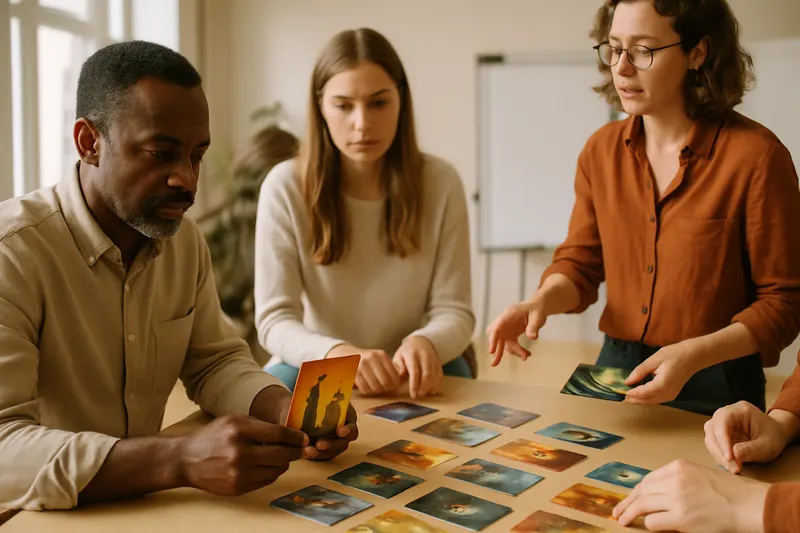
Dixit in Facilitation
Using Dixit cards to elicit feelings, feedback, and visions through metaphor.
This activity repurposes the dreamlike illustrated cards from the board game Dixit, created by Jean-Louis Roubira and published by Libellud, as a means of expression in workshops. It serves to open a team weather check, conclude a session, gather feedback, or project a shared vision. Participants choose a visible image and explain what it evokes for them in relation to the posed question. The principle is similar to photo language, with metaphorical images that facilitate sensitive expression and unleash the imagination. The original game rules are not used.
Walkthrough
- 1
Setting the Frame and Intention
3 to 5 minThe facilitator introduces the exercise as a time for expression through images, without attempting to play the original Dixit game. They say: 'We will use these cards as metaphorical supports; there are no right or wrong answers.' They clarify the purpose of the moment: weather check, conclusion, feedback, or vision. Participants listen and prepare to speak from their feelings rather than from a lengthy analysis.
Tip — Clearly announce that everyone speaks from their own interpretation of the card: this avoids debates about 'what the image really means.'
- 2
Spreading the Cards Face Up
2 to 4 minThe facilitator spreads a wide selection of Dixit cards face up on a table, on the floor, or on several accessible surfaces. They ensure that participants can move around and see the illustrations without hindrance. They do not comment on the images or suggest any interpretations. Participants freely observe the cards, in silence or relative calm, to allow the imagination to start working.
Tip — Provide more cards than participants so that the choice remains open and no one feels they are taking 'the last available card.'
- 3
Posing the Exploration Question
2 to 3 minThe facilitator poses a single, short question that is appropriate to the objective. For example: 'How do I feel this morning?', 'What do I take away from this training?', or 'What does our team look like in a year?' They ask participants to choose a card that responds to this question through association of ideas. Participants do not seek the perfect image: they take the one that attracts or questions them the most.
Tip — Write the question visibly for all; a stable formulation prevents everyone from responding to a different intention.
- 4
Choosing Your Card
3 to 7 minThe facilitator invites everyone to stand, look at the cards, and choose one. They say: 'Take the card that resonates most with your response, even if you don't yet know exactly why.' Participants take their card and return to their place without starting the explanation immediately. If two people want the same card, the facilitator allows sharing of the same image or suggests that they both express themselves based on it.
Tip — Allow a real moment of silence: the richest choices often come after an initial hesitation.
- 5
Sharing in a Round of Speaking
7 to 20 minThe facilitator initiates a roundtable discussion and gives a simple speaking guideline: 'Show your card, then say what it evokes for you in relation to the question.' Each participant explains their metaphor, feeling, or message to the group. Others listen without interpreting on their behalf and without correcting. The facilitator regulates the time so that everyone can speak, especially in larger groups.
Tip — For a group of 15 to 20 people, ask for short shares focusing on one strong idea; otherwise, the exercise quickly shifts into lengthy discussion.
- 6
Eliciting Common Patterns
5 to 8 minAfter the shares, the facilitator invites the group to take a step back. They ask: 'What common themes do you hear in what has just been shared? What surprises you?' Participants identify themes, tensions, aspirations, or weak signals. The facilitator may note the visible keywords for everyone to transform the images into usable material.
Tip — Note the participants' words, not your expert reformulations: this reinforces ownership and limits interpretation biases.
- 7
Concluding and Linking to Next Steps
3 to 5 minThe facilitator concludes by linking the expressions to the context of the workshop. They might say: 'What we have just heard will help us adjust the next steps / conclude the day / nourish our vision.' Participants either return the cards or keep them for a moment if an individual trace is useful. The facilitator thanks the group for their quality of listening and reminds them that the cards are a support, not a diagnosis.
Tip — Finish with an action phrase if the exercise serves a decision: 'Based on these shares, what point should we keep in mind for the future?'
Variants
- Opening weather check: each participant chooses a card that represents their current state of mind and shares in a maximum of one minute. This variant works well at the beginning of the day or before a demanding collective task.
- Training conclusion: everyone chooses a card that symbolizes what they take away, what they carry with them, or what has changed for them. The facilitator can note recurring learnings to conclude the session.
- Team vision: the group responds to the question 'Our team in a year' by individually choosing a card, then grouping the images by themes. The resulting clusters serve as a basis for a discussion on ambitions and conditions for success.
- Collective feedback: after a workshop or project, each participant chooses a card to express what worked well, what was difficult, or what deserves attention. The facilitator can conduct two separate rounds if the group needs to distinguish successes from irritants.
Debrief guide
- What did your choice of card allow you to express that you might not have articulated otherwise?
- What common themes emerge from the cards and shared narratives?
- Which card or statement impacted you the most, and why?
- What do these images reveal about our collective mindset today?
- If we were to transform these shares into a concrete action, which would be a priority?
- What remains unclear, sensitive, or needs further exploration after this round of expression?