Draw Toast
Visualising our mental models to better understand a system and build a shared representation.
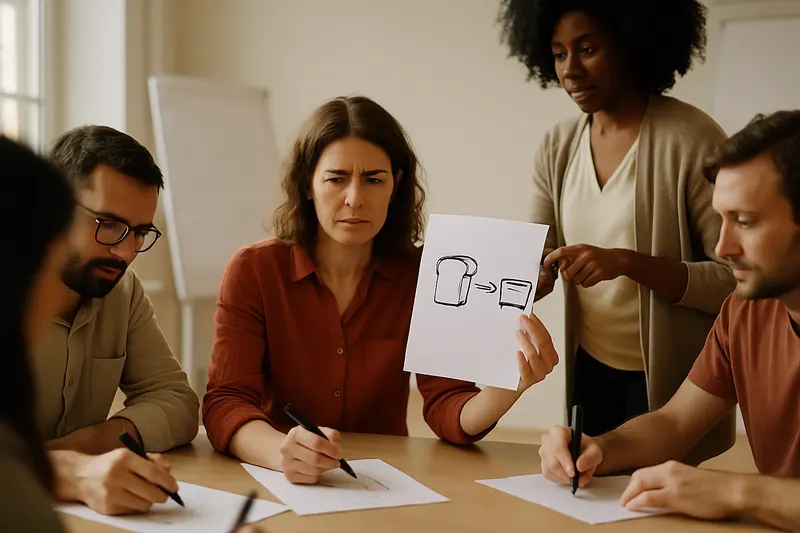
Draw Toast is a systemic thinking workshop designed by Tom Wujec. Participants first draw, without words, how to make toast, then observe the diversity of the models produced. The game highlights the nodes, which are the objects or steps, and the links, often represented by arrows. It then allows the same approach to be applied to a real organisational problem to produce a shared model.
Walkthrough
- 1
Framing the intention and the rules of the game
5 minThe facilitator presents the objective: "We will see how each person represents a simple system, then use this method on a real topic." They specify that the first topic is deliberately mundane: making toast, that is, toasted bread. They announce the three principles: draw without words, represent steps or objects, then connect what depends on what. Participants must understand that it is not about drawing well, but about making a mental model visible.
Tip — Immediately reassure those who say they cannot draw: prohibit aesthetic judgment and value pictograms, simple lines, and arrows.
- 2
Individually draw how to make toast
7 to 10 minThe facilitator hands out a sheet to each participant and gives the instruction: "Draw, without using words, how to make toast. You can use objects, steps, arrows, or any other visual symbol." Everyone works alone, in silence, without looking at others' sheets. The absence of words is important: it forces participants to choose what really matters in the system. The facilitator circulates only to remind the rule if words appear, without suggesting content.
Tip — If someone gets stuck, simply say: "Start with a first object or action, then add what comes before or after." Do not help further, otherwise you influence the model.
- 3
Compare the drawings and name nodes and links
8 to 12 minParticipants display or place their drawings visibly, then circulate to observe them. The facilitator asks: "What is similar? What differs? Where do you see steps, objects, arrows?" They introduce the vocabulary: nodes are the objects or steps, links are the relationships between them, often represented by arrows. The group observes that, for a simple task, mental models can be very different.
Tip — Encourage observation of the differences without seeking the best drawing: some models will be linear, others more detailed or circular, and this is precisely the useful material.
- 4
Redo the toast with one node per card
8 to 12 minThe facilitator distributes post-its or cards and gives the new instruction: "Represent again how to make toast, but this time with one node per card: one object or step per card." Participants can add arrows or organise the cards to show the links. This constraint makes the model modular: elements can be moved, grouped, removed, or completed. Each person thus reconstructs their system in a more explicit and easier-to-reorganise way.
Tip — Emphasise "one node per card" before starting: this is the rule that makes collective merging possible later.
- 5
Merge a common model in silence
10 to 15 minThe facilitator gathers the group around a wall, table, or board and announces: "Now, you will merge all your cards into a single common model, in silence. You can move, group, bring closer, or connect the cards, but without speaking." Participants build a shared representation from their nodes and links. The silence prevents the fastest or most influential individuals from imposing their logic. The facilitator observes the movements, hesitations, and convergences without intervening in the content.
Tip — Prepare a large space: if the support is too small, the group stacks the cards too early and loses the richness of the differences.
- 6
Apply the method to a real organisational problem
15 to 25 minThe facilitator chooses a real problem from the organisation with the group, formulated as a system to understand. They give the instruction: "As with the toast, identify the important nodes — actors, steps, objects, events — then make the links between them visible." Participants work on cards or post-its, with one node per card, so they can reorganise the model. The group can then merge the cards to produce a common representation of the problem. The goal is not yet to solve, but to better see what makes up the system.
Tip — Choose a topic concrete enough to be drawn: avoid abstract formulations, and rephrase as "how does... work?" rather than a debate of opinions.
- 7
Debrief the learnings and next steps
7 to 12 minThe facilitator brings the group back to the process experienced: "What have we made visible that we did not see at the start?" They distinguish the contents of the model and the way the group constructed it. Participants identify gaps in representation, points of consensus, and areas still unclear. The facilitator concludes by asking which cards, links, or questions deserve to be explored further after the workshop. The expected outcome is a better shared understanding of the system, not a comprehensive solution.
Tip — Photograph the models at each stage: the individual drawing, the cards, then the common model tell the story of the evolution of collective understanding.
Variants
- In a short version, limit the workshop to toast: individual drawing, comparison, then reconstruction with one node per card. This variant serves as a quick introduction to systemic thinking.
- In a more in-depth version, dedicate most of the time to the real problem of the organisation after the toast exercise. The toast then becomes a training before tackling a complex subject.
- Remotely, use a collaborative whiteboard: each participant first draws in a personal area, then creates digital cards with one node per card. The collective merging then takes place in silence, by moving the cards into a common area.
- For a large group, form several sub-groups, each producing a common model, then compare the models obtained. This variant highlights the differences in interpretation between teams or professions.
Debrief guide
- What did you discover about your own way of representing a simple system?
- What significant differences did you see between the individual models?
- Which nodes or links were obvious to some and absent for others?
- What did moving to cards make possible compared to drawing on paper?
- How did silence influence the construction of the common model?
- On the real problem, which areas of the system remain unclear or controversial?
- What action or investigation would be useful now that the system is more visible?