Elevator Pitch (the Geoffrey Moore template)
Align a product vision in 60 seconds using Geoffrey Moore's positioning template.
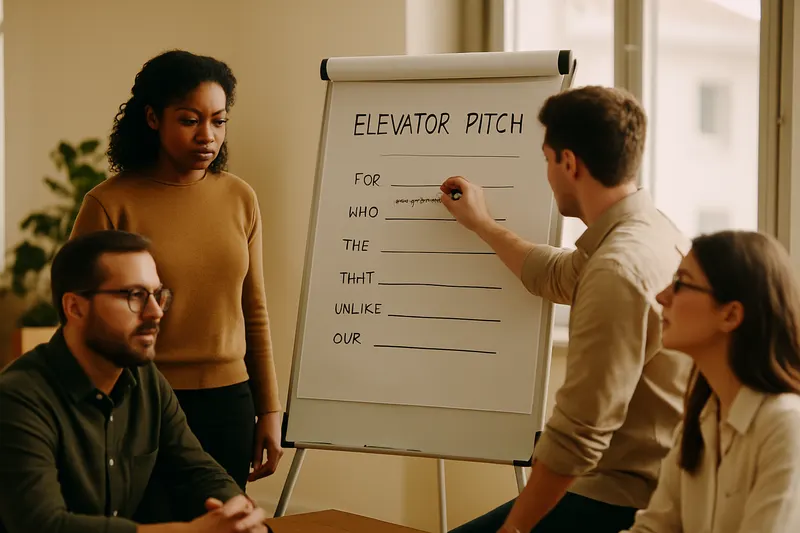
Elevator Pitch is a product vision formulation workshop based on Geoffrey Moore's positioning template from Crossing the Chasm. It serves to clarify for whom the product exists, what need it addresses, what category it occupies, what benefit it promises, and how it differentiates itself. Participants first draft several versions in small groups, then compare them to converge on a common formulation. The expected outcome is a clear, shareable pitch that can be delivered in 30 to 60 seconds.
Walkthrough
- 1
Frame the objective and level of expectation
5 minThe facilitator opens by explaining that the goal is not to produce a slogan, but a positioning formulation that can be used to align the team. They say: "In the end, we want a sentence that everyone can say in 30 to 60 seconds, without notes, that clearly describes our product." They clarify that disagreements are expected, as they reveal ambiguities in vision. Participants listen, ask their questions for understanding, and agree to work on an imperfect version before seeking the final version.
Tip — Announce from the start that the formulation will be tested aloud: this prevents overly long, abstract sentences or those written solely to be read.
- 2
Present the Geoffrey Moore template
7 minThe facilitator displays the complete template and reads it slowly: "FOR target customer, WHO need or opportunity, product name IS A product category THAT key benefit, reason to buy. DIFFERENT FROM main alternative, OUR PRODUCT differentiating element." They explain that each blank forces a choice: target, need, category, benefit, alternative, and differentiation. They ask participants to note any vague or debatable words. The group checks that they understand each part before moving on to drafting.
Tip — Do not let the 'product category' field become a list of features: ask, 'In what mental box would the customer place us?'
- 3
Form sub-groups and clarify the product being addressed
5 minThe facilitator forms balanced sub-groups, ideally mixing business, product, technical, sales, or support profiles if these roles are present. They remind: "Each group fills in the same template for the same product, using your words and current assumptions." They check that everyone is indeed discussing the same product scope to avoid pitches about different objects. Participants split up, open a shared document or sheet, and appoint someone to write the group's proposal.
Tip — If the product scope is contested, make a temporary decision with a visible sentence for all; otherwise, the workshop becomes a scope debate.
- 4
Draft a first version in sub-groups
12 minEach sub-group fills in all the blanks of the template: target customer, need or opportunity, product name, product category, key benefit or reason to buy, main alternative, and differentiating element. The facilitator circulates and prompts with short questions: "Who pays or decides? What problem makes the purchase urgent? What alternatives exist today?" Participants must produce a complete formulation, even if it still seems awkward. The goal is to make assumptions visible rather than to immediately find the best sentence.
Tip — When a group gets stuck, ask them to fill in the blanks first with simple words, then refine the sentence only at the end.
- 5
Read the pitches aloud
8 minThe facilitator invites each sub-group to read their version aloud, without explaining it beforehand or defending it afterwards. They remind: "The pitch should fit within 30 to 60 seconds; if you exceed this, it's a signal that the formulation needs to be tightened." Other participants listen and note what is clear, what is missing, and what differs from their own understanding. After each reading, the facilitator displays or collects the version to compare them side by side. This step transforms implicit opinions into observable formulations.
Tip — Time the readings kindly: the reading time is an excellent indicator of complexity, without needing to critique the content.
- 6
Compare versions and identify gaps
10 minThe facilitator guides a structured comparison field by field: target, need, category, benefit, alternative, differentiation. They ask: "Where are we aligned? Where do we use different words to say the same thing? Where do we have real disagreements?" Participants identify strong formulations and ambiguous areas, without rewriting everything yet. The facilitator notes decisions and points to arbitrate. The goal is to distinguish style preferences from positioning divergences.
Tip — Address one field at a time; if you debate target, benefit, and differentiation simultaneously, convergence becomes confusing.
- 7
Merge into a common formulation
10 minBased on the best proposals, the facilitator works with the group to create a merged version of the complete template. They say: "We are looking for a sentence that is good enough to be used, not a perfect sentence for all time." Participants suggest precise adjustments, word by word, ensuring that each part of the template remains present. Once the version is stabilised, someone reads it aloud and the group checks that it fits within 30 to 60 seconds. The facilitator finalises the common version and notes questions that require external data.
Tip — Keep the original template visible during the merging: this prevents the alternative or differentiation from being omitted, which is often forgotten when the sentence becomes more marketing-oriented.
- 8
Close and decide on usage
5 minThe facilitator concludes by asking where this formulation will be used: product page, internal brief, onboarding, sales support, backlog, or team communication. They remind that the pitch is a tool for alignment and that it will need to evolve if the target, need, or differentiation changes. Participants validate who will keep the final version and how absentees will be informed. The facilitator thanks the group and highlights the decisions made as well as the open questions. The closure transforms the sentence into a living artifact rather than a simple workshop exercise.
Tip — End with a final reading by someone who did not draft the version: if they say it naturally, the pitch is likely shareable.
Variants
- Short version: the facilitator prepares the template on a single page, limits drafting in sub-groups to 8 minutes, and only merges a provisional version. This variant is suitable when the goal is to reveal gaps rather than finalise the formulation.
- In-depth version: each sub-group drafts two pitches, one aimed at the decision-making customer and the other aimed at the user. The comparison allows us to see if the product meets different needs depending on the audience.
- Remote version: use a collaborative document or online whiteboard with a template for each sub-group. Readings are done via video conference, timed, and then the merging is done live in a common area visible to all.
- Multi-product version: assign a different product or offering to each sub-group, then compare the pitches to clarify the portfolio. This variant is useful for identifying positioning overlaps between offerings.
Debrief guide
- What have we learned about our target customer by comparing the different formulations?
- Which field of the template generated the most debate, and what does this debate reveal about our product alignment?
- Does our key benefit provide a real reason to buy, or does it merely describe what the product does?
- Is the main alternative one that the customer actually considers, or one that we prefer to combat?
- Is our differentiating element credible, understandable, and important to the target?
- If a new team member read this pitch, what product decisions would they understand better?
- What assumptions do we need to validate with the market or users before considering this pitch robust?