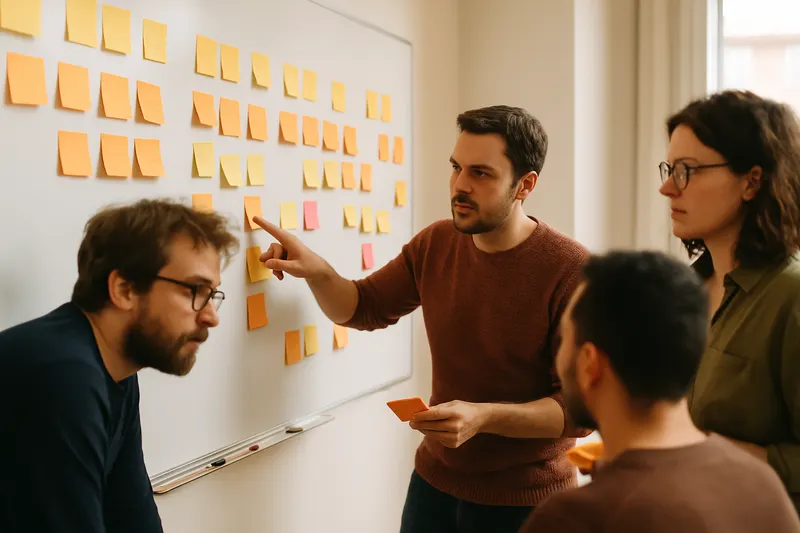
Event Storming
Model your business domain with Event Storming for optimal alignment.
Event Storming is a collaborative method that allows for the visualisation and understanding of a complex business domain through events. Using post-its, this technique facilitates alignment between developers, Product Owners, and stakeholders, particularly within the framework of Domain Driven Design (DDD). It encourages a shared and common vision of the product and business processes.
Walkthrough
- 1
Introduction and objectives
10 minThe facilitator introduces the session by explaining the objective of Event Storming: 'We will explore our business domain to better understand and align our visions using the Event Storming method.' They emphasise the importance of collaboration and open-mindedness during the workshop. Participants are invited to ask questions to clarify the objective.
Tip — Use a concrete example to illustrate the importance of alignment in a past project.
- 2
Identification of events
30 minParticipants write key events of the business domain on orange post-its, using the past tense verb format (e.g., 'Order placed'). The facilitator encourages everyone to think of all the steps in the process without self-censorship. The post-its are placed on a wall or board, forming a timeline of events.
Tip — Encourage participants to write their ideas individually before sharing to stimulate diverse perspectives.
- 3
Organisation and discussion
20 minThe facilitator guides the group to organise the events in chronological order and discusses the links between them. They ask questions to clarify the events and their sequence, ensuring that all participants understand the process. This step helps identify gaps or inconsistencies in the understanding of the domain.
Tip — Use open-ended questions to stimulate reflection and exchange, such as 'What happens after this event?'.
- 4
Identification of actors and systems
20 minParticipants identify the actors and systems involved in each event, adding post-its of different colours (e.g., actors in pink, systems in blue). The facilitator encourages thinking about all the people and systems that interact with each event, thereby enriching the understanding of the domain.
Tip — Encourage participants to focus first on the main actors before moving on to systems to avoid information overload.
- 5
Synthesis and adjustments
20 minThe group steps back to examine the overall flow of events, actors, and systems. The facilitator asks participants to identify areas of uncertainty or potential improvements. Together, they adjust the post-its to better reflect the reality of the business domain.
Tip — Suggest taking photos at this stage to document the progress and adjustments made.
- 6
Conclusion and next steps
10 minThe facilitator concludes the session by summarising the key learnings and discussing the next steps. They ask participants to share their impressions of the workshop and the actions to be taken to deepen the modelling or address the identified issues.
Tip — Encourage participants to propose a concrete action to be taken in the week following the workshop.
Variants
- Incorporate coloured post-its to mark uncertainties or assumptions to verify.
- Add a brainstorming step to imagine desired future events in the domain.
- Use a digital format with online collaborative tools for distributed teams.
Debrief guide
- What have you learned about our business domain that you did not know before?
- Which events sparked the most discussion and why?
- How has this workshop changed your perception of the current process?
- What gaps or inconsistencies have you identified in our model?
- What concrete actions can we take to improve our understanding of the domain?
- What obstacles did we encounter and how could we overcome them?
- How could this workshop be improved for even greater effectiveness?