The Biodiversity Fresco
Understand as a team the erosion of biodiversity, its causes, impacts, and levers for action.
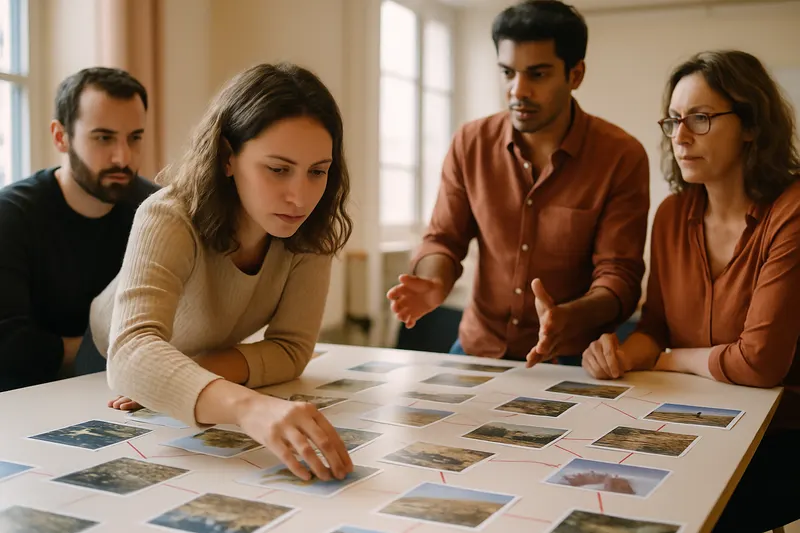
The Biodiversity Fresco is a collaborative workshop lasting approximately 3 hours, designed by the Association La Fresque de la Biodiversité. Inspired by the model of the Climate Fresco, it is based on the work of the IPBES, the international scientific platform on biodiversity. In groups of 4 to 8 participants with a trained facilitator, the group connects cards to understand biodiversity, the services it provides, the pressures that erode it, and the consequences for human societies. The workshop concludes with a time for sharing emotions and identifying action pathways.
Walkthrough
- 1
Welcome, Framework, and Intention
10 minThe facilitator welcomes the 4 to 8 participants around a table and ensures that everyone can see the workspace clearly. They set the framework: 'For the next 3 hours, we will collaboratively build a systemic understanding of biodiversity, using cards from the official kit.' They clarify that the goal is not to test knowledge but to reason collectively. Participants briefly introduce themselves and share, in one word, what biodiversity means to them. This step establishes safety, curiosity, and the right to make mistakes.
Tip — From the outset, emphasise that the group is learning together: this prevents an expert from dominating or a less informed participant from withdrawing.
- 2
Introduction to the Fresco Principle
10 minThe facilitator explains how the process works without revealing the content of the cards: participants will gradually receive sets of official cards, read them, and then connect them through cause-and-effect links. They say: 'Your mission is to discuss, place, move, and connect the cards to make the system visible.' They remind participants that the cards should not be copied or reproduced outside the framework set by the association. Participants ask questions to clarify their understanding of the method. The aim is to clarify the rules of the game before delving into the content.
Tip — Keep explanations brief: participants will primarily understand by manipulating the cards. If a question already pertains to the content, note it down and suggest revisiting it during the construction.
- 3
Collaborative Construction of the Fresco
90 minThe facilitator distributes the sets of cards from the official kit according to the progression outlined by La Fresque de la Biodiversité. For each set, they invite the group to read the cards, debate their positions, and trace or materialise the relevant links. They prompt with questions like: 'What influences what?', 'Which card seems to be a cause, and which a consequence?' Participants gradually build a shared representation of biodiversity, the services it provides to human societies, the pressures, and the impacts. The facilitator facilitates without doing the work for the group.
Tip — Resist the urge to correct immediately. Allow the group to argue, then use a short question to prompt adjustment: 'What evidence do you have in the cards?'
- 4
Highlighting Major Pressures
25 minOnce the main structure is established, the facilitator helps the group explicitly identify the major pressures responsible for the erosion of biodiversity. They name and locate in the fresco land and sea use changes, overexploitation, climate change, pollution, and invasive alien species. They ask: 'Which ones do you see most in your professions, your territories, or your daily choices?' Participants connect these pressures to the visible consequences in their fresco. This step anchors scientific reasoning in concrete situations.
Tip — Have the group name the five pressures aloud before moving on. This reinforces memorisation and prevents the workshop from becoming a mere card manipulation exercise.
- 5
Creative Ownership and Narration
20 minThe facilitator invites the group to give their fresco a readable form: title, visual groupings, clarified arrows, keywords, or illustrations if the format allows. They say: 'Your fresco should be understandable to someone who arrives in the room now.' Participants organise the space, choose what they want to highlight, and prepare a brief reading of their system. This phase transforms understanding into a collective narrative. It also allows for the emergence of tipping points, interdependencies, and strong messages.
Tip — If the group gets lost in aesthetics, bring them back to readability: a good title, understandable links, and two or three key messages are better than a highly decorated but confusing fresco.
- 6
Presentation and Clarification
15 minThe facilitator asks participants to present their fresco in a few minutes, starting with what biodiversity is, then the services it provides, the pressures, and the consequences. They listen to the formulations, add if necessary, and rephrase the essential points while remaining faithful to the official kit and the work of the IPBES. Participants can ask their final questions for clarification. The facilitator ensures to distinguish what is established in the workshop, what pertains to a local example, and what would require an additional source. This step secures learning before the emotional debrief.
Tip — Request a rotating presentation: each participant explains a part. This prevents the most comfortable person from monopolising the summary and allows for checking real ownership.
- 7
Emotional Debrief and Action Pathways
30 minThe facilitator opens a speaking time on experiences: 'What does this fresco make you feel? What surprises, worries, or motivates you to act?' They welcome emotions without trying to correct them, then guide towards individual, collective, professional, or territorial action pathways. Participants identify a few realistic levers to explore after the workshop. The facilitator concludes by reminding that systemic understanding serves to choose more relevant actions. They refer to the Association La Fresque de la Biodiversité for resources, training, and official materials.
Tip — Do not rush from emotions to solutions. Allow a silence after the first question: it is often here that the most authentic realizations emerge.
Variants
- Inter-team format: if multiple tables are playing in parallel, each group builds its fresco with a trained facilitator, then shares a key message, a surprise, and an action pathway in plenary.
- Job-oriented format: during the debrief, ask participants to relate the pressures and consequences to their sector of activity, without altering the rules or the official content of the workshop.
- Remote format: use the online setup recommended by the Association La Fresque de la Biodiversité, with a collaborative board, sub-groups of 4 to 8, and a trained facilitator for each group.
- Internal awareness format: maintain the duration of approximately 3 hours, then add a separate time after the workshop for translating into team commitments, so as not to reduce the time for understanding and debriefing.
Debrief guide
- What have you understood today about biodiversity that you did not perceive clearly before the workshop?
- Which cause-and-effect link struck you the most in the fresco, and why?
- Among the major pressures identified, which seems most present in your personal or professional context?
- What emotions did the workshop evoke in you, and what can they teach you?
- Which services provided by biodiversity to human societies seem most invisible or underestimated?
- What concrete action, individual or collective, could you initiate or strengthen after this workshop?
- What do you need to move from awareness to sustainable action?