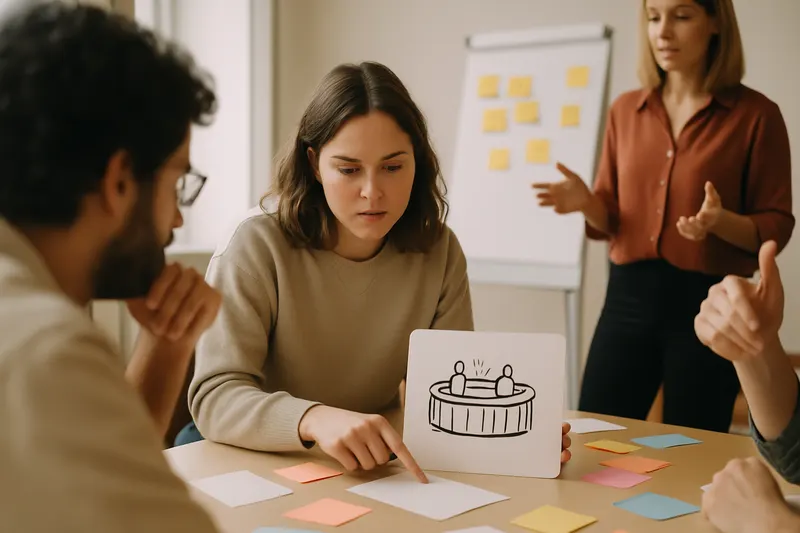
Give Them a Hot Tub
Uncover hidden needs through deliberately absurd features.
Give Them a Hot Tub is an innovation game derived from Luke Hohmann's Innovation Games. It involves presenting clients or users with feature cards, some of which are deliberately extravagant or absurd for the product, such as the idea of a hot tub. The contrast provokes reactions, pushes participants away from incremental requests, and invites them to imagine their own crazy features. The goal is then to analyse what these excessive ideas reveal: behind a whimsical proposal often lies a real, unexpressed need.
Walkthrough
- 1
Frame the intention of the game
5 minThe facilitator welcomes the group and sets the stage: "We will explore deliberately exaggerated ideas to understand what they reveal about your real needs." They clarify that the aim is not to immediately choose a feasible solution, but to open up the realm of possibilities. Participants are encouraged to react honestly, without trying to be reasonable too quickly. This framing secures the group and prevents absurd ideas from being dismissed as a waste of time.
Tip — Clearly announce that the absurd is a tool, not a gratuitous joke: this helps very rational profiles accept the exercise.
- 2
Present the product or context being studied
5 to 10 minThe facilitator reminds the group of the product, service, or journey they will be working on. They provide just enough context for everyone to project themselves: main usage, relevant users, current situation, and innovation challenge. They ask: "Keep in mind your real experience: what helps you, what you lack, what annoys you." Participants can ask clarification questions, without yet debating solutions.
Tip — Deliberately limit the presentation: too many technical details confine the group to the existing and reduce the ability to imagine breakthroughs.
- 3
React to the feature cards
10 to 15 minThe facilitator presents a series of pre-prepared feature cards, including plausible proposals and others that are deliberately extravagant or absurd for the product, such as the famous "hot tub." For each card, they ask: "What does this idea make you say? What attracts you, disturbs you, or makes you laugh?" Participants react spontaneously, and the facilitator notes important verbatim responses. The goal is to capture raw reactions before the group rationalises.
Tip — Never defend an absurd card: let the group critique it, twist it, or take it seriously, as this is precisely where hidden needs emerge.
- 4
Explore reactions behind the absurd
10 minThe facilitator revisits some striking reactions and probes with simple questions: "What would this idea give you if it existed?", "What problem would it indirectly solve?" Participants seek what the crazy feature could symbolise: comfort, status, speed, control, pleasure, simplicity, or another lived need. The facilitator reformulates without judgement: "So behind this idea, I hear a need for..." This step transforms laughter or rejection into material for innovation.
Tip — When an idea seems completely useless, ask: "In what extreme case would this become interesting?" This question often unlocks an overlooked usage situation.
- 5
Invent crazy features
10 to 15 minThe facilitator now invites participants to create their own extravagant features: "Your turn, propose crazy, excessive, impossible, or offbeat ideas for this product." Everyone can write or state an idea, and the group welcomes them without immediate feasibility discussion. The facilitator encourages exaggeration: "If it's too reasonable, push the idea further." The goal is to move beyond incremental improvements and bring forth desires that participants might not have directly articulated.
Tip — If the group remains sensible, give explicit permission to be unrealistic: "Your idea doesn't need to be buildable; it just needs to reveal something interesting."
- 6
Translate crazy ideas into real needs
10 to 15 minThe facilitator selects several strong or surprising ideas with the group and translates them into underlying needs. For each idea, they ask: "If we didn't keep the solution, what need must we absolutely retain?" Participants then formulate needs, irritants, expectations, or usage situations revealed by the excess. The facilitator clearly distinguishes the whimsical idea from the exploitable insight, in order to produce useful material for the subsequent work on the product or innovation.
Tip — Write in two visible columns: on the left the crazy idea, on the right the revealed need. This separation prevents decision-makers from dismissing the insight along with the absurd solution.
- 7
Close and prioritise the learnings
5 to 10 minThe facilitator rereads the revealed needs and asks the group which seem the most surprising, the most important, or the most promising for inventing something else. They do not seek to validate a complete roadmap but to identify breakthrough avenues to explore further. They thank participants for their ability to play along and remind them that absurd ideas served as a revelation. The session concludes with a list of insights and avenues to pass on to the relevant team.
Tip — End on the needs, not the gadgets: this makes the workshop credible to product, design, or business teams.
Variants
- Short variant: reduce the number of cards presented and focus the workshop on a few strong reactions, then immediately translate the ideas into underlying needs.
- Variant with clients and internal team: first have clients react, then ask the product or business team to listen without defending the existing before reformulating the heard needs.
- Remote variant: use a collaborative whiteboard with a section for feature cards, a section for participants' crazy ideas, and a separate section for revealed needs.
- Deepening variant: after the workshop, select a few revealed needs and organise a separate session for designing realistic solutions.
Debrief guide
- Which absurd idea provoked the strongest reaction, and what does this reaction reveal?
- What have we discovered that we probably wouldn't have articulated with a traditional discussion on improvements?
- Behind the wildest proposals, what real needs recur several times?
- Which requests seemed unrealistic but point to a very concrete frustration?
- Which breakthrough avenues deserve to be explored without literally taking the whimsical idea?
- What does this exercise change in our understanding of clients or users?