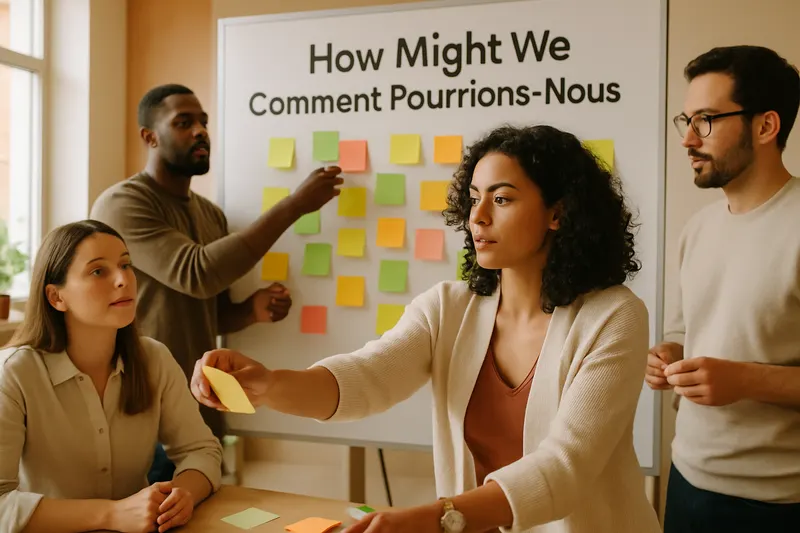
How Might We (HMW) – How Could We
Transform challenges into creative opportunities with HMW.
The 'How Might We' (HMW) game allows for the reframing of problems into inspiring questions to stimulate creativity. By transitioning from an analysis phase to an idea generation phase, it fosters innovation and collaboration within teams. This process helps participants to view obstacles from a new perspective, thereby stimulating innovative and effective solutions.
Walkthrough
- 1
Introduction and context
10 minThe facilitator begins by explaining the objective of the workshop: to transform challenges into opportunities through inspiring questions. They present the concept of 'How Might We' and its importance in the innovation process. Participants are invited to think about a specific problem or challenge they wish to address.
Tip — Use a concrete example from your organisation to illustrate the HMW process.
- 2
Identifying challenges
15 minEach participant takes a few minutes to list the challenges or problems they encounter in their work context. The facilitator encourages them to be precise and concrete in describing each challenge. Then, participants share their lists with the group, and together they select one or two common challenges to work on.
Tip — Encourage participants to formulate challenges that start with 'How might we...'.
- 3
Formulating HMW questions
20 minThe facilitator guides participants in transforming the selected challenges into 'How might we' questions. Each challenge is reformulated into one or more HMW questions, ensuring they are open and inspiring. Participants work in small groups to generate as many HMW questions as possible.
Tip — Remind participants that the questions should be broad enough to encourage creativity but not too vague to remain relevant.
- 4
Sharing and selection
15 minEach group shares its HMW questions with all participants. The facilitator facilitates a discussion to evaluate the potential impact of each question. Together, the group selects the most promising HMW questions to explore further.
Tip — Use a show of hands to facilitate the selection process of the questions.
- 5
Idea generation
30 minParticipants are divided into groups, and each group works on a selected HMW question. The goal is to generate as many ideas as possible in response to the question. The facilitator encourages the use of brainstorming techniques to stimulate creativity.
Tip — Remind participants that there are no bad ideas at this stage; the important thing is quantity.
- 6
Conclusion
10 minThe facilitator concludes the workshop by thanking participants for their creativity and collaboration. They recap the main ideas generated and discuss the next steps for further exploration. Participants are invited to reflect on how they can apply the HMW process in their daily work.
Tip — Give participants the opportunity to note their favourite ideas for the next steps.
Variants
- Use post-its to write each HMW question and organise them on a board.
- Introduce a rapid prototyping phase to test some of the generated ideas.
- Integrate a feedback loop where participants can refine the HMW questions after an initial round of ideation.
Debrief guide
- What did you learn about transforming a challenge into an opportunity?
- How did the HMW process influence your way of thinking?
- Which HMW questions were the most inspiring for you and why?
- How could you apply this process in other contexts?
- Which ideas generated during the workshop seem the most promising to you?
- How did this process affect the team's collaboration dynamics?