The String Game
Making visible, with a simple string, the hidden connections behind our plate.
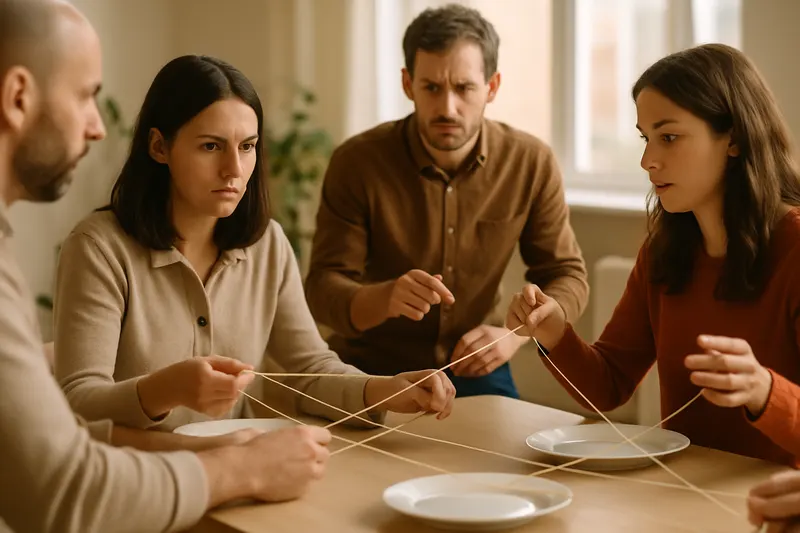
The String Game is an interactive Belgian game of systemic thinking created by Rencontre des Continents and Quinoa. It explores our food consumption model based on the contents of a plate. Each participant embodies a role — food, actor, impact, or institution — and links are materialised by a string to form a web of interdependencies. The experience highlights the connections between food, environment, economy, social issues, and politics, before opening a discussion on individual and collective alternatives.
Walkthrough
- 1
Setting the Framework and Intention
10 minThe facilitator welcomes the group in a circle, with the central space clear to circulate the string. They announce: "We will start with a plate to explore what it connects to in the real world: people, institutions, impacts, and political choices." They clarify that the game aims to understand a system, not to assign blame. Participants listen, ask questions for understanding, and agree to play a role during the activity.
Tip — Emphasise from the start the right to be surprised or disturbed: this secures the group and prevents the debrief from turning into a defensive debate about eating habits.
- 2
Distributing Roles and Engaging with the Cards
15 minThe facilitator distributes the identity cards from the official educational kit, without modifying them, so that each participant embodies a food, actor, impact, or institution. They say: "Take a few minutes to discover your role; you will then speak on its behalf." Participants read their cards silently and identify the essential information to share. The facilitator circulates, clarifies instructions if needed, but does not summarise the cards for them.
Tip — For a large group, ask participants to mentally underline a key phrase from their card: this will make speaking more fluid without diluting the content of the kit.
- 3
Presenting the Plate and the Initial Roles
20 minThe facilitator places the plate or its representation in the centre and invites the roles directly related to its content to introduce themselves. They state the instruction: "When I give you the floor, read your identity card or present it faithfully, as if you were this role." The relevant participants speak one after the other, while the rest of the group listens without commenting. This step anchors the system in a concrete and everyday object: what we eat.
Tip — Maintain a lively pace by limiting side comments: reactions will have their place in the debrief, otherwise the construction of the web loses intensity.
- 4
Gradually Weaving the Links
35 minThe facilitator hands one end of the string to the first role, then circulates the spool to another role when a link is identified by the cards or by the logic of the kit's scenario. They say: "If your role is connected to what has just been said, make yourself known; we will materialise this link with the string." Each participant holds the string before passing it on. Gradually, foods, actors, impacts, and institutions connect, and the web becomes visible.
Tip — Ask participants to keep a slight tension in the string, without pulling hard: the group physically feels the interdependence while avoiding breaking the dynamic or the material.
- 5
Observing the Web and Feeling the System
15 minWhen the web is dense, the facilitator marks a silence and invites everyone to look at the whole. They propose: "Without speaking right away, observe where you are placed, how many links touch you, and what that makes you feel." Participants remain in their roles and become aware of the complexity built collectively. The facilitator can then ask one role to move slightly to demonstrate that the movement of one element affects the others.
Tip — Do not comment on the web too quickly: a few seconds of silence often provide more strength to the experience than an additional explanation.
- 6
Debriefing Feelings and Understanding
30 minThe facilitator invites the group to carefully lay down the string, then return to a circle. They start with the experience: "What did you feel in your role, and then when the web became denser?" Participants first talk about sensations, emotions, and surprises, before analysing the links. The facilitator reformulates without judging and brings out the interdependencies between food, environment, economy, social issues, and politics.
Tip — Clearly separate feelings from analysis: if someone jumps directly to solutions, thank them and say that this step comes just after.
- 7
Exploring Alternatives and Concluding
25 minThe facilitator opens the final sequence: "Based on what we have seen, what alternatives exist at the individual, collective, or institutional level?" Participants suggest ideas, relate them to the roles played, and distinguish what falls under personal choice, collective organisation, or political decision. The facilitator ensures not to reduce the game to eco-friendly gestures. They conclude by reminding that the tool serves citizenship education and refers to the official educational kit from Rencontre des Continents and Quinoa.
Tip — Ensure at least one collective alternative is named before concluding: this is often where the game takes on its civic significance and transcends individual guilt.
Variants
- For a group of 10 to 15 people, assign only part of the roles from the kit while maintaining diversity among foods, actors, impacts, and institutions. The debrief can then be more in-depth, with more speaking time for each participant.
- For a group close to 35 people, plan a large circle and a co-facilitator to help circulate the string and identify requests to speak. The co-facilitator can also ensure that everyone keeps their link visible.
- For a shorter workshop, reduce the time for analysing the cards and move more quickly to weaving, then focus the debrief on two axes: feelings and alternatives. Do not skip the debrief, as it is what transforms the experience into learning.
- In a remote setting, this facilitation is not well-suited as the heart of the game relies on the string and the physical web. If necessary, replace it with an online collaborative mapping of roles and links, clarifying that it is an adaptation and not the complete experience.
Debrief guide
- What did you feel when your role was connected to others by the string?
- Which link surprised or shifted your understanding of food the most?
- What does the web make visible that we do not usually see on a plate?
- Where did you perceive tensions between environmental, economic, social, and political issues?
- In this system, which actors seem to have the most power to act, and why?
- What individual and collective alternatives seem realistic based on this experience?
- What will you take away to look at your food choices or those of your organisation differently?