
The Meaning Chain
Connect your tasks to the people, impacts and levers that restore meaning.
In short. The Meaning Chain is a serious game (team building) for 3–30 participants, lasting 60–75 min. Created by serious-games.com. Use it for: engagement & motivation, alignement, leadership.
Card by serious-games.com, updated 22 November 2026. Original game by serious-games.com.
The Meaning Chain is a workshop game for connecting everyday tasks to their beneficiaries and concrete impacts. Participants build “I do… for… so that…” chains, then identify what breaks them. Finally, they choose simple levers they can act on from the following week. It is for teams that want to talk about meaning at work without grand speeches or judgment.
The full kit as a free PDF
Printable cards, rules, timed running order, facilitator sheet and canvases. Enter your email to download it.
No spam. Unsubscribe in one click.
Walkthrough
- 1
Set the frame
7 minPresent the objective, the 5 card families and the safety frame. Form groups of 3 to 5. Hand out the canvases. Explain that the score is a collective mirror, not a ranking. “Today, we will connect tasks to people and impacts. We are not judging roles: we are observing chains of meaning.”
Tip : Set the frame before the cards: this prevents the first jokes from creating a cynical tone.
- 2
Choose your tasks
10 minEach participant chooses 3 Task cards close to their daily work. They note them on the “My meaning chains” canvas. If they do not find an exact match, they choose the closest one and adapt it orally. “Choose three tasks you really do or know well. Not the noblest ones: the most real ones.”
Tip : If someone hesitates, suggest choosing one frequent task, one useful task and one painful task.
- 3
Build the chains
15 minFor each task, participants choose 1 Beneficiary and 1 Impact. Everyone presents their chains by saying: “I do… for… so that…”. Others may help clarify, without correcting on their behalf. “Test the sentence: I do this task for this person so that this effect happens. If it sounds false, that is interesting.”
Tip : Ask for concrete examples: a first name, a department, a moment when the result is used.
- 4
Spot the breaks
10 minEach group counts its complete chains. Chains with “No one” or “No visible impact” are marked as broken. The group then draws 3 Irritant cards that resonate with its situations. “A broken chain is not a failure. It is information: something is missing, or something needs to be questioned.”
Tip : Avoid general debates: always ask “on which specific task do you see this?”.
- 5
Choose levers
15 minFor each selected irritant, the group chooses a lever shown under “Repaired by” or invents another one. It fills in “Our levers” with a concrete action, an owner and a deadline. “A good lever is small: a conversation, a test, a temporary stop, feedback requested.”
Tip : If the action depends on the whole organisation, look for the first check the team can do itself.
- 6
Commit and recount
8 minEach participant chooses a personal lever. Each group chooses a collective lever. Recount the chains that could become complete if the levers are tested, then record the before/after. “We are not promising to solve everything. We are choosing what deserves a real test before the next team update.”
Tip : Have them name a specific date. “Soon” is not a commitment; “Tuesday at the 9 a.m. update” is.
- 7
Debrief
10 minFacilitate a three-step debrief: feel, understand, transfer. Have the manager speak last if present. Finish by collecting the collective levers and support needs. “What does this mapping change in the way we look at everyday work?”
Tip : Keep the final two minutes to photograph the group canvases or decide who will keep them.
Variants
- Remote : Use a collaborative board with five card areas. Participants drag 3 tasks into their space, then add a beneficiary and impact. Irritants and levers are handled in breakout rooms.
- Large group : For 20 to 30 people, work at autonomous tables with one deck per table. Debrief in plenary only on common irritants and collective levers.
- Team under strain : Reduce the number of tasks to 2 per person and move more quickly to the levers. Emphasise the frame: talk about observable facts and testable actions.
Debrief guide
- Which chain surprised you, positively or negatively?
- At what point did you feel pride, irritation or lack of clarity?
- What makes a task more meaningful: the beneficiary, the impact, the feedback, something else?
- Which irritants come up most often in your broken chains?
- Which tasks seem to need removing or simplifying rather than justifying?
- What feedback could you request this week to make an impact more visible?
- Which collective lever deserves to be tested first, with a short deadline?
- How will you know in one month that the meaning chain has been strengthened?
Facilitator reviews
No review yet. Have you run this game? Your feedback will help the next facilitators.
Similar games
Same objectives or same category, to vary or follow up.

The 9 Whys
Clarifying the deeper purpose of a task by exploring up to nine levels of 'why' in pairs.

Delegation Poker
A hidden vote across seven levels to discuss how far to delegate a decision without creating ambiguity.

Day One
Build onboarding that withstands the real irritants newcomers face.
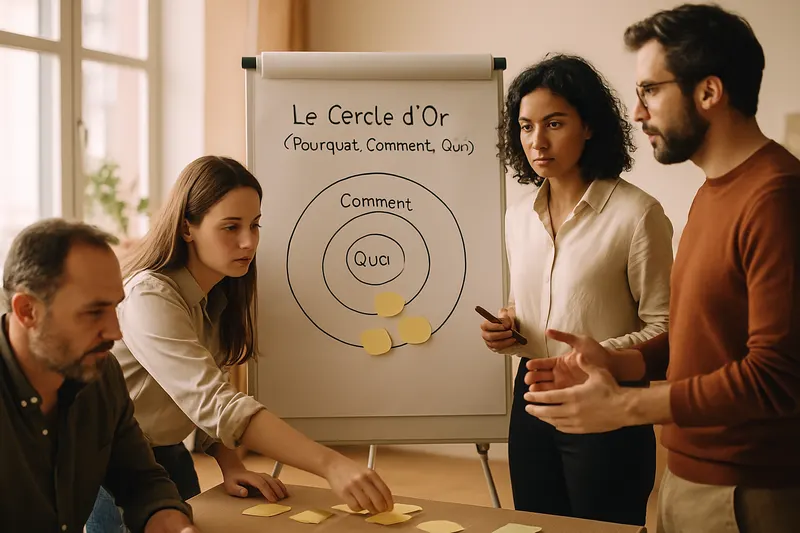
The Golden Circle (Why, How, What)
To bring forth a shared Why, then align it with action principles and concrete outputs.

Meetingitis
Diagnose meetings that go off the rails, then test the antidotes that make them useful.

Safe to Speak
A game to see how managerial reactions make real issues spoken… or silenced.