LEGO® Serious Play®
Bringing ideas, visions, and decisions to life by building metaphors with LEGO® bricks.
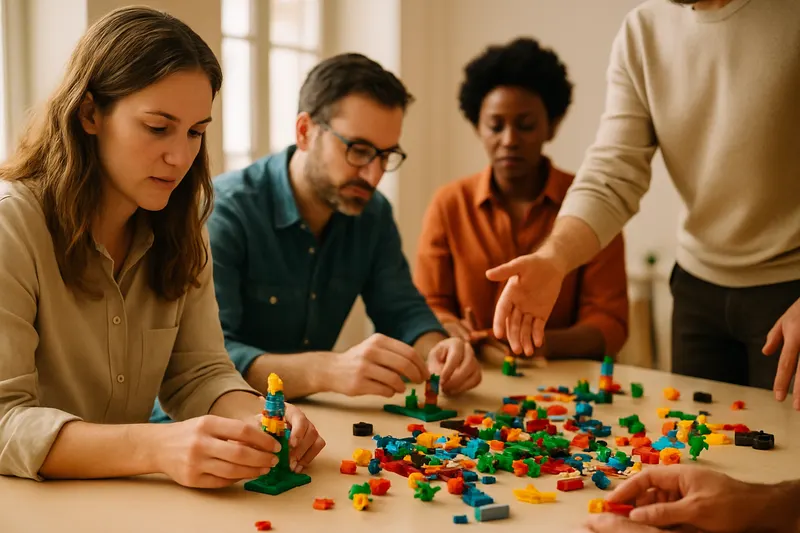
LEGO® Serious Play® is a facilitation method developed by the LEGO Group with Johan Roos, Bart Victor, and Robert Rasmussen. Participants build metaphorical models using LEGO® bricks to address challenges posed by the facilitator. The method embodies thinking with hands: everyone builds, shares, listens, and questions the models. It has been published as open source since 2010; the brick materials are paid for, and facilitator training is available.
Walkthrough
- 1
Setting the framework and rules of the game
10 to 20 minThe facilitator welcomes the group, reminds them of the workshop's objective, and clarifies that the method is based on metaphorical models, not on the aesthetic quality of the constructions. They state the non-negotiable rules: 'Everyone builds, everyone shares; the meaning of the model belongs to its builder; we question the model, not the person; think with your hands.' Participants settle in with accessible bricks for everyone. The framework secures speech and prevents the more verbally confident from dominating.
Tip — Have the group repeat the key rules, especially 'the meaning belongs to the builder': this significantly reduces wild interpretations during the narratives.
- 2
Warming up hands and metaphor
15 to 30 minThe facilitator proposes a first simple challenge to familiarise participants with building, for example, representing an idea, quality, or situation with a few bricks. They say: 'Don’t seek beauty or realism; build something that helps you think.' Everyone builds individually, then briefly shares what their model means. Others listen without correcting or adding, to establish the reflex of storytelling through the model.
Tip — Choose a warm-up challenge without sensitive stakes: it should train the gesture and metaphor, not open a deep debate too early.
- 3
Posing the first central challenge
5 to 10 minThe facilitator formulates a clear, open question directly related to the workshop's objective. They pose it as a construction challenge: 'Build a model that answers the following question...' then leave a few seconds of silence for everyone to absorb it. They check that the question is understood, without starting to debate possible answers. The quality of this step conditions the richness of the models and the relevance of the debrief.
Tip — Display the question prominently and do not rephrase it unnecessarily: a stable formulation prevents everyone from building on a different instruction.
- 4
Building individually
15 to 45 minEach participant builds their model individually, in silence or with minimal exchanges depending on the context. The facilitator reminds: 'Think with your hands; if you’re stuck, take a brick and start.' They circulate without interpreting the models or providing solutions but may prompt with the instruction. This phase gives everyone the same reflection time and brings forth ideas that might have remained implicit in a traditional discussion.
Tip — Regularly announce the remaining time, but avoid rushing too soon: some important models emerge after a phase of exploration.
- 5
Sharing individual models
30 to 90 minEach person presents their model in turn and shares the story of what they built. The facilitator gives the instruction: 'Speak from the model: show the elements, the relationships, the tensions, the surprises.' Others listen without debating, translating for the builder, or judging the form. This step ensures that everyone shares and that individual representations become visible to the group.
Tip — Ask the narrator to touch or point to the elements they are discussing: this keeps attention on the model and limits overly abstract discourse.
- 6
Questioning the models and delving deeper
20 to 60 minAfter each narrative, the facilitator opens a time for short questions focused on the model. They remind: 'We question the model, not the person: ask what this element, this connection, this distance, this size represents.' The builder responds while remaining the owner of the meaning and can enrich their explanation if a question helps clarify. The aim is to clarify, explore hypotheses, and bring forth convergences or tensions without premature debate.
Tip — Politely interrupt questions that start with 'Do you think that...' and rephrase towards the model: 'What does this part of the model show?'
- 7
Building a shared model
30 to 120 minIf the objective requires it, the facilitator invites the group to combine elements from the individual models into a shared model. They clarify: 'Don’t seek an average; keep what is essential to represent our common understanding.' Participants negotiate what goes into the model, what remains aside, and how the elements are connected. This step makes explicit the agreements, disagreements, and collective priorities.
Tip — Have each addition or removal of an element verbalised: a shared model becomes powerful when the decisions are visible, not just when it is assembled.
- 8
Debriefing and translating into concrete follow-ups
20 to 60 minThe facilitator organises a debrief based on the models still visible. They ask the group to articulate the learnings, possible decisions, and points to investigate, without losing the connection to the constructions. They may conclude with an oral or visual summary of the main ideas arising from the narratives and the shared model. This final step transforms the metaphorical experience into common understanding and actionable insights.
Tip — Photograph the models only with the group's consent and note the meaning given by the builders: a photo alone is not enough to retain the meaning.
Variants
- Short workshop of 120 minutes: limit the number of challenges, work on a single individual model per participant, then create a collective synthesis without delving into all possible scenarios.
- Long workshop of up to 480 minutes: chain several progressive challenges, deepen the narratives, then build a more comprehensive shared model and link it to decisions or action pathways.
- Team-focused variant: first ask each person to represent their perception of the team, then combine the essential elements into a shared model of desired functioning.
- Strategy or vision variant: pose a challenge on the desired future state, have each model narrated, then build a shared model that materialises the common priorities.
Debrief guide
- What have you understood through your model that you might not have articulated directly in discussion?
- Which elements of the models seem most revealing of our current situation?
- What strong convergences appear between the individual narratives?
- What tensions or contradictions become visible in the models?
- In the shared model, which elements are essential and why?
- What decisions, actions, or new questions should we retain from this construction?