Opportunity Solution Tree
Mapping the path between customer outcomes, opportunities, solutions, and tests without jumping to features.
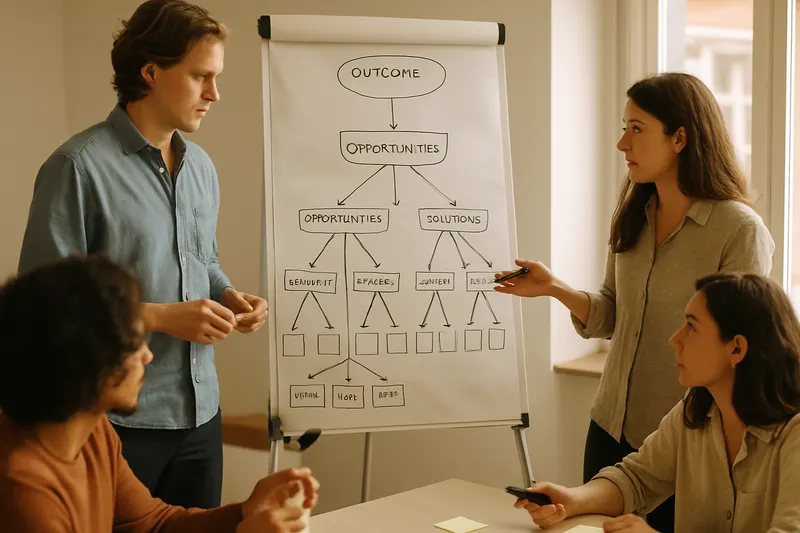
The Opportunity Solution Tree is a product discovery tool by Teresa Torres. It structures thinking into four levels: a measurable desired outcome, opportunities derived from customer interviews, possible solutions, and hypothesis tests. The workshop helps a team make their reasoning visible, consciously choose a target opportunity, and compare multiple paths before investing. It embodies a key discipline: starting from customer needs, pain points, and desires rather than feature ideas.
Walkthrough
- 1
Frame the workshop and the desired outcome
10 to 15 minThe facilitator opens by reminding the objective: "Today, we are going to build a tree that connects a measurable outcome to customer opportunities, then to solutions and tests." They specify that the tree has four levels: outcome, opportunities, solutions, hypothesis tests. The group formulates a measurable desired outcome at the top, avoiding deliverables or features. Participants clarify ambiguous terms so that everyone is aligned.
Tip — If the group suggests a solution as the outcome, rephrase by asking: "What measurable change for the user or in the business is this solution supposed to produce?"
- 2
Gather customer opportunities
15 to 25 minThe facilitator invites the group to list opportunities under the outcome: "Note only customer needs, pain points, or desires, ideally from interviews." Each idea is written on a separate post-it or note, with a short and understandable formulation. Participants avoid disguised solutions and discuss what the customer is seeking, experiencing, or wishing for. The goal is to broaden the scope before selecting a target.
Tip — Keep a 'to rephrase' area for ideas that resemble features; this prevents blocking energy while protecting the logic of the tree.
- 3
Map and group opportunities
15 to 20 minThe facilitator asks participants to place the opportunities under the outcome and to group similar ones together. They say: "Let’s group by proximity of customer need, not by internal organisation or presumed solution." The group creates clusters and renames if necessary to make each opportunity clear. This step reveals the discovery landscape and possible connections between elements.
Tip — When a grouping becomes too broad, ask: "Would the same customer really express these elements in the same sentence?" This helps keep opportunities actionable.
- 4
Choose a target opportunity
10 to 15 minThe facilitator guides the choice of an opportunity to explore during the workshop. They remind: "We are not trying to solve the entire tree now; we are choosing one branch to learn quickly." Participants discuss the relevance of the opportunities in light of the desired outcome and what they know about the customers. A target opportunity is selected and placed as a priority branch for the next steps.
Tip — If the debate goes in circles, ask each person to briefly defend the opportunity they believe most clearly connects customer interviews to the measurable outcome.
- 5
Generate at least three solutions
15 to 25 minThe facilitator invites the group to produce several possible responses to the target opportunity: "For this opportunity, we want at least three solutions, not just one favourite idea." Participants write distinct solutions, each under the chosen opportunity. They allow for simple, partial, or alternative ideas, without rushing to decide. This multiplicity prevents jumping too quickly to a single feature.
Tip — Clearly announce that the first idea is not forbidden, but it does not have special status: it must coexist with at least two other options.
- 6
Define hypothesis tests
15 to 25 minFor each solution retained at this stage, the facilitator asks: "What hypothesis do we need to test to know if this solution deserves to move forward?" Participants add hypothesis tests under each solution to evaluate it. They formulate what they want to learn, rather than a complete implementation plan. The tree then shows the path: desired outcome, customer opportunity, proposed solution, necessary learning.
Tip — Have each participant verbalise the main risk of each solution before proposing a test; this avoids decorative tests that would not change any decisions.
- 7
Review the tree and decide on next steps
10 to 15 minThe facilitator has the tree read from top to bottom: measurable outcome, opportunities, target opportunity, solutions, tests. They ask: "Is the reasoning visible to someone absent from the workshop? Where are we skipping a step?" The group adjusts formulations, removes duplicates, and identifies which tests to launch first. The session ends with an agreement on the next steps and how to keep the tree alive.
Tip — Take a photograph or export the tree immediately, then appoint someone responsible for updates; otherwise, the tool quickly becomes a workshop artifact instead of a discovery support.
Variants
- Short version in 60 minutes: come with a pre-formulated outcome and opportunities prepared from recent interviews, then focus the workshop on choosing the target, the three solutions, and the tests.
- In-depth version in 120 minutes: spend more time grouping opportunities and formulating hypotheses, with a collective review of the coherence of each branch.
- Remote version: use a collaborative whiteboard with four vertical areas titled outcome, opportunities, solutions, and hypothesis tests; ask participants to write silently before each oral exchange.
- Expanded team version: limit active production to 8 participants and invite others as contributing observers during the debrief, to maintain the quality of the mapping.
Debrief guide
- At what point did we most want to jump straight to a solution, and what does that reveal about our product habits?
- Which opportunities are truly based on customer interviews, and which still need validation?
- How does the chosen target opportunity clearly contribute to the measurable outcome placed at the top?
- What did we learn by generating at least three solutions rather than defending a single idea?
- Which hypothesis tests can most reduce our uncertainty before investing further?
- What does the tree reveal that our usual discussions do not show?