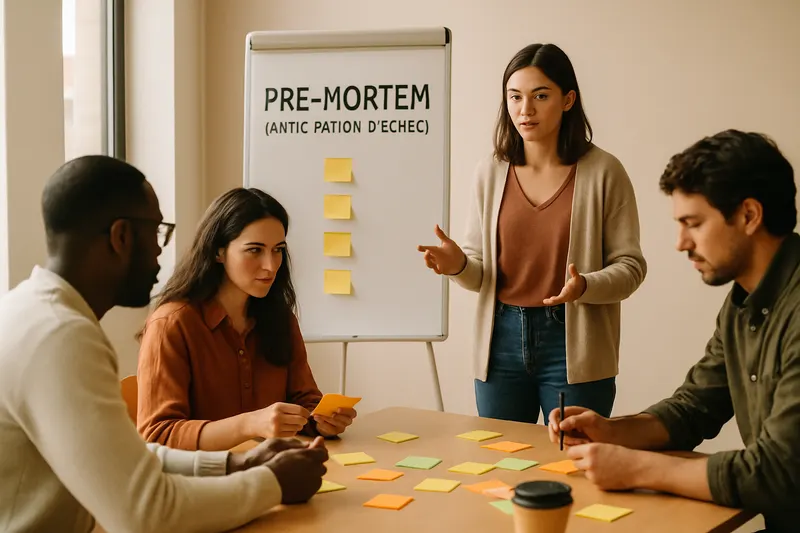
Pre-Mortem (Failure Anticipation)
Anticipate potential failures to strengthen your project from the outset.
The Pre-Mortem is a proactive reflection exercise where the team imagines that their project has failed. By identifying the possible causes of this failure, members can anticipate risks and develop strategies to avoid them. This game encourages a critical and proactive approach, allowing for better preparation before launching a project.
Walkthrough
- 1
Introduction to the Pre-Mortem
10 minThe facilitator begins by explaining the concept of the Pre-Mortem. They describe how this exercise helps identify potential risks of a project by imagining that it has failed. They clarify that the goal is to prevent these risks by finding solutions before they manifest. The facilitator reassures participants that this exercise is a space for free reflection and not for criticism.
Tip — Use an anecdote or a concrete example to illustrate the value of the Pre-Mortem and capture participants' attention.
- 2
Imagining Failure
15 minThe facilitator asks participants to close their eyes and imagine that the project is completed and has failed spectacularly. They ask them to reflect on the possible reasons for this failure. After a few minutes of individual reflection, participants write down their ideas on post-its.
Tip — Encourage participants to be creative and consider even the most unlikely causes of failure.
- 3
Sharing Causes of Failure
20 minParticipants stick their post-its on a board and share their ideas with the group. The facilitator groups similar causes and facilitates a discussion to clarify and delve deeper into certain points. Each participant is encouraged to explain their ideas and ask questions about those of others.
Tip — Ensure that each participant has the opportunity to express themselves and that all ideas are respected, even the most unusual.
- 4
Prioritisation of Risks
15 minThe facilitator asks the group to prioritise the identified risks based on their likelihood and potential impact. Participants vote using stickers or by raising their hands. The most critical risks are identified to be addressed as a priority.
Tip — Use a risk matrix to help visualise and classify risks according to their importance.
- 5
Developing Strategies
20 minFor each priority risk, the team brainstorms strategies to prevent or mitigate it. The facilitator encourages the generation of practical and actionable ideas. The solutions are noted and assigned to responsible individuals for follow-up.
Tip — Stimulate creativity by suggesting brainstorming techniques such as 'mind mapping' or 'six thinking hats'.
- 6
Conclusion and Commitment
10 minThe facilitator concludes the session by summarising the main risks and the strategies developed. They ask each participant to commit to a specific action to contribute to risk prevention. The facilitator thanks the participants for their involvement.
Tip — Ask each participant to share a sentence about what they learned or what they take away from the exercise to reinforce commitment.
Variants
- Conduct the exercise in two phases: first individually, then in a group to encourage a diversity of ideas.
- Use specific scenarios (technical, commercial, human) to guide reflection on different aspects of the project.
- Incorporate an external expert to provide a fresh perspective and different insights on potential risks.
Debrief guide
- What did you feel when imagining the project's failure?
- Which risks seemed the most surprising to you?
- How did this exercise change your perception of the project?
- Which strategies do you find the most promising?
- How could this reflection influence your daily work?
- What concrete actions will you implement following this workshop?
- How could we improve this exercise in the future?