Low-tech Social Network
A wall of drawn profiles to make existing connections visible and trigger new ones.
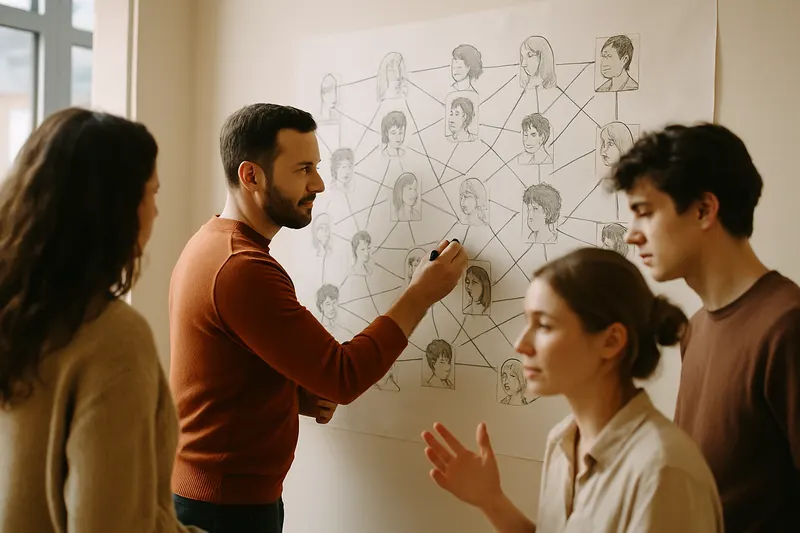
Low-tech Social Network is an opening game derived from Gamestorming, attributed to Dave Gray. Each participant creates a profile card with their name, a drawn avatar, and two or three keywords related to their interests or expertise. The profiles are displayed on a large paper wall, and then everyone draws connections with the people they know, indicating the nature of each relationship. The game makes the network visible, facilitates contact, and can remain active throughout the event.
Walkthrough
- 1
Prepare the Social Wall
3 minBefore the arrival or at the very beginning, the facilitator sets up a large accessible paper wall, visible and wide enough to accommodate all the cards. They provide blank cards, markers, and glue nearby. They announce: "This wall will become our low-tech social network: it will remain displayed and can evolve during the event." Participants thus understand that this is not just an icebreaker, but a living support. The goal is to create a space that encourages looking, completing, and connecting.
Tip — Place the wall in a thoroughfare area, but not in a bottleneck: participants should be able to stop without blocking traffic.
- 2
Launch the Game's Intention
3 minThe facilitator gathers the group in front of the wall and explains the principle simply. They say: "We will make the people present, what they know or love, and the links that already exist between them visible." They specify that everyone will create a profile with their name, a drawn avatar, and two or three keywords. They emphasise that the drawing does not need to be beautiful: it only serves to personalise the card. This introduction reassures those who are less comfortable and directs attention towards connections.
Tip — Draw a very simple avatar yourself as an example: this immediately demystifies the expected graphic level.
- 3
Create Individual Profiles
5 à 7 minEach participant takes a card and writes their name, draws an avatar, and then adds two or three keywords. The facilitator gives examples of categories without imposing content: interests, expertise, topics of curiosity, experience useful to the group. They say: "Choose words that might encourage someone to come and talk to you." Meanwhile, they circulate, answer questions, and encourage short formulations. This step transforms each person into a readable entry point in the network.
Tip — If someone struggles with the keywords, ask: "What topic would you like to be approached about today?" The answer often provides a relevant keyword.
- 4
Display Profiles on the Wall
3 à 5 minParticipants come to stick their card on the large paper wall. The facilitator invites them to arrange the profiles in a readable manner, without trying to classify too early. They might say: "Stick your card wherever you want, leaving enough space around to draw connections." Once the cards are placed, everyone takes a moment to look at the names, avatars, and keywords. The wall begins to play its role as a collective map of the group.
Tip — Ensure to leave blank spaces between the cards: a wall that is too dense makes the lines unreadable and discourages additions.
- 5
Draw Known Links
7 à 10 minThe facilitator gives the central instruction: "Identify the people you already know, draw a line between your card and theirs, then write the nature of the link on the line." They cite examples allowed by the game: former colleague, same project, same passion. Participants move to the wall, draw connections, and annotate each line. They can quickly exchange to clarify a link or verify a memory. The network gradually takes shape and makes existing relationships visible.
Tip — Encourage writing the nature of the link in full, even briefly: an unannotated line intrigues less and nourishes fewer conversations.
- 6
Observe the Emerging Network
4 à 5 minWhen the first links are drawn, the facilitator gathers the group in front of the wall. They invite everyone to observe in silence for a few moments, then ask: "What do you see emerging? Where are the highly connected areas? Where do you see possible bridges?" Participants share some observations without yet entering into a long debrief. The facilitator reformulates factual observations and values the diversity of connections. This pause helps the group transition from manual activity to collective reading of the network.
Tip — Start with visual observations rather than interpretations: this avoids prematurely fixing roles like 'isolated' or 'central'.
- 7
Keep the Network Alive
2 à 4 minThe facilitator concludes the sequence by explaining that the wall will remain displayed during the event. They say: "If you discover a common point, an expertise, or a link throughout the day, come back to add a line and note the nature of the link." They encourage everyone to use the wall to engage in conversation with someone they know little. Participants thus understand that the network is not finished at the end of the opening. The support becomes a reference for creating new connections.
Tip — Provide markers attached or placed near the wall throughout the event: without available tools, additions quickly stop.
Variants
- Red thread version: after the opening, plan a short moment halfway through or at the end of the event to invite everyone to add the links created since the beginning.
- Large group version: organise the wall into several sufficiently spaced areas and ask participants to come in waves to avoid congestion in front of the cards.
- Remote version: use a collaborative whiteboard with an area for each profile. Each participant creates their digital card with name, simple avatar, and two or three keywords, then draws annotated lines to the people they know.
- Expertise-focused version: ask participants to choose keywords oriented towards skills, topics mastered, or subjects on which they are willing to be approached, to support mutual aid during the workshop.
Debrief guide
- What have you discovered about the group that you did not see before tracing the network?
- What types of links appear most clearly: work, projects, passions, expertise, others?
- Which people or areas of the network do you want to explore further?
- What new links could you create during the event based on the displayed keywords?
- What does this network reveal about our usual way of knowing or collaborating?
- How can we concretely use this wall after this opening?