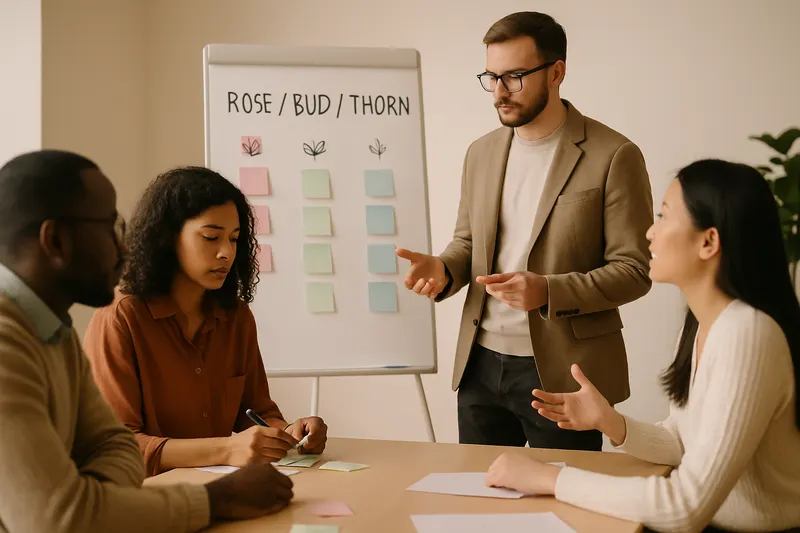
Rose / Bud / Thorn
Explore successes, opportunities, and challenges with Rose / Bud / Thorn.
Rose / Bud / Thorn is an agile retrospective method that helps teams identify what has worked well, opportunities to explore, and challenges encountered. This visual and interactive format encourages open communication and collective learning. It is ideal for quick and engaging retrospectives, allowing each team member to express themselves.
Walkthrough
- 1
Introduction
5 minThe facilitator explains the concept of Rose / Bud / Thorn: the rose represents what has worked well, the bud symbolizes emerging opportunities or ideas, and the thorn denotes the challenges or problems encountered. They clarify that the goal is to share constructive feedback to improve teamwork.
Tip — Use concrete examples to illustrate each category and facilitate understanding.
- 2
Idea Collection
15 minEach participant receives post-its in three different colours: red for roses, green for buds, and blue for thorns. The facilitator invites everyone to reflect individually and jot down their ideas. They encourage precision and conciseness in the descriptions.
Tip — Encourage participants to recall specific situations to enrich their contributions.
- 3
Group Sharing
20 minParticipants stick their post-its on a board divided into three sections: Rose, Bud, Thorn. The facilitator asks each person to briefly present their ideas. Other members can ask questions to clarify or delve deeper into certain points.
Tip — Ensure that each participant has the opportunity to speak, regulating speaking time if necessary.
- 4
Discussion and Prioritisation
15 minThe facilitator leads a discussion to identify recurring themes and priorities. They may use voting points to help the team choose the most relevant items to address as a priority.
Tip — Encourage the team to focus on actionable items and avoid getting sidetracked on too many topics.
- 5
Action Plan
10 minTogether, the team develops an action plan to address the buds and thorns identified as priorities. The facilitator ensures that each action has a responsible person and a clear deadline.
Tip — Ensure that the actions are realistic and verifiable to facilitate follow-up in future retrospectives.
Variants
- Use symbols or drawings instead of post-its for a more visual approach.
- Create a digital version using an online whiteboard tool for remote teams.
- Add an additional category for 'lessons learned' to capture key learnings.
Debrief guide
- What were the main discoveries from this retrospective?
- How did we feel about sharing our ideas?
- What actions can we take immediately?
- How can we improve this process for next time?
- Are there recurring themes that we should explore in more depth?