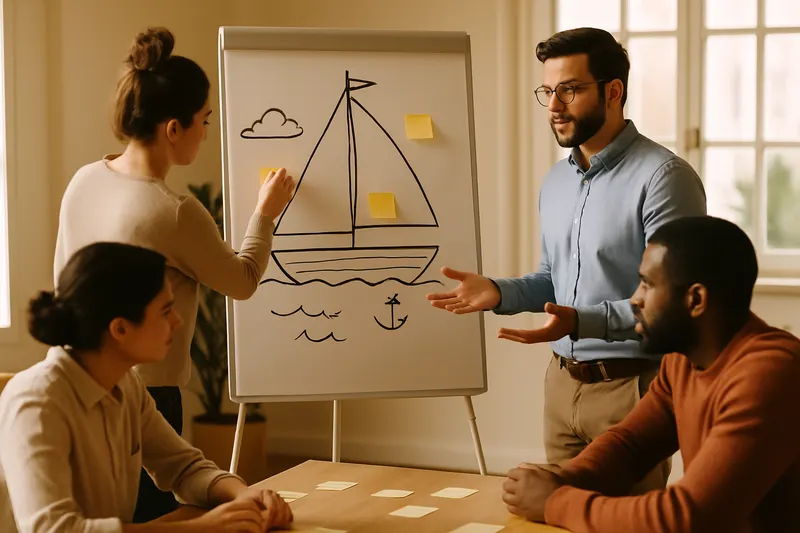
Sailboat Retrospective
Navigate towards continuous improvement with the Sailboat retrospective.
The Sailboat retrospective is a metaphorical exercise that helps teams identify positive and negative factors influencing their progress. By visualising the boat (the team), the wind (the aids), the anchors (the obstacles), and the rocks (the risks), participants can better understand their dynamics and define concrete actions to reach their goal (the island). This game promotes collective reflection and continuous improvement.
Walkthrough
- 1
Introduction
5 minThe facilitator welcomes the participants and explains the concept of the Sailboat retrospective. They describe the metaphors: the boat represents the team, the wind symbolises the elements that help, the anchors are what slows down, the rocks represent the risks, and the island is the goal. "Today, we will explore what helps us move forward and what holds us back."
Tip — Use vivid language to help participants emotionally connect with the metaphor.
- 2
Draw the Boat
5 minOn a large board or sheet of paper, the facilitator draws a boat, a blowing wind, anchors, rocks, and an island in the distance. Each element should be clearly visible to all participants. "Here is our boat, our team, and our journey towards our goal."
Tip — Opt for a simple and clear drawing to avoid wasting time while keeping participants' attention.
- 3
Identify the Supporting Winds
10 minThe facilitator asks participants to reflect on the elements that have recently helped the team. Each person writes their ideas on post-its and places them next to the wind. "What is pushing us forward?" Encourage discussion and explanations around the post-its.
Tip — Invite participants to provide concrete examples for each element mentioned.
- 4
Identify the Anchors
10 minParticipants reflect on the elements that have slowed their progress. They write their ideas on post-its and place them near the anchors. "What is holding us back?" The facilitator facilitates a discussion to understand and prioritise these obstacles.
Tip — Ensure that each participant has the opportunity to express themselves to gather a comprehensive range of perspectives.
- 5
Identify the Rocks
10 minThe facilitator invites participants to identify potential risks that could threaten the achievement of the goal. Participants write their ideas on post-its and place them near the rocks. "What dangers should we anticipate?"
Tip — Encourage proactive thinking by asking how each risk could be mitigated.
- 6
Define the Island
5 minThe facilitator asks the team to clearly define the goal they wish to achieve. Participants discuss and agree on the goal, which is written on the island. "What is our ultimate aim?"
Tip — Ensure that the goal is SMART (Specific, Measurable, Achievable, Realistic, Time-bound).
- 7
Action Plan
10 minThe facilitator guides the team to transform discussions into concrete actions. Participants choose 2-3 priority actions to implement to lift the anchors and avoid the rocks. "What actions will we take to move forward?"
Tip — Use prioritisation tools like the Eisenhower matrix to help choose the most impactful actions.
Variants
- Use different colours for the post-its representing the wind, anchors, and rocks for better visualisation.
- Add a step where participants vote for the most important supporting winds and anchors.
- Integrate a brainstorming moment to imagine creative solutions to the identified problems.
Debrief guide
- What have you learned about our team by navigating together?
- What elements were the most surprising to discover?
- How can we maintain the supporting winds in the future?
- Which anchors can we lift immediately?
- What rocks require particular attention to be avoided?
- How has this exercise influenced our vision of the goal?
- What concrete actions will we prioritise following this retrospective?