Starfish Retrospective
Explore the nuances of your team with the Starfish retrospective.
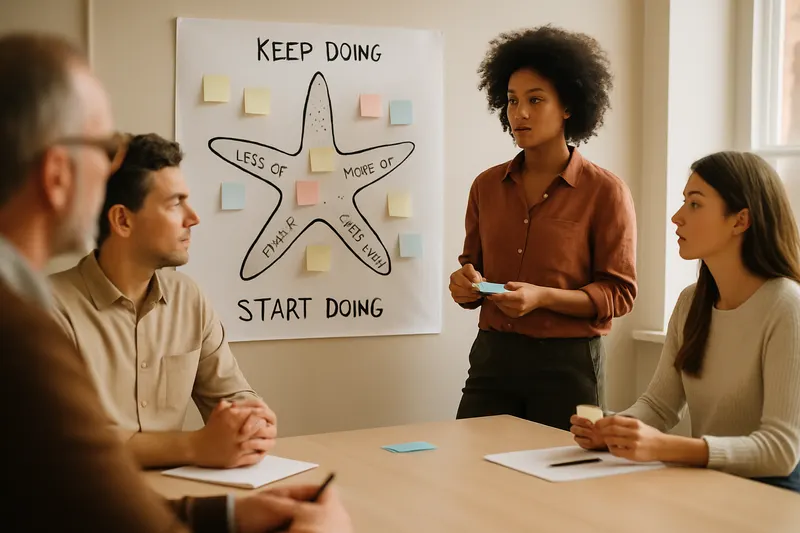
The Starfish retrospective allows teams to explore the nuances of actions to take for improvement. Using the starfish format, each participant can express what they wish to stop, do less of, keep, do more of, or start, thereby fostering a rich and constructive discussion.
Walkthrough
- 1
Introduction
5 minThe facilitator welcomes the participants and explains the purpose of the retrospective: to identify what is working well and what can be improved. They present the starfish format and the five categories: Stop, Do Less, Keep, Do More, Start. They emphasise the importance of honesty and kindness in the exchanges.
Tip — Use a visual of the starfish to help participants visualise the categories.
- 2
Idea Collection
15 minEach participant takes post-its and a pen. The facilitator asks participants to reflect individually and note their ideas for each category. Ideas should be clear and concise. The facilitator circulates to encourage participants and answer their questions.
Tip — Encourage participants to write one idea per post-it to facilitate sorting and discussion.
- 3
Idea Sharing
20 minParticipants stick their post-its on a whiteboard or wall, grouping them by category. The facilitator then invites each participant to briefly explain their contributions. This helps clarify points and ensures everyone understands the shared ideas.
Tip — If the group is large, limit speaking time for each participant to maintain the pace.
- 4
Discussion and Prioritisation
20 minThe facilitator guides a discussion to identify common themes and priorities. Participants can vote on the ideas they consider most important to address. The facilitator uses stickers or a point system to visualise the priorities.
Tip — Use different colours for votes to distinguish categories or levels of priority.
- 5
Action Plan
15 minFor each priority idea, the facilitator helps the group define concrete actions to implement. Each action should have an owner and a deadline. The facilitator ensures that the actions are realistic and aligned with the team's objectives.
Tip — Ensure that each action is SMART (Specific, Measurable, Achievable, Realistic, Time-bound).
- 6
Closure
5 minThe facilitator thanks the participants for their engagement and contribution. They recap the agreed actions and the next steps. They may also ask for quick feedback on the session to improve future retrospectives.
Tip — End on a positive note to reinforce participants' motivation and engagement.
Variants
- Use a digital format with online tools for a remote retrospective.
- Add a 'Questions' category to address points of uncertainty.
- Limit the number of ideas per participant to encourage conciseness.
Debrief guide
- What new insights did you gain about our team today?
- Which category sparked the most discussion and why?
- How can we ensure we follow up on the agreed actions?
- Were there any ideas you wished had emerged?
- How has this retrospective influenced your perception of our work?
- What improvements would you suggest for our next retrospective?
- What are the main obstacles we need to overcome to progress?