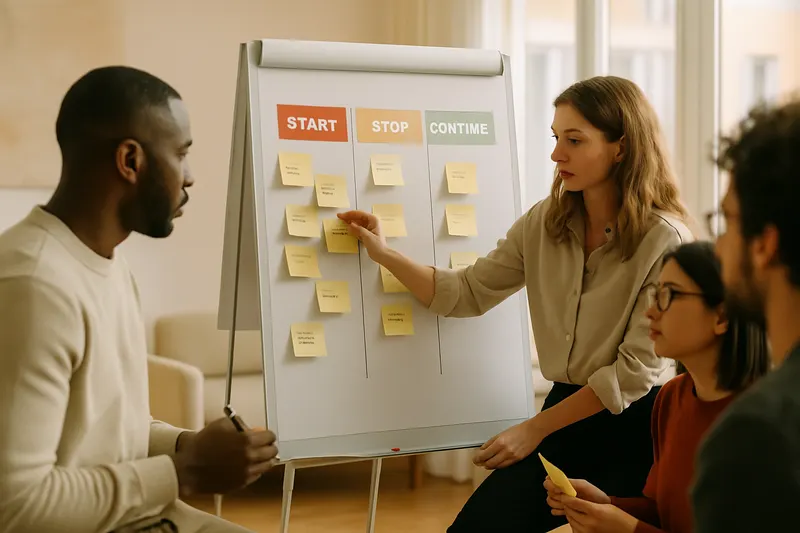
Start / Stop / Continue
Identify key actions for the team at a glance.
Start / Stop / Continue is an agile retrospective workshop that allows the team to identify actions to start, stop, and continue. This straightforward format promotes continuous improvement and communication within the team. It encourages each member to reflect on current practices and propose concrete adjustments for the future.
Walkthrough
- 1
Introduction
5 minThe facilitator welcomes the participants and explains the objective of the workshop: to collectively identify what the team should start, stop, and continue to improve. They clarify that this workshop is a space for open and supportive expression, where every voice matters.
Tip — Use a concrete example to illustrate each category (Start, Stop, Continue) to clarify expectations.
- 2
Individual Reflection Phase
10 minEach participant takes a few minutes to reflect individually and jot down their ideas on post-it notes: one colour for 'Start', another for 'Stop', and a third for 'Continue'. This step allows everyone to structure their thoughts before the collective sharing.
Tip — Play calming background music to enhance concentration during this phase.
- 3
Idea Sharing
15 minParticipants stick their post-it notes on a board divided into three columns (Start, Stop, Continue). The facilitator invites each person to briefly explain their proposals. This step encourages discussion and the exchange of ideas.
Tip — Encourage participants to ask questions to clarify their colleagues' ideas.
- 4
Discussion and Prioritisation
15 minTogether, the team discusses the proposals and identifies priority actions to implement. The facilitator can use a dot voting technique to help prioritise ideas. This step aims to build consensus on the actions to be taken.
Tip — Limit the number of votes per person to enforce prioritisation.
- 5
Action Plan
10 minThe facilitator helps the team transform the priority ideas into a concrete action plan, defining responsibilities, deadlines, and necessary resources. This step ensures that the decisions made translate into concrete actions.
Tip — Use a Kanban board to visualise upcoming actions and facilitate tracking.
- 6
Closure
5 minThe facilitator thanks the participants for their engagement and contribution. They remind everyone of the next steps and ensure that everyone is aligned on the action plan. A quick round allows each person to share a final comment or feeling.
Tip — Conduct a final round where everyone shares a word that summarises their feelings after the workshop.
Variants
- Organise the workshop online using collaborative tools like Miro or Mural.
- Add a feedback phase where participants evaluate the effectiveness of previously implemented actions.
- Incorporate visual elements or metaphors to stimulate participants' creativity.
Debrief guide
- Which identified actions seem most impactful for the team?
- How did you feel sharing your ideas with the group?
- How has this workshop influenced your perception of the team's current practices?
- What difficulties did you encounter during the prioritisation of actions?
- How can we ensure that the action plan will be followed and respected?
- What did you learn about yourself or the team during this workshop?
- How could this workshop be improved for next time?