Risk Storming
Anticipate and prioritise project risks through visual collaboration.
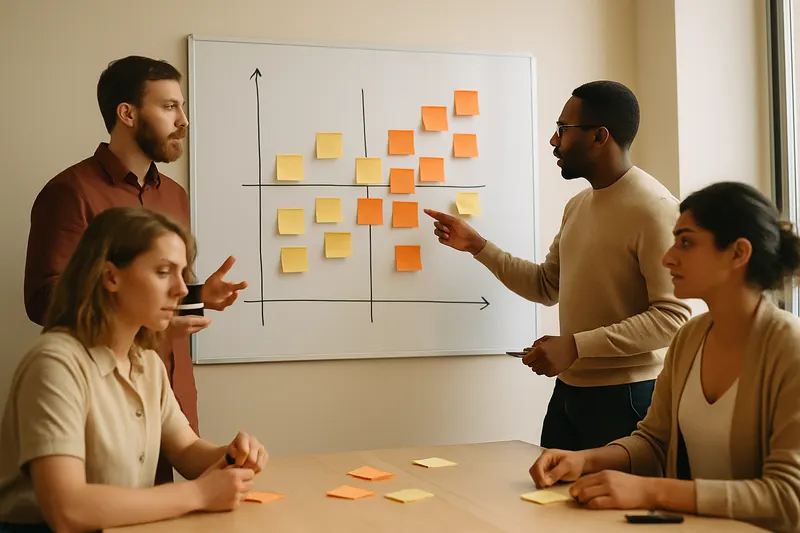
Risk Storming is a serious game that helps teams identify, visualise, and prioritise risks associated with an architecture or project before its launch. By using a shared diagram, participants collaborate to better understand potential risks and improve collective decision-making. This game promotes problem-solving and continuous improvement within the team.
Walkthrough
- 1
Introduction and Objectives
10 minThe facilitator presents the workshop's objective: to identify and prioritise project risks. They explain how the game will unfold and emphasise the importance of collaboration. "We will explore the potential risks of our project together to better prepare ourselves. The goal is to leave this workshop with a clear vision of the priority risks." Participants ask questions if necessary.
Tip — Use a concrete example of a risk to illustrate the importance of the activity and capture participants' attention from the start.
- 2
Diagram Presentation
15 minThe facilitator presents the diagram that will be used, often a board with columns for risk categories and rows for priority levels. Participants are invited to ask questions to clarify any ambiguities. "Here is our working tool: a board that will allow us to visualise and prioritise risks. Each column represents a risk category."
Tip — Ensure that the diagram is visible to everyone and that it is easy to add information.
- 3
Risk Identification
20 minParticipants reflect individually and then share in the group the risks they perceive for the project. The facilitator encourages everyone to express themselves and notes the risks on post-its. "Take a few minutes to think about the risks you see. Then, let's share them and note them on our board."
Tip — Encourage a diversity of viewpoints by asking everyone to speak at least once.
- 4
Risk Categorisation
15 minParticipants collectively categorise the identified risks into the predefined categories of the diagram. The facilitator guides the group to ensure that each risk is well understood and correctly categorised. "Now let's group our risks into the appropriate categories. This will help us analyse them better."
Tip — Facilitate the discussion by asking open-ended questions to assist in the categorisation of risks.
- 5
Risk Prioritisation
20 minParticipants discuss and evaluate the impact and probability of each risk, then rank them in order of priority. The facilitator ensures that consensus is reached for each decision. "For each risk, let's evaluate its impact and probability together. Then, let's rank the risks in order of priority."
Tip — Use a show of hands to facilitate the prioritisation process and save time.
- 6
Action Plan
15 minFor the priority risks, participants develop an action plan to mitigate them. The facilitator encourages creative and practical solutions. "For each priority risk, let's list concrete actions we can take to mitigate them."
Tip — Encourage individual commitments to ensure follow-up on the agreed actions.
Variants
- Use collaborative digital tools for remote teams.
- Involve an external expert to provide a fresh perspective on risks.
- Organise a follow-up session to assess the impact of the actions taken.
Debrief guide
- What have you learned about the risks of our project?
- How has the prioritisation of risks influenced your perception of the project?
- What surprises did you encounter during the workshop?
- How could we improve this risk management process in the future?
- What concrete actions will you implement following this workshop?
- How has this workshop strengthened collaboration within the team?
- What other tools or methods could we use to manage risks?