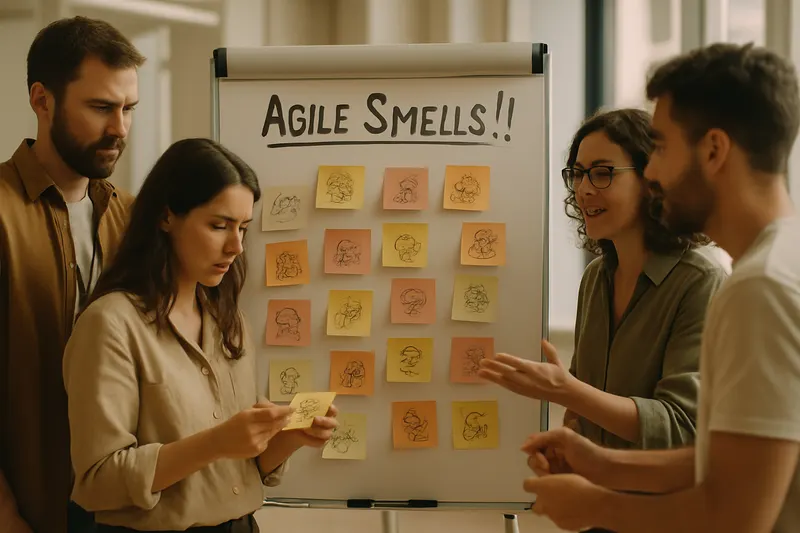
Agile Smells !!
Identify and rectify poor agile practices with humour and introspection.
Agile Smells is a serious game that highlights poor practices in agile methodology through humorous situations. Participants learn to recognise these 'smells' or warning signs in their current practices. The game encourages discussion and the sharing of ideas to collaboratively improve agile processes.
Walkthrough
- 1
Introduction and Objectives
10 minThe facilitator begins by explaining the concept of Agile Smells, emphasising the importance of recognising poor practices to enhance efficiency. They present the rules of the game and define the objectives: to identify agile 'smells' and propose solutions. Participants are invited to ask questions to clarify the rules.
Tip — Use concrete examples of poor practices to illustrate what an 'Agile Smell' is.
- 2
Team Formation
5 minThe facilitator divides the participants into small teams of 4 to 6 people. Each team receives a set of cards representing different poor agile practices. Teams are encouraged to discuss the cards and share their personal experiences related to these practices.
Tip — Ensure that teams are diverse in terms of roles and experiences to enrich discussions.
- 3
Identification of Agile 'Smells'
20 minEach team selects a few cards that they consider most relevant or problematic for their context. Participants discuss why these practices are deemed 'bad' and share anecdotes or real-life examples.
Tip — Encourage participants to be honest and open about their experiences, even if they are negative.
- 4
Proposing Solutions
20 minOnce the 'smells' are identified, each team brainstorms solutions to correct these poor practices. Teams are invited to be creative and propose actionable ideas. Each team then prepares a quick presentation of their conclusions.
Tip — Provide markers and sheets of paper for teams to visualise their ideas.
- 5
Plenary Sharing
20 minEach team presents their identified 'smells' and proposed solutions to the other participants. The facilitator encourages questions and discussions to delve deeper into the ideas presented and draw common lessons.
Tip — Time the presentations to maintain a good pace and allow each team to express themselves.
- 6
Conclusion and Summary
10 minThe facilitator concludes the workshop by summarising the main identified 'smells' and the creative solutions proposed. They encourage participants to apply these learnings in their respective work environments and to continue monitoring for agile 'smells'.
Tip — Encourage participants to note down a concrete action they commit to implementing following the workshop.
Variants
- Use cards specific to a particular agile framework (Scrum, Kanban) to personalise the experience.
- Add a phase where teams must create their own cards based on their experiences.
- Organise a vote to elect the most creative or innovative solution proposed by the teams.
Debrief guide
- Which 'smells' did you find most relevant for your team?
- How do these poor practices affect your daily work?
- Which proposed solutions seem most feasible to you?
- Did you discover any 'smells' that you were not previously aware of?
- How can you encourage your team to remain vigilant against agile 'smells'?
- What obstacles do you think you will encounter in eliminating these poor practices?
- How can you measure improvement after implementing the solutions?