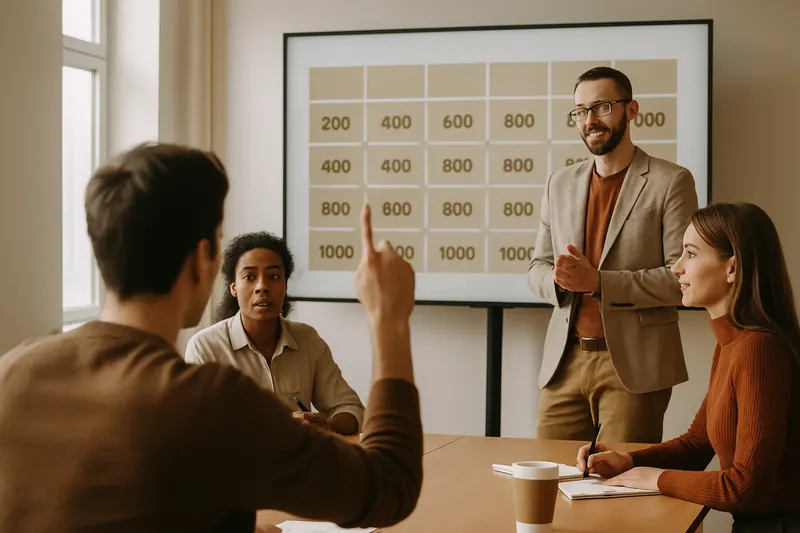
Jeopardy
Stimulate continuous improvement with a reverse question-and-answer game.
Jeopardy is a retrospective format inspired by the famous television game show. Participants must formulate questions based on given answers, which fosters creative thinking and engagement. This game revitalises retrospectives by adding a playful and surprising touch, thus encouraging continuous improvement within the team.
Walkthrough
- 1
Introduction and explanation of the rules
10 minThe facilitator explains the concept of Jeopardy and its adaptation for the retrospective. They emphasise that each participant will need to write one or more answers on post-its, without revealing the questions. "Your goal is to guess the question that corresponds to each answer given by your teammates."
Tip — Use a simple example to illustrate the concept and reassure those who are unfamiliar with the television game.
- 2
Individual reflection phase
10 minEach participant individually reflects on the questions they wish to ask and writes only the answers on post-its. This allows them to focus on the important aspects to address during the retrospective.
Tip — Encourage participants to focus on the topics that matter most to them.
- 3
Display of answers
5 minAll post-its are collected and displayed on a board visible to everyone. The facilitator ensures that the answers are legible and well distributed on the game board.
Tip — Organise the post-its by themes or categories if it facilitates reading and understanding.
- 4
Guessing the questions
15 minParticipants take turns proposing questions corresponding to the displayed answers. The facilitator encourages exchanges and discussions around the proposals.
Tip — Foster a relaxed atmosphere and encourage participants to be creative in their proposals.
- 5
Revealing the original questions
10 minThe authors of the answers reveal their original questions. This often elicits varied reactions: surprises, laughter, or discoveries. The facilitator facilitates exchanges and notes the key points.
Tip — Be attentive to reactions and encourage participants to share their impressions.
- 6
Voting and prioritisation
10 minParticipants vote for the questions they consider most important to address, using, for example, stickers for Dot voting. The facilitator compiles the results and identifies priority topics.
Tip — Limit the number of votes per participant to focus attention on the most relevant topics.
- 7
Defining concrete actions
15 minThe team discusses actions to be implemented by the next retrospective. The facilitator ensures that each action is clear, achievable, and assigned to a responsible person.
Tip — Use a Kanban board to visualise the actions to be taken and their progress status.
Variants
- Use thematic categories to structure the answers, as in the television game.
- Introduce a collective brainstorming phase before individual reflection.
- Adapt the game for a remote retrospective using an online whiteboard tool.
Debrief guide
- What did you feel when discovering the original questions?
- What surprises did you encounter during this exercise?
- How did this approach influence your perception of the topics discussed?
- What lessons do you take away from this retrospective?
- What concrete actions have you identified to improve our functioning?
- How could we improve this format for next time?
- What topics deserve to be explored further in a future retrospective?