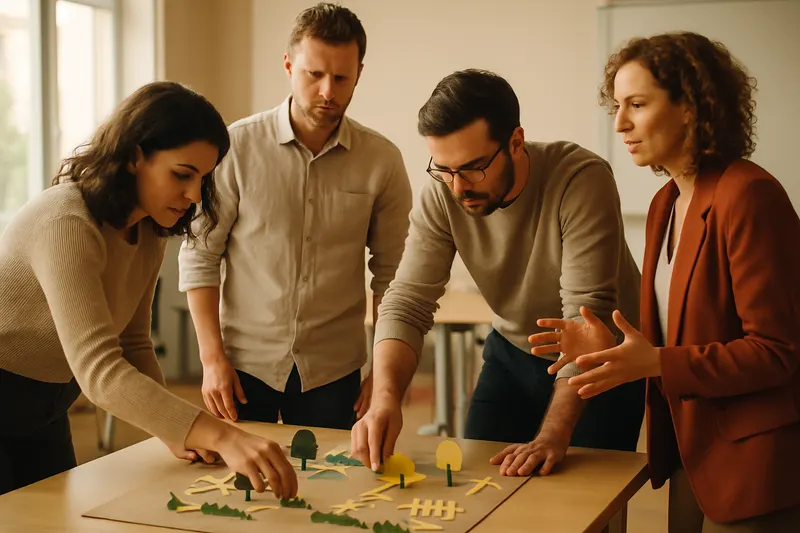
The Agile Meadow
Two teams, a common goal despite divergent instructions.
The Agile Meadow is a serious game that highlights the importance of collaboration and communication between teams. Each team receives distinct instructions to create a drawing together. This game encourages creativity, adaptability, and the ability to work together despite seemingly divergent objectives.
Walkthrough
- 1
Introduction
10 minThe facilitator introduces the game to the participants by explaining the main objective: to create a common drawing despite different instructions. They divide the group into two teams and distribute the specific instructions to each team. It is made clear that teams must not share their instructions with each other.
Tip — Use clear but sufficiently ambiguous instructions to encourage creativity and discussion between the teams.
- 2
Planning Phase
15 minEach team discusses its instructions and develops a plan to create its part of the drawing. Participants must think about how to collaborate with the other team without revealing their specific instructions. This phase highlights strategy and internal communication.
Tip — Encourage teams to appoint a spokesperson to facilitate inter-team communication.
- 3
Execution
20 minTeams begin to draw together on a large sheet or board. They must collaborate and adjust their actions based on the reactions and contributions of the other team. This step highlights the flexibility and adaptability of the participants.
Tip — Observe group dynamics and intervene if necessary to encourage communication and collaboration.
- 4
Review
10 minOnce the drawing is complete, each team takes a moment to observe the final result and discuss what worked well and the challenges faced. Participants should reflect on how they adapted to the contributions of the other team.
Tip — Encourage each team to identify one thing they could have done differently to improve collaboration.
- 5
Presentation
10 minTeams present their drawing and share their reflections on the process. Each team explains its initial strategy and how it evolved during the game. This step allows for highlighting the learning and insights gained.
Tip — Highlight moments of successful cooperation and discuss the lessons learned.
Variants
- Add a third team with additional instructions to increase complexity.
- Limit the communication time between teams to increase pressure and test responsiveness.
- Introduce additional constraints, such as the use of specific colours or geometric shapes.
Debrief guide
- What were the main difficulties encountered during collaboration?
- How did you adapt your initial strategy based on the actions of the other team?
- What elements facilitated communication between the teams?
- What did you learn about managing divergent objectives?
- How could you apply this learning in your professional context?
- What roles emerged naturally within your team?
- How was the perception of the final result influenced by the initial expectations of each team?