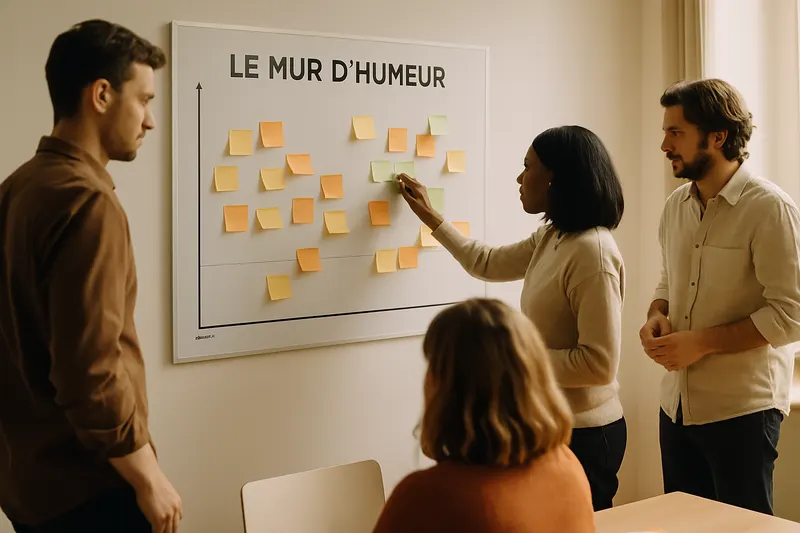
The Mood Wall
Visualise and understand the evolution of the group's emotions in real-time.
The Mood Wall is an interactive tool that allows participants to share their emotional state throughout a seminar. Using coloured dots, each participant can express their mood at different times of the day. This exercise promotes collective and individual awareness of emotional dynamics within the group, thereby facilitating exchanges and necessary adjustments to enhance the collective experience.
Walkthrough
- 1
Introduction and Setup
10 minThe facilitator explains the concept of the Mood Wall, specifying that each participant will be able to stick coloured dots to indicate their mood at different times. They set up a board or large paper on a wall accessible to everyone and distribute coloured dots. They explain the colour code: for example, green for 'positive', yellow for 'neutral', and red for 'negative'.
Tip — Prepare the materials in advance and ensure that the board is visible and accessible to all participants.
- 2
First Update
5 minThe facilitator invites participants to stick a first dot to indicate their current mood. They clarify that the goal is to take a moment to reflect on their feelings before choosing a colour. Participants stand up, choose a dot, and stick it on the board.
Tip — Encourage participants to be honest and not to feel judged by their colour choices.
- 3
Regular Updates
5 min par mise à jourThroughout the seminar, the facilitator regularly reminds participants to update their mood, for example after an intense session or a break. They might announce: 'Let's take a moment to update our Mood Wall'. Participants add a new dot with each update.
Tip — Schedule these update moments at regular intervals to create a habit and capture mood variations.
- 4
Collective Observation
10 minAt a chosen moment, the facilitator invites the group to observe the Mood Wall together. They ask open questions to initiate a discussion about the observed trends, for example: 'What do we observe about the evolution of our moods?'. Participants share their observations and feelings.
Tip — Use this step to reinforce the sense of cohesion and empathy within the group.
- 5
Conclusion and Feedback
10 minAt the end of the seminar, the facilitator asks participants to look at the Mood Wall one last time and reflect on what they take away from it. They invite each person to share a word or phrase about their experience with this tool. This exchange allows for the exercise to be concluded and for feedback to be gathered for future improvements.
Tip — Encourage honest and constructive feedback to adapt the tool to the specific needs of your group.
Variants
- Use emoticons instead of dots for a more visual expression.
- Add a time dimension by asking participants to date their dots.
- Offer a comments space where participants can explain their colour choice.
Debrief guide
- How did you feel using the Mood Wall?
- What did you learn about yourself by observing your moods?
- Did you notice any collective trends in the moods?
- How did the Mood Wall influence your participation in the seminar?
- What improvements would you suggest for this tool?
- How could you use this tool in other contexts?
- Which emotions were the most frequent and why, in your opinion?