The Japanese Step
A movement and strategy game to promote cooperation.
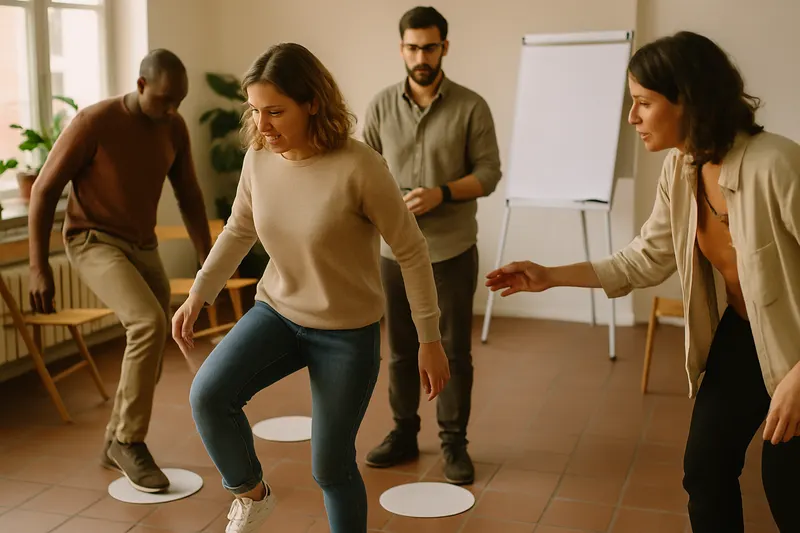
The Japanese Step is an agility game that highlights collaboration and communication among participants. Players must swap places while adhering to simple rules, all within a limited space. This game encourages collective thinking and coordination, inspired by the principles of effective cooperation and management observed in work environments such as NUMMI.
Walkthrough
- 1
Introduction
5 minThe facilitator explains the context of the game, mentioning the importance of cooperation and communication. They may refer to the NUMMI experience to illustrate how effective work systems foster involvement and quality. 'We are going to play a game that requires coordination and strategy, just like in a well-managed company.'
Tip — Use an anecdote or an inspiring story to capture participants' attention from the start.
- 2
Setup
5 minThe facilitator forms a circle with the participants, spaced about a metre apart. They explain that the goal of the game is to swap places with another participant by crossing the circle without touching anyone. 'Remember, the key is to communicate clearly and work together to succeed.'
Tip — Ensure that the space is large enough for participants to move freely.
- 3
Game Phase - Simple Exchanges
10 minParticipants begin to swap places two by two. The facilitator observes and encourages participants to discuss their intentions before moving. 'Be attentive to the movements of others and announce your intentions clearly.' This phase allows them to become familiar with movement and communication.
Tip — Encourage participants to use gestures to complement their verbal communication.
- 4
Game Phase - Multiple Exchanges
15 minThe facilitator introduces a new rule: multiple exchanges can occur simultaneously. Participants must therefore be even more attentive and coordinated. 'The challenge is to maintain order and fluidity of movement, even with several people in action.'
Tip — Observe group dynamics and intervene if necessary to facilitate communication.
- 5
Cool Down
5 minOnce the exchanges are completed, the facilitator asks participants to return to the circle and take a moment to breathe deeply. This helps calm the energy and prepares the group for the debriefing. 'Take a moment to centre yourself and reflect on what you have learned.'
Tip — Use soft music to help transition to a calmer state.
- 6
Debriefing
10 minThe facilitator asks open-ended questions to encourage reflection on the experience. They encourage participants to share their observations and feelings. 'What did you feel during the game? What facilitated or hindered communication?'
Tip — Take notes on participants' comments to identify areas to work on in future workshops.
Variants
- Introduce physical obstacles in the circle to increase difficulty.
- Ask each participant to pass through a central point before reaching their new place.
- Add a time constraint to intensify the coordination challenge.
- Ensure that exchanges must be done in silence, using only gestures.
Debrief guide
- What did you feel during the exchanges?
- How did communication influence the course of the game?
- What strategies were implemented to successfully complete the exchanges?
- What parallels can you draw between this game and real work situations?
- How could you apply these learnings in your professional daily life?
- What surprised you about how the group collaborated?
- How did playing this game change your perception of cooperation?