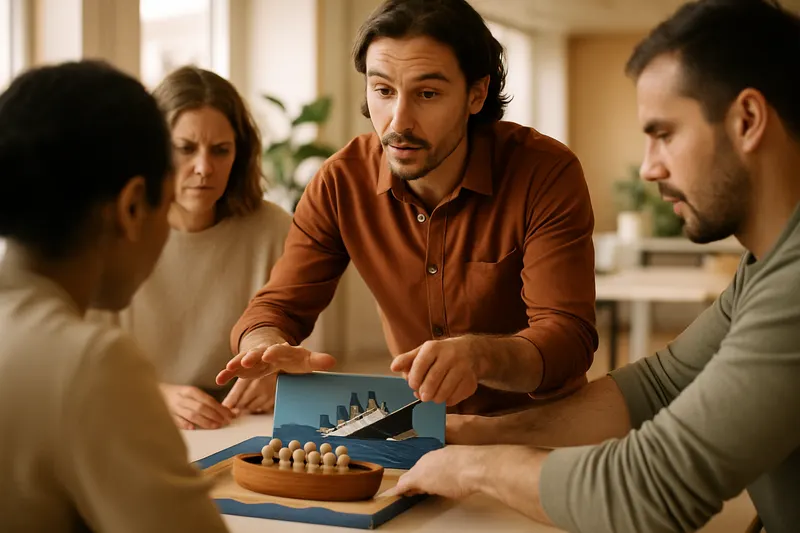
SOS Titanic in Distress
Turn the lifeboat over to survive the disaster!
SOS Titanic in Distress is a collaborative game where participants must turn over a lifeboat to access supplies. The game highlights communication, cooperation, and creativity in a crisis context. Participants face a complex problem that requires strategic thinking and excellent coordination to solve.
Walkthrough
- 1
Introduction
10 minThe facilitator explains the context: participants are survivors of a shipwreck and must turn over a lifeboat to access supplies. They describe the rules of the game and the objectives: collaborate to find a solution within a limited time. Participants are encouraged to ask questions to clarify the rules.
Tip — Use a captivating story to immerse participants in the scenario.
- 2
Team Formation
5 minThe facilitator divides the group into teams of 4 to 6 people. Each team receives a workspace around a lifeboat (symbolised by an object or structure to be turned over). Teams must choose a captain to guide them in discussion and decision-making.
Tip — Ensure that teams are balanced in terms of skills and personalities.
- 3
Planning Phase
15 minEach team discusses and develops a plan to turn over the lifeboat. Participants must identify available resources, assign roles, and define the steps to achieve their goal. The facilitator moves among the groups to provide guidance and encourage collective thinking.
Tip — Encourage teams to consider multiple strategies before diving in.
- 4
Plan Execution
20 minTeams implement their plan to turn over the lifeboat. They must work together, adjust their strategy if necessary, and communicate effectively to succeed. The facilitator observes and notes group dynamics, strategies used, and challenges encountered.
Tip — Stay alert for signs of blockage and offer subtle hints to help teams progress.
- 5
Calm Down
5 minAfter execution, the facilitator gathers the teams for a calm-down session. They congratulate participants for their efforts and cooperation. This step allows for tension release before the debriefing.
Tip — Use a quick relaxation technique, such as deep breathing, to help participants unwind.
- 6
Debriefing
20 minThe facilitator leads a discussion to allow participants to share their experiences and identify lessons learned. Debriefing questions are posed to stimulate reflection and encourage idea sharing.
Tip — Encourage each participant to express themselves to obtain a variety of perspectives.
Variants
- Add additional constraints, such as a stricter time limit, to increase difficulty.
- Integrate specific roles with unique skills for each participant to diversify approaches.
- Introduce an element of surprise by changing the rules mid-game, forcing teams to adapt quickly.
Debrief guide
- What strategies were most effective in turning over the lifeboat?
- How did communication influence your team's success?
- What were the main challenges encountered and how did you overcome them?
- How did you manage disagreements within your team?
- What individual skills were highlighted during the game?
- What would you do differently if you were to replay this scenario?
- How can you apply the lessons learned to your daily work?