Speed Boat
Identify the barriers and levers of your project with Speed Boat.
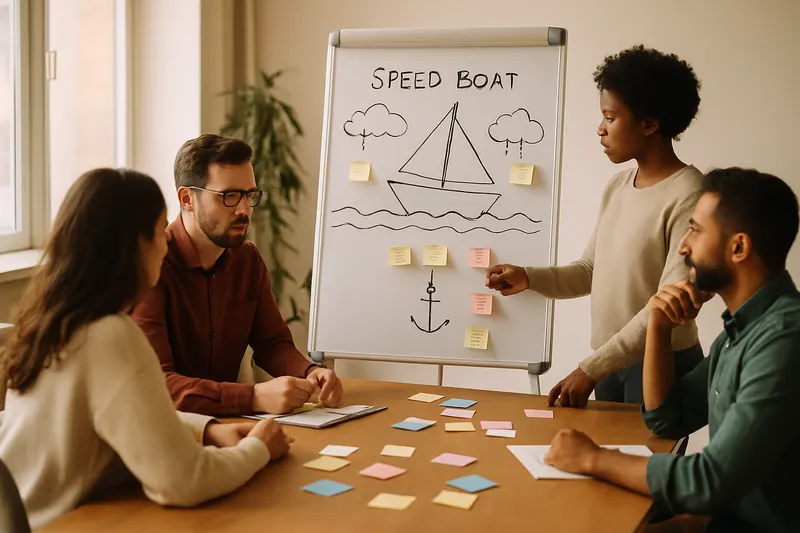
Speed Boat is a serious game that uses the metaphor of a boat to help teams identify the obstacles and drivers of a project. Participants collaborate to visualise what hinders their progress and what propels them forward. This game fosters collective reflection and enhances team dynamics by making visible the positive and negative elements influencing the project.
Walkthrough
- 1
Introduction and explanation of the concept
10 minThe facilitator begins by explaining the Speed Boat metaphor: the boat represents the project, the anchors symbolise the obstacles, and the sails represent the drivers. They clarify the objective of the workshop: to identify these elements to better steer the project. 'Imagine that our project is a boat at sea. What are the winds pushing it forward and what are the anchors slowing it down?'
Tip — Use a drawing of a boat on a whiteboard to illustrate the metaphor and capture the participants' attention.
- 2
Brainstorming obstacles
15 minParticipants take a few minutes to individually reflect on the obstacles they perceive in the project. They then share their ideas with the group. The facilitator notes each obstacle on a card or sticky note and places them under the boat on the board. 'What are the anchors holding our project back? Share your ideas.'
Tip — Encourage participation by asking open-ended questions and ensuring a trusting environment where everyone feels free to express themselves.
- 3
Identification of drivers
15 minIn this step, participants reflect on the factors that drive the project forward. They share their ideas, and the facilitator notes them on cards or sticky notes, placing them above the boat on the board. 'What are the winds pushing us forward? Let's identify our strengths and assets.'
Tip — Ensure a balance between the number of obstacles and drivers to provide a complete and nuanced view of the project.
- 4
Discussion and prioritisation
20 minThe group discusses the identified obstacles and drivers, seeking to understand their respective impacts. The facilitator guides the discussion to prioritise the most critical elements. 'Among these elements, which have the greatest impact on our project? How can we address them?'
Tip — Use a show of hands or sticky dots to help the group prioritise the elements.
- 5
Action plan
20 minParticipants develop an action plan to address the priority obstacles and strengthen the identified drivers. The facilitator facilitates the discussion to turn ideas into concrete actions. 'What actions can we take to lift these anchors and strengthen our sails?'
Tip — Suggest small immediate actions and longer-term actions to maintain engagement and motivation.
- 6
Conclusion
10 minThe facilitator concludes the workshop by summarising the key points and agreed actions. They thank the participants for their contributions and encourage regular follow-up on the actions. 'Thank you all for your active participation. Let's ensure we regularly track our progress.'
Tip — Take a photo of the final board to share with the team and ensure follow-up on actions.
Variants
- Use different colours for the cards of obstacles and drivers for better visualisation.
- Conduct the exercise outdoors to reinforce the maritime metaphor and inspire participants.
- Add a step where participants draw their own boat and its elements for a more personal approach.
Debrief guide
- What did you feel when identifying the obstacles and drivers of our project?
- What elements surprised you the most?
- How has this visualisation changed your perception of the project?
- What lessons can we draw from this exercise for our future projects?
- How can we improve our collaboration in the future?
- What actions are you eager to implement?
- How can we maintain the momentum created by this workshop?