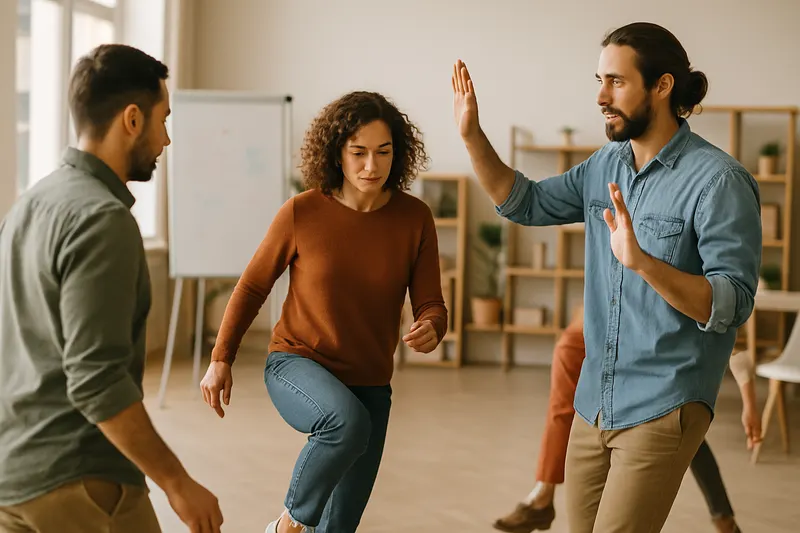
Walk & Stop
Stimulate attention and responsiveness with reversed movements.
Walk & Stop is an energetic game that physically engages participants while developing their attention and responsiveness. Through three rounds, players must follow the facilitator's instructions, alternating between actions and reversals, creating a playful and interactive atmosphere. It is an excellent way to break the ice and prepare a group for an agility session.
Walkthrough
- 1
Introduction
5 minThe facilitator asks participants to stand up and explains the objective of the game: to experience agility of body and mind. They announce that the activity will take place in three rounds with instructions to follow. They ensure that everyone is ready and enthusiastic.
Tip — Use an energetic and engaging tone to motivate participants from the start.
- 2
First round: Walk / Stop
5 minThe facilitator explains that when they say 'Walk', participants must walk, and when they say 'Stop', they must stop. After a few trials, they announce that participants must do the opposite: 'Walk' means stop and 'Stop' means walk. This trains participants to adapt quickly.
Tip — Start slowly to allow participants to get used to it before increasing the pace.
- 3
Second round: Name / Clap
5 minThe facilitator adds two new instructions: 'Name' to say their name out loud and 'Clap' to clap their hands. They remind everyone that the previous instructions are reversed. After a few trials, they ask to reverse these new instructions as well. This increases the complexity and attention required.
Tip — Encourage participants with humour to lighten the increasing difficulty.
- 4
Third round: Dance / Jump
5 minThe facilitator introduces two final instructions: 'Dance' to do a little dance step and 'Jump' to jump. They remind everyone that all instructions are reversed. Participants must now juggle multiple reversals, which strongly stimulates their responsiveness.
Tip — Slightly increase the frequency of instructions to maintain dynamism.
- 5
Conclusion
2 minThe facilitator thanks participants for their engagement and good spirits. They highlight the importance of agility and quick adaptation in a professional context, relating it to the exercise experienced.
Tip — Use concrete examples from professional life to connect with the exercise.
Variants
- Add additional instructions such as 'Turn' to spin around.
- Conduct the exercise in silence, using only gestures for the instructions.
- Ask participants to suggest their own reversed instructions for more creativity.
Debrief guide
- How did you feel when reversing the instructions?
- What was the most difficult to follow? Why?
- How did you manage the increasing complexity of the instructions?
- What parallels can you draw between this exercise and your daily work?
- How does this exercise help you understand the importance of adaptability?